Ford Kuga review
Category: Family SUV
The Kuga’s hybrid engines and plentiful standard kit make it a tempting family SUV choice


What Car? says...
The Ford Kuga not only belongs to the super-fashionable family SUV class but also has added appeal because it's available with petrol, regular hybrid or plug-in hybrid engine options, as well as several trim levels.
In other words, there’s a Kuga for most buyers (although if you want a diesel or electric SUV you're out of luck). That approach could work in Ford’s favour but also means there are lots of rival models to consider too.
For example, the Honda ZR-V and Toyota RAV4 are excellent alternatives if you’re specifically looking for a hybrid. The Mazda CX-5 and Skoda Karoq offer a strong line-up of traditional petrols and diesels. And the Hyundai Tucson and Kia Sportage offer a similarly varied engine range to the Kuga.
Ford Kuga video review
Ford has recently given the model an update, with a refreshed exterior design, new interior tech and revised trim levels. There are also minor revisions to the mechanicals of the regular hybrid (FHEV) and plug-in hybrid (PHEV) versions.

So how does the Ford Kuga stack up against the best family SUVs and is it the right car for you? Read on to find out...
Performance & drive
What it’s like to drive, and how quiet it is
Strengths
- +Strong performance
- +Tidy handling
- +Good high-speed refinement
Weaknesses
- -ST-Line versions have firm suspension
- -Hybrids are noisy under acceleration
Engine, 0-60mph and gearbox
The Ford Kuga's entry-level 1.5 EcoBoost petrol takes 9.5sec to accelerate from 0-62mph, but will easily cope with fast-flowing roads and can tow up to 1730kg. It’s only available with a six-speed manual gearbox.
The 2.5 FHEV (full hybrid) offers a bit more pace – 0-62mph takes 8.3sec with four-wheel-drive and 9.1sec with front-wheel drive. It can pootle around for short distances without using the engine, and comes with a CVT automatic gearbox. Plus, the maximum towing weight rises to 2,100kg (the PHEV manages the same). It's our pick of the engine range for private buyers.
If you drive a company car you'll want to consider the 2.5-litre petrol PHEV instead, because its 42-mile electric-only range will reduce your BIK tax bill compared with the other two engines. That said, the PHEV version of the Volkswagen Tiguan can officially go more than 70 miles on battery power alone.
The PHEV Kuga is also the quickest version, with 0-62mph in a respectable 7.3sec, outpacing the equivalent Hyundai Tucson or Kia Sportage.
Suspension and ride comfort
The Kuga’s suspension set-up varies between trim levels. Entry-level Titanium trim gets a standard set-up, while ST-Line trim gets firmer, sportier suspension, and the more rugged Active trim gets raised suspension to improve the ground clearance.
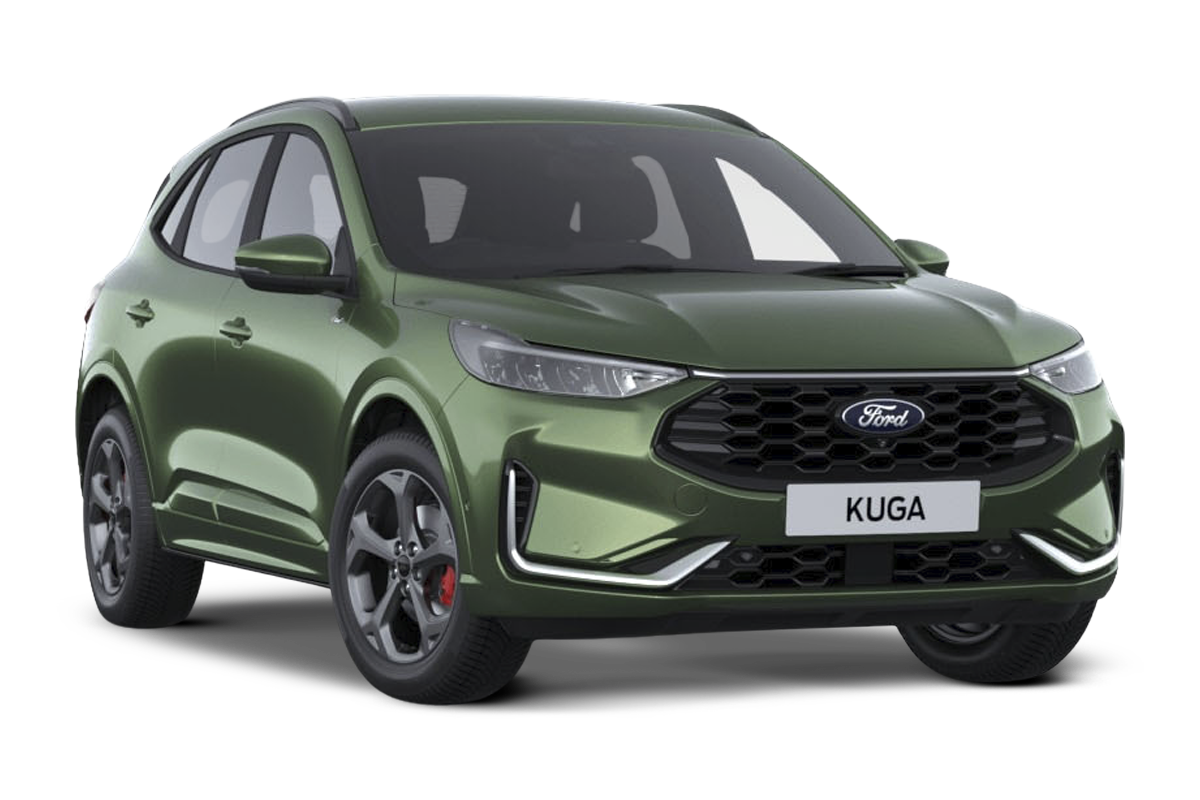
Even the entry-level Titanium trim with its softer set-up tends to feel a little busy over scarred urban roads, but ST-Line cars are even firmer and tend to thump more often over larger abrasions. Mind you, it’s far from intolerable, and settles down better than a Hyundai Tucson on motorways.
We’d avoid the Kuga's optional 20in wheels because they amplify lumps and bumps enough to result in a choppier ride.

Handling
The Kuga's quick steering makes it feel eager to turn in to corners, but is not as naturally weighted as the Kia Sportage steering and doesn’t feel quite as precise. Even so, it gives you enough feel through quicker turns, allowing you to place the car with reasonable confidence.
This is a tall car, but the Kuga hides its size well and feels more composed than a Tucson. Titanium and Active models tend to lean over more in quick corners due to their softer suspension set-ups, whereas ST-Line cars stay flat during cornering.
In other words, versions with sharper handling will have a harsher ride, so you'll have to decide how much you're willing to compromise comfort for fun.
Noise and vibration
The Kuga manages to filter out road noise quite well, with just a faint rumble at speed over coarse surfaces on versions without the optional 20in alloys (which are louder). There’s also very little wind or suspension noise and the car is more hushed than a Mazda CX-5 on the move.
The FHEV and PHEV versions move around stealthily in pure-electric mode, and the FHEV is more willing to run on electric power for longer periods than a Tucson or Sportage hybrid. Even when the engine does kick in, it’s fairly hushed despite the CVT gearbox (a technology that can be noisy when used in other models).
The Kuga's brake-pedal response is pretty consistent and brings the car to a stop smoothly. Only the hybrid versions, with their regenerative braking systems, can occasionally be grabby at lower speeds.
“I found the Kuga to be a quiet cruiser, with refinement only disappointing slightly under hard acceleration.” – Will Nightingale, Reviews Editor
Interior
The interior layout, fit and finish
Strengths
- +High driving position
- +Large infotainment screen
- +Digital driver’s display fitted as standard
Weaknesses
- -No physical climate controls
- -Interior quality doesn’t match rivals
Driving position and dashboard
The good news for lovers of tall SUVs is that the Ford Kuga has a relatively lofty driving position, so you sit high up. The driver’s seat is supportive and there’s plenty of adjustment, including for lumbar support on all trims, as well as generous levels of steering wheel height and reach movement.
All versions come with a 12.3in digital driver's display as standard. It show important driving information clearly (including battery charge on the PHEV model) and its contents can be customised. You can’t view the sat-nav map on the driver's display though, unlike in some versions of the Seat Ateca, Skoda Karoq and VW Tiguan.
Unfortunately, the Kuga's climate controls are now integrated into the infotainment touchscreen (previously there was a bank of physical buttons and dials). That's a shame because the new set-up is more distracting to use while driving, especially compared with the physical controls in the Hyundai Tucson.
Visibility, parking sensors and cameras
The Kuga's front pillars are quite wide so they can restrict forward visibility in certain circumstances, such as when approaching roundabouts. The rear pillars are rather chunky too, and sometimes block your view of obstacles behind.
On the plus side, every Kuga comes with front and rear parking sensors as standard, and the entry-level Titanium trim gets a rear-view camera. That camera is upgraded to a fancier 360-degree version on all other trim levels.
All versions come with bright LED headlights and as part of a Technology Pack they can be upgraded to adaptive matrix LED headlights, which allow you to keep the main beams on without dazzling oncoming drivers.

Sat nav and infotainment
You get a large 13in infotainment touchscreen on all Kugas. It’s relatively straightforward to use, with a quick touchscreen response and sharp graphics, much like the systems in the Kia Sportage and VW Tiguan.
Even so, the Mazda CX-5 provides a more user-friendly rotary controller interface instead of relying on the touchscreen, so it's less distracting to use while you're driving.
Android Auto and Apple CarPlay smartphone mirroring are included, allowing you to run sat-nav apps and other phone features through the touchscreen.
Quality
On the surface, the Kuga’s interior looks good, but if you prod around you find more hard, shiny and unappealing plastic inside than in most family SUV rivals.
There are some slightly soft-touch surfaces, such as on the top of the dashboard and above the door armrests, but they don't feel as dense or plush as their equivalents in a Mazda CX-5.
Premium-badged alternatives such as the Audi Q5, BMW X3 and Volvo XC40 display much more panache inside and feel better assembled.
“I found the driver's display bright and clear, but it’s a pity you have to pay extra for a head-up display, which is part of the Technology Pack.” – Lawrence Cheung, New Cars Editor
Passenger & boot space
How it copes with people and clutter
Strengths
- +Spacious back seats
- +Tilting and sliding rear seats are useful
- +Loads of interior storage space
Weaknesses
- -Boot on the small side
- -Some rivals get 40/20/40 split rear seats
Front space
The Ford Kuga is one of the more spacious family SUVs available in the UK. You’ll find that the wide interior gives you plenty of space up front, plus the high roofline gives you a decent amount of front head room. Leg room, meanwhile, is very generous, so it’s pretty easy to get comfortable.
The large cubby at the bottom of the centre console is big enough for your mobile phone and wallet, and there are USB-A and USB-C sockets (one of each) for charging devices.
Between the front seats there are two large cupholders along with a dish for storing change or keys, and the central armrest opens to reveal a deep storage bin and a 12V socket. The front door pockets are quite narrow though, and a 500ml bottle of drink is about as much as you can fit in there.
Rear space
Space in the back of the Kuga is generous, with more room than you’ll find in the Citroën C5 Aircross. There’s more leg room than inside a Hyundai Tucson or Kia Sportage and it's not far off the Sportage for head room, although the panoramic roof on ST-Line X models eats into space slightly.
Two tall adults will have no problem getting comfortable, and a third occupant between should have enough leg and head room, despite the middle seat being slightly raised.
The middle passenger will, though, need to straddle the central floor hump, although there’s more space for feet on either side of it than in the Tucson and Sportage. Reasonably tall rear side windows let in enough light to stop it feeling claustrophobic.

Seat folding and flexibility
Like the Tucson and Sportage, all Kuga models have tilting rear seat backs to improve comfort. However, the Kuga also includes a sliding rear bench so you can prioritise boot space or passenger knee room depending on your needs. The rear outer seats are heated if you opt for the ST-Line X trim or add the optional Winter Pack to other trims.
The rear seats can be folded down in a 60/40 split by pulling levers on the walls of the boot compartment. That split matches the Nissan Qashqai but isn’t as handy as the more versatile 40/20/40 split in the Audi Q5, the BMW X3, the Tucson or the Sportage.
Once the Kuga's back seats are folded down, they lie almost flush with the boot floor, making it easy to slide long or heavy items in and out, although they don’t lie quite as flat as in the Tucson and Sportage.
Boot space
Regardless of which engine you go for, the Kuga's boot capacity is rated at 412 litres with the second row of seats in the normal position, and 553 litres with them slid forwards.
In the normal configuration, the boot is smaller than in the petrol-powered Sportage (562 litres) or the Qashqai (504 litres) – in more relatable terms, we managed to fit six carry-on suitcases in the Kuga compared with eight in the Sportage and Tucson.
Capacity aside, there are some good points. For starters, there’s no lip at the boot entrance and the PHEV gets a space under its floor to stow the charging cables. Better still, a hands-free electric tailgate comes with all trim levels except entry-level Titanium.
“The Kuga's boot isn't huge but I found it easy to make the most of the space you do get because the floor is square and unhindered by wheel-arch intrusion.” – Stuart Milne, Digital Editor
Buying & owning
Everyday costs, plus how reliable and safe it is
Strengths
- +Well equipped
- +Plenty of standard safety kit
- +FHEV version's competitive official fuel economy
Weaknesses
- -Expensive
- -Hybrid's reliability
- -Some PHEVs can do more electric-only miles
Costs, insurance groups, MPG and CO2
For cash buyers, the entry-level Ford Kuga costs less than a Hyundai Tucson or Mazda CX-5 but more than the Kia Sportage, Nissan Qashqai and Skoda Karoq. The FHEV (full hybrid) is more expensive than the Sportage and Tucson HEV.
The cheapest company car choice in the Kuga range will be the PHEV, which rivals the Tucson for BIK tax. Charging the PHEV’s batteries takes 3.5 hours from a 7kW home EV charger or around six hours if you use a three-pin domestic plug.
The Kuga petrol can achieve an average of 44.1mpg officially, but the figure lifts to 52.3mpg for the front-wheel drive FHEV and 48.7mpg for the four-wheel drive FHEV. The PHEV can officially manage an impressive 313.9mpg but you'll have to charge up the battery regularly to get anywhere close to that.
Equipment, options and extras
The Kuga's entry-level Titanium trim comes with a long list of standard kit, including a leather-trimmed steering wheel and gear lever, cruise control, 17in alloy wheels, privacy glass keyless entry and start and a heated windscreen. It's a good choice if you want to keep costs down, but is not available with the PHEV or FHEV versions.
You get a few more luxuries (and the choice of hybrid engines) with ST-Line and Active trims, which come with the same amount of kit but have different styling and suspension set-ups. Both add 18in alloys, automatic climate control, adaptive cruise control and 12-way electrically adjustable front seats.
ST-Line X is the range-topping trim and adds 19in alloys, a panoramic roof, heated front and rear seats, and a heated steering wheel, as well as the same styling and suspension changes as the regular ST-Line trim.

Reliability
The Kuga came 11th out of 15 large SUV models in our 2024 What Car? Reliability Survey with a reliability score of 89.6, which is a bit disappointing. Meanwhile, Ford came 14th our of 31 car brands, above Nissan but below Renault, Hyundai and Kia.
You get a three-year, 60,000-mile warranty included as standard, which is pretty par for the course. Indeed, it matches what you’ll get from Mazda and VW, but isn’t as generous as the seven-year, 100,000-mile warranty you’ll get from Kia. On top of the standard warranty, the batteries in the Kuga PHEV are covered for eight years, 100,000 miles.
Safety and security
The Kuga is well provisioned with safety kit. Lane-keeping assistance comes as standard, as does automatic emergency braking (AEB), which can stop the car automatically if it senses an imminent crash. Blind-spot monitoring, rear cross-traffic alert and lane-departure warning are all standard on ST-Line trim upwards.
Euro NCAP awarded the Kuga five stars (out of five) for overall safety in 2019, and the model scored well for adult and child crash protection. The Hyundai Tucson and Kia Sportage also scored five stars, but it’s impossible to compare the results because the tests have become more stringent over time and all three were tested in different years.
“I'm impressed by the fuel economy of the front-wheel-drive Kuga FHEV, even though you're unlikely to match its 53.3mpg official figure in the real world.” – Dan Jones, Reviewer
For all the latest reviews, advice and new car deals, sign up to the What Car? newsletter here
FAQs
If you’re after an efficient and spacious family SUV that’s quite good to drive, the Kuga is worth considering. However, the Kia Sportage and Hyundai Tucson are more practical and cheaper to buy.
If you go for the front-wheel drive full hybrid (FHEV), the Kuga shouldn’t be too expensive to run, with efficiency figures suggesting up to 48.7mpg.
It's not available as an electric car but it is available with full hybrid (FHEV) or plug-in hybrid (PHEV) engine technology. If you want an all-electric model, see our best electric cars and best electric SUVs pages.
| RRP price range | £33,335 - £43,965 |
|---|---|
| Number of trims (see all) | 6 |
| Number of engines (see all) | 3 |
| Available fuel types (which is best for you?) | petrol hybrid, petrol, petrol plug-in hybrid |
| MPG range across all versions | 44.1 - 313.9 |
| Available doors options | 5 |
| Company car tax at 20% (min/max) | £567 / £2,572 |
| Company car tax at 40% (min/max) | £1,134 / £5,144 |

