Honda CR-V review
Category: Family SUV
The CR-V is a spacious and practical family SUV with two types of hybrid engine to choose from


What Car? says...
The Power of Dreams. As slogans go, surely Honda's counts as one of the best. We love to dream, after all, and when it comes to the Japanese manufacturer, that could mean a superbike, a private jet, a speedboat engine – or this Honda CR-V.
The previous-generation CR-V saw Honda ditch traditional engines for a regular hybrid setup (the e:HEV). Now this latest version is available as an e:HEV or a petrol plug-in hybrid (the e:PHEV).
It’s the first – and, so far, only – plug-in hybrid Honda has built for the UK market, and while it looks like it's hit the ground running, there are lots of rival PHEV family SUVs to consider. They include versions of the Land Rover Discovery Sport, Lexus NX, Toyota RAV4 and Volkswagen Tiguan.
The regular hybrid has its work cut out too because it's up against the likes of the Ford Kuga, Hyundai Tucson and Kia Sportage. Read on to find out how we rate the latest Honda CR-V against the best family SUVs...
What’s new?
- August 2023: Orders open: choice of e:HEV Elegance, e:HEV Advance, e:PHEV Advance Tech
- May 2023: Sixth-generation CRV unveiled with full hybrid (e:HEV) and plug-in hybrid (e:PHEV) engines, both with 2.0-litre four-cylinder petrol engine and CVT automatic gearbox

Performance & drive
What it’s like to drive, and how quiet it is
Strengths
- +Smooth power delivery
- +Neat handling
Weaknesses
- -Quite a lot of road noise
- -There are quicker rivals out there
- -Newer PHEV rivals have a longer battery range
How fast is it and which motor is best?
Both versions of the Honda CR-V have a 181bhp 2.0-litre four-cylinder petrol engine and an electric motor. The regular hybrid (e:HEV) has four-wheel drive while the plug-in hybrid (e:PHEV) has front-wheel drive.
Both versions managed to accelerate from 0-60mph in 8.4sec in our tests. That’s a bit quicker than its official time and is respectable against hybrid family SUVs. It’s on a par with the Ford Kuga FHEV, while the Hyundai Tucson and Kia Sportage HEV are only slightly quicker. In short, the CR-V HEV never feels slow.
The e:PHEV isn’t quite as competitive against direct rivals, with the Toyota RAV4 and VW Tiguan eHybrid being slightly quicker. Meanwhile the Lexus NX 450h (which managed 0-60mph in just 5.8sec when we tested it) and the MG HS PHEV are far more brisk.
The e:PHEV has a towing mode that allows it to use the engine and motor together and pull up to 1500kg – the same as the NX and Kia Sorento.
Is it agile and is the ride comfortable?
The CR-V e:HEV has a slightly firmer ride than the e:PHEV, which comes with adaptive dampers that make the ride more supple, so the plug-in hybrid is the version to go for if you want maximum comfort.
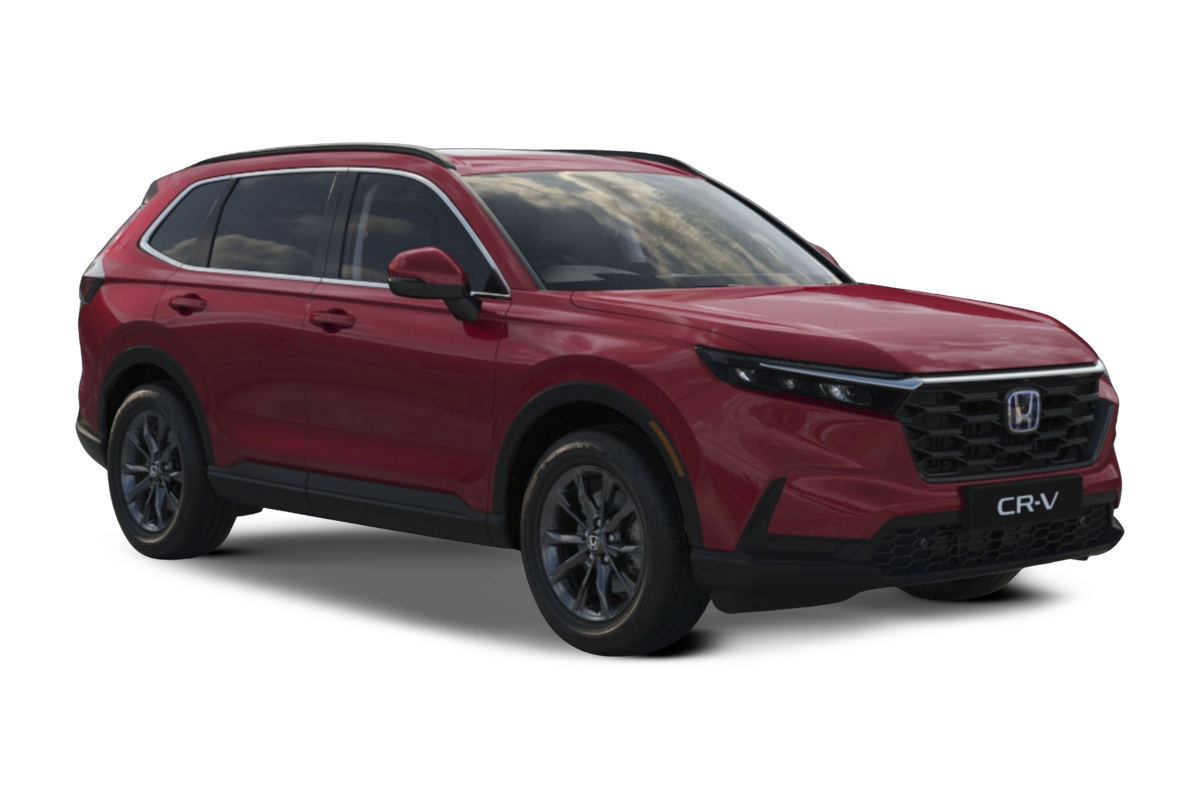
Both versions are more forgiving on scruffy roads and less punishing over potholes than the Mazda CX-60, but the e:HEV thumps a bit more than the PHEV and struggles to settle down as well as a Volvo XC60.
That said, while the CR-V e:HEV doesn't quite match the pillowy ride comfort offered by a Citroën C5 Aircross, the upside is that it feels better tied down over undulations and less likely to trouble passengers prone to travel sickness.
Big family SUVs such as the CR-V are not usually associated with nimble handling, but there are some tidy offerings around – most notably the BMW X3 and Mazda CX-5. The Audi Q3 and VW Tiguan are pretty good to drive, too.
The CR-V is competent on a twisty road, being more agile than a CX-60 and XC60, with body lean kept under control in corners. The steering is precise, responsive and well weighted, which is reassuring at higher speeds. That said, we wish the tyres had more grip when pressing on.
Meanwhile, even if you set the CR-V e:PHEV’s adaptive suspension to Sport mode, it doesn’t quite match the X3 or CX-5 for driver engagement.
Is it quiet and how easy is it to drive smoothly?
The CR-V e:HEV’s engine is quite vocal when you're pressing on, as it works hard to generate electricity to charge the battery while also driving the wheels.
Thanks to its larger battery, the e:PHEV can eliminate engine noise altogether by driving on electricity alone for long periods. The switch to engine-only running is smooth – unlike in the Lexus NX, which sends a small vibration through the steering wheel and seat.
The CR-V does generate quite a lot of wind and road noise at motorway speeds, though – more than you'll experience in most premium rivals. On longer journeys that could become a little tiring.
More positively, the CR-V’s brake pedal is well-weighted and responds naturally enough to help you to stop smoothly. The CR-V also has four levels of regenerative braking that helps harvest back some energy that can be used to top up the battery while slowing you down, which can be adjusted via paddles on the back of the steering wheel.
What’s the range and efficiency like, and how quickly can it charge?
Reasonable efficiency helps to offset the price tag, with the e:HEV managing a real-world fuel economy figure of 38mpg on our test route. That's much more than a petrol Volvo XC60 B5 (29.6mpg) averaged on the same day.
The e:PHEV’s 17.7kWh battery covered 37.6 miles before the engine chimed in – short of its 51-mile official range but further than the 36.8 miles we saw from an NX 450h on the same day. While that was competitive a few years ago, newer rivals are now able to cover around 75 miles (including the Audi Q3, MG HS, Toyota RAV4 and VW Tiguan).
The e:PHEV can charge from 0-100% in about two and a half hours when using a 7kW home EV charger. That’s on a par with most PHEV SUVs, but some newer rivals now include a CCS charging socket for fast public charging. This includes the Q3, Tiguan and RAV4, as well as the Land Rover Discovery Sport PHEV with its 32kW maximum charging speed.
“The CR-V isn't in the same league as an equivalent Land Rover Discovery Sport or Lexus NX for 0-60mph times. However, I found it reacts quickly because the electric motor drives the wheels most of the time, giving it a similar feeling to an electric car.” – Lawrence Cheung, New Cars Editor

Interior
The interior layout, fit and finish
Strengths
- +High driving position
- +Great visibility
- +Physical air-con controls
Weaknesses
- -Interior materials are a bit disappointing
- -Digital driver display isn’t all that configurable
What does the interior look like and is it well made?
The CR-V’s interior design is very similar to what’s in the smaller Honda ZR-V SUV and Honda Civic hatchback. It covers the basics well, with a good range of materials and a user-friendly layout with plenty of physical controls.
Build quality is pretty good, with everything feeling solidly built. There are soft-touch plastics and leather-effect materials on higher-up areas, something that looks like stitched leather on the doors plus gloss-black panels and silvery highlights. Leather upholstery comes as standard, while Advance tech gets silver sports pedals.
However, it’s predominantly dark inside and it doesn’t take much searching to find scratchy plastics. When you consider its relatively high price tag, that’s disappointing. The Volvo XC60 is much better for perceived quality, as well as the Mazda CX-60.
Is the driving position comfortable and is it easy to see out?
If you want something that feels like a proper high-up family SUV to sit in, the Honda CR-V will be right up your street because of its lofty seating position. You get eight-way electrically adjustable seats as standard, with a memory function if you go for Advance trim or higher, making it really easy to get comfortable behind the wheel.
Every CR-V comes with a crisp 10.2in digital driver’s display, which is easy to read at a glance and gives you a couple of configurable menus. As a whole, it’s a good display but it's not as versatile as the brilliant one in the Audi Q3 or VW Tiguan.
One thing we really like is the fact that you get lots of buttons and dials to quickly access parts of the infotainment system or adjust the air-con. They're much less distracting to use when you're driving than the touch-sensitive buttons in a Tiguan or Volvo XC60.
Thanks to the CR-V’s tall side and rear windows, visibility is excellent. And despite the rear pillars being rather wide, the large side windows help with the view over your shoulder.
Parking should be pretty easy because every CR-V gets front and rear parking sensors, and a rear-view camera. Top-spec Advance trim swaps the camera for a 360-degree one, and Advance Tech gets Honda Parking Pilot, which will park the car for you in certain circumstances.
Bright LED headlights with automatic high-beam come as standard, so you’ll always be able to see plenty at night. Advance trim upgrades these lights to units with adaptive high beam, which automatically dims full beam when it detects other drivers.
Is the dashboard and infotainment system easy to use?
The 9.0in infotainment touchscreen in the CR-V is conveniently positioned high on the dashboard and has physical shortcut buttons and a knob for the stereo volume for easy on-the-go control.
The screen responds quickly enough when you prod it, and the layout is easy to get to grips with. However, the screen falls short of some rival systems in terms of resolution, and its user interface looks a bit outdated.
The 12-speaker Bose sound system offers a sharper sound quality than the 10-speaker set-up in the Lexus NX but has to work harder to overcome road noise.
Advance trim also adds a head-up display that usefully projects information (such as your speed) on the windscreen at eye level. It’s easy to read, even if it doesn’t have the sharpest looking graphics.
“I found parking the CR-V surprisingly easy for such a big SUV. You sit up high and the windows are huge, so you get great all-round visibility. You also get front and rear parking sensors, and a rear-view camera as standard.” – George Hill, Staff Writer

Passenger & boot space
How it copes with people and clutter
Strengths
- +Loads of rear leg room
- +Big boot
- +Generous front-seat space
Weaknesses
- -Limited head room
- -Less versatile 60/40 split-folding rear seats
- -Small glovebox and door bins
How much space does it have for people?
We have few complaints about front space in the Honda CR-V. If you extend the front seats all the way back, you'll have plenty of leg room unless you're exceptionally tall, and there's loads of head room. Even with the standard-fit panoramic glass roof fitted, you'll have space above you.
The interior is suitably wide, with a decent-sized armrest between the driver and passenger that lifts to reveal a cubby with a sliding tray. There are two cupholders and a wireless phone-charging pad with a built-in fan to cool your device. On the downside, the door bins are quite narrow and the glovebox isn’t huge.
There’s no doubt the CR-V looks massive, and the upside to that is there’s acres of rear leg room and a flat floor that doesn’t rob foot space from a middle-seat occupant. However, when you're sitting in the back it’s impossible to ignore the ridge running across the width of the roof in front of your head.
That ridge is where the roller blind for the panoramic roof lives, and it makes the rear seats of the CR-V feel rather claustrophobic – even if you’re an averagely tall adult. The raised middle seat robs you of more head room if you're in the centre of the back seats, too.
The wide door openings will ensure that putting a child in a car seat is a breeze. Just keep in mind that you can only have the CR-V with five seats. If you need more, see our best seven-seaters page.
How much room does it have for luggage?
If you want the CR-V with maximum boot space, you'll want the e:PHEV – which has 617 litres – rather than the e:HEV, with 579. Either is pretty generous, though: we managed to fit in eight carry-on suitcases in both versions, with space left over for a couple of soft duffle bags. For comparison, a Lexus NX took seven cases.
Only the PHEV comes with a height-adjustable boot floor, but it needs to be positioned in its highest position for it to run level with the rear back rest when it’s folded.
You shouldn’t have any issues loading bulky items into a CR-V because there’s no load lip to speak of. It’s a slight shame the CR-V doesn’t have levers in the boot to conveniently fold down the rear seats remotely, like you can in the Mazda CX-60.
The rear seats split 60/40, rather than the more useful 40/20/40 arrangement you get in the Mazda CX-60 and Peugeot 5008. Still, they can be slid back and forth so you can prioritise rear leg room or boot space.
What’s more, rear head room can be increased thanks to the rear seats reclining in eight different settings. Yes, eight. That means head room can vary from "good" when the seat is upright to "great" if you recline the seat.
“The CR-V has a huge amount of leg and elbow room – more than a Land Rover Discovery Sport in fact, which I think is impressive.” – Oliver Young, Car Reviewer

Buying & owning
Everyday costs, plus how reliable and safe it is
Strengths
- +Loads of standard equipment
- +Efficient engines
- +Lots of safety kit
Weaknesses
- -High list price
- -Warranty is nothing special
How much does it cost and what equipment do you get?
No matter how you slice it, the Honda CR-V looks pretty expensive – especially the e:PHEV, which costs more than the Citroën C5 Aircross, Toyota RAV4 and VW Tiguan. It's worth keeping an eye out for discounts on our New Car Deals pages.
Company car users will pay less BIK tax for the PHEV than the HEV version, but an electric SUV will be even cheaper if you’re paying via salary sacrifice.
Considering the price, at least the CR-V comes loaded with equipment. The range starts with Elegance trim and includes 18in alloy wheels, wireless phone-charging, dual-zone climate control, adaptive cruise control, heated front seats, a heated steering wheel, keyless entry and rear privacy glass.
Next in line is the Advance trim, which builds on the standard kit list by adding ventilated front seats and heated rear seats, plus the tech kit mentioned above.
Advance Tech sits at the top of the range and is only available with the e:PHEV version. It has different exterior styling, bespoke details around the interior and other extras but not much else.
Is it reliable, and how long is the warranty?
The Honda CR-V is too new to feature in our latest What Car? Reliability Survey but Honda as a brand finished at the top of the manufacturer league table, out of 30 brands.
Honda’s default warranty is three years, 90,000 miles, with breakdown assistance included. That mileage cover is more generous than many rivals in the family SUV class, but can’t match the five-year, unlimited mileage warranty you get from Hyundai or the seven years Kia gives you.
How safe is it, and is it easy to steal?
The experts at Euro NCAP awarded the CR-V the full five stars when they tested it in 2024. Looking deeper into the results, it scored well for protecting adults in the front and children in the back seats.
Every CR-V comes with plenty of standard safety kit, including 11 airbags and Honda’s latest Honda Sensing 360 system, which keeps an eye on all areas of the car and includes blind-spot monitoring and cross-traffic monitoring front and rear.
Automatic emergency braking (AEB) is standard, along with lane-departure warning, traffic-sign recognition, lane-keeping assistance and a driver attention monitor.
“With the battery completely flat, I achieved an average of 46.1mpg in a CR-V plug-in hybrid on our real-world test route, which is better than Land Rover Discovery Sport and Lexus NX PHEVs in the same conditions.” – Will Nightingale, Reviews Editor
Buy it if...
-You want a family SUV with generous leg room all-round
-You like the CR-V’s user-friendly interior
-You’re after an interior that feels durable, rather than luxurious
Don’t buy it if…
-You want the biggest boot in the class
-You need plenty of head room for rear occupants
-You need a plug-in hybrid with a long range
For all the latest reviews, advice and new car deals, sign up to the What Car? newsletter here

FAQs
While the CR-V is a great family SUV in most areas, its main issues are its high list price, limited rear head room and higher levels of road noise than its rivals.
The CR-V comes as a hybrid or a PHEV but is not available as a full electric car.
No – it's only available as a five-seater. Honda doesn't sell any seven-seaters in the UK.
| RRP price range | £47,795 - £51,250 |
|---|---|
| Number of trims (see all) | 4 |
| Number of engines (see all) | 2 |
| Available fuel types (which is best for you?) | petrol hybrid, petrol plug-in hybrid |
| MPG range across all versions | 42.8 - 353.1 |
| Available doors options | 5 |
| Company car tax at 20% (min/max) | £697 / £3,336 |
| Company car tax at 40% (min/max) | £1,393 / £6,671 |

