Nissan X-Trail review
Category: 7-seater
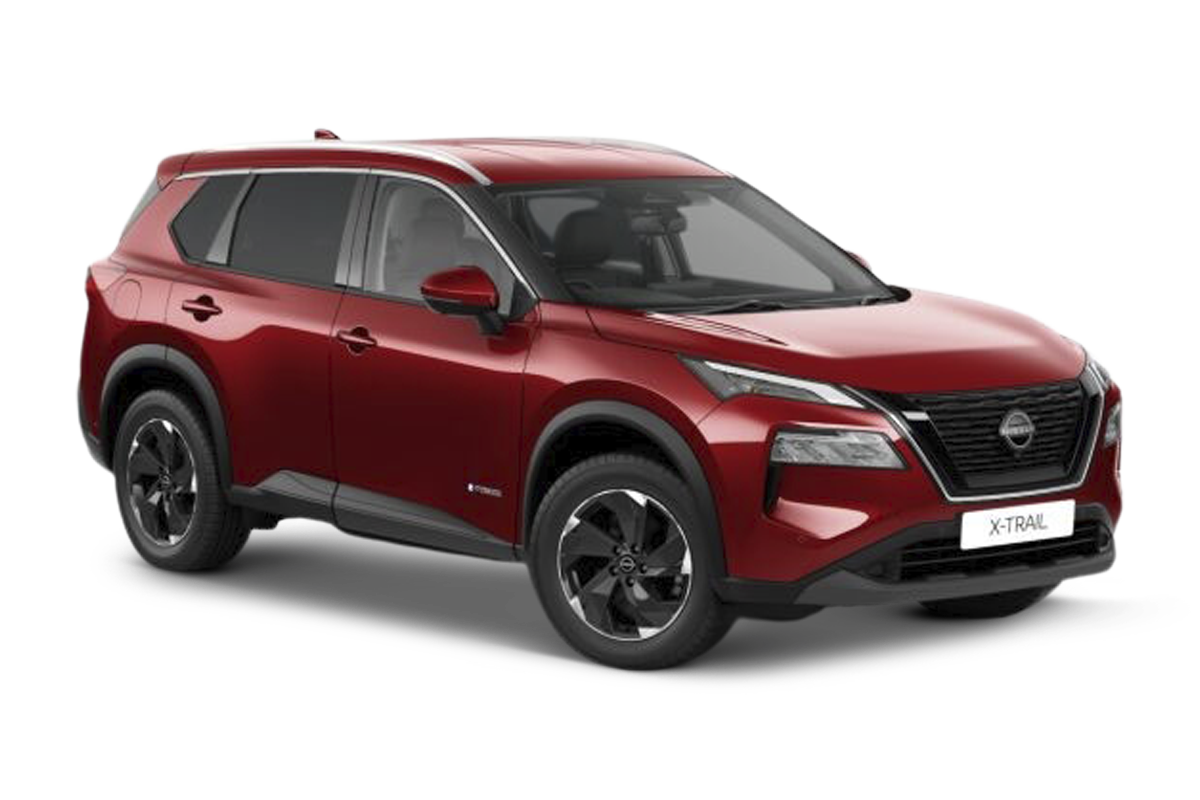
The X-Trail hybrid SUV offers plenty of space and is available with seven seats and four-wheel drive


What Car? says...
SUV means "sports utility vehicle", and while many would argue that most new SUVs have forgotten that, the Nissan X-Trail certainly hasn’t. It combines sports with utility to make it fit for a lifestyle featuring beaches, surfboards and mountain bikes.
Adding to the X-Trail's appeal as practical family transport, it's available with up to seven seats, making it an attractive alternative to an MPV. It comes as the VC-Turbo mild-hybrid or as a full hybrid called the e-Power, which is an interesting option because it drives like an electric car.
You can have the X-Trail e-Power with four-wheel drive – slightly confusingly called "e-4orce" by Nissan – and the 4x4 version was a winner in its weight category at our Tow Car Awards. Don't worry: we'll explain all these "e-" terms in more detail later in this review.
Nissan X-Trail video review
Sounds promising, doesn’t it? Even so, the Nissan X-Trail has plenty of rival SUVs and seven-seaters to contend with – ranging from the Hyundai Santa Fe and Kia Sorento to the Mazda CX-60 and Peugeot 5008. Read on to find out how it compares...

What’s new?
- November 2022: new X-Trail earns five-star Euro NCAP safety rating
- September 2022: fourth-generation Nissan X-Trail revealed, offering five- or seven-seat configurations, and Nissan’s e-Power tech, in which the petrol engine charges the battery, while an electric motor drives the wheels
Performance & drive
What it’s like to drive, and how quiet it is
Strengths
- +Comfortable ride
- +Not much wind or road noise
Weaknesses
- -Mild-hybrid engine isn’t very refined
- -Some rivals are more fun to drive
Engine, 0-60mph and gearbox
You can have your Nissan X-Trail with two types of hybrid tech, the first of which is a mild hybrid. That version, badged the VC-Turbo, gets its power from a 161bhp 1.5-litre turbocharged petrol engine with a small electric motor to boost efficiency.
There’s enough grunt for normal driving, with 0-62mph taking less than 10 seconds, but it needs working quite hard if you’re in a hurry. In fact, it feels a bit laboured and jittery in its power delivery, in part because the automatic gearbox is hesitant.
That’s where the 201bhp e-Power comes in. Its 1.5-litre turbocharged petrol engine never interacts with the wheels – instead it charges a battery that powers the wheels with an electric motor. As a result it drives almost like an electric car, getting instant acceleration off the line. If you want even more pace, there’s the four-wheel-drive e-4orce variant, which has two electric motors and managed to sprint from 0-60mph in just 7.6 seconds when we tested it.
Suspension and ride comfort
If you like a car that’s softly sprung, you’ll like the X-Trail. It’s far more supple than the Mazda CX-60 and Peugeot 5008, with slightly less fidget felt through your seat on a motorway than in the Hyundai Santa Fe.
The X-Trail proves an effective shield from imperfections, only thudding through the worst potholes. Despite its soft suspension it’s well controlled, too, resisting side-to-side sway over undulations and never feeling floaty, both issues you’ll experience in the Citroën C5 Aircross.
Sticking to the smaller 18in alloy wheels, which come as standard on all but the two Tekna trims, is likely to make the X-Trail even more comfortable. That said, if ride comfort is a priority of yours, we recommend trying the Skoda Kodiaq too, because it's strong in this area.

Handling
As with most big SUVs and seven-seaters, the X-Trail wasn’t designed for driving thrills, and that shows on a twisty road. Body control is slightly better than in a Hyundai Santa Fe but the light, slow steering makes it a bit more tricky to place on the road.
During spirited driving, it's not hard to find the limits of grip, and it doesn't take much use of the accelerator pedal to make the front end push wide. As you might expect, going for the four-wheel drive versions helps to increase the amount of grip on offer, but it still doesn’t make the X-Trail engaging.
If handling is important to you, you're likely to prefer a Mazda CX-60 or Skoda Kodiaq.
Noise and vibration
For the best refinement, you'll want the X-Trail e-Power rather than the mild-hybrid VC-Turbo, because while you’re cruising or tootling around it’s one of the quieter big SUVs out there.
The single gear set-up means the engine fires up to charge the battery at a constant rev rate. In the past, that's caused a constant drone as you drove along but tweaks to the engine have changed that, and now it remains fairly quiet even when you work it hard. The VC-Turbo is nowhere near as smooth and quiet.
Whichever version you go for, there's little wind or road noise. The e-Power model has regenerative braking (regen) to recover energy for the battery, but unlike in some hybrid cars they're easy to modulate, although they could be smoother and more reassuring when you brake hard. There's an e-Pedal mode that maximises regen so the X-Trail slows to a crawl when you lift off the accelerator pedal.
"I think it's interesting how the electric-ish X-Trail e-Power takes a fresh slant on hybrid power, making it feel more like a stepping stone to electric motoring than more conventional hybrids." – Stuart Milne, Digital Editor
Interior
The interior layout, fit and finish
Strengths
- +Appealing interior materials
- +More physical controls than in some SUVs
- +Comfortable driving position
Weaknesses
- -Rear visibility could be better
- -Infotainment looks a bit old school
Driving position and dashboard
All trim levels for the Nissan X-Trail have a height-adjustable driver’s seat with electrically-adjustable lumbar support, as well as reach and rake adjustment for the steering wheel. Going for Tekna trim or above adds electronically adjustable front seats with a memory function.
The dashboard is clear and logically laid out, with controls placed within easy reach. The buttons and switches are all large and easy to operate while you’re driving, as well as positive and precise in their actions.
While many cars have done away with physical controls for their air-con systems, we like that the X-Trail comes with proper buttons and rotary controllers. They’re far more user-friendly when you're driving than having to search through menus on the infotainment touchscreen.
Visibility, parking sensors and cameras
The X-Trail’s high driving position and broad windscreen provide good forward visibility, so you’ll never have trouble seeing out at junctions.
Large rear pillars partially block the view over your shoulder so rear visibility could be better. Luckily, even the entry-level X-Trail comes with front and rear parking sensors, a rear-view camera and blind-spot mirroring as standard. Stepping up to N-Connecta trim adds a surround-view monitor.
To aid visibility when you’re driving at night, bright LED headlights with main-beam assist are standard across the range. Tekna trim and above comes with Adaptive Driving Beam, which allows you to keep full beam on without dazzling other drivers.

Sat nav and infotainment
Unlike the climate control, which is adjusted using proper switches, the infotainment is controlled through the touchscreen, which measures 8.2in in entry-level Acenta Premium trim and 12.3in with other versions. So far we’ve tried the bigger screen, and while the graphics could be sharper, it's easy enough to read and responds quickly to your prods.
Android Auto and Apple CarPlay smartphone mirroring are standard with every X-Trail (wired with entry-level Acenta Premium and wireless on the rest), allowing you to use sat-nav apps from your phone through the touchscreen. That’s handy because you have to upgrade to the mid-level N-Connecta trim to get built-in sat-nav.
You can add a head-up display by going for Tekna trim, while Tekna+ adds an upgraded Bose sound system with 10 speakers. Strangely, the top N-Trek trim misses out on both those features.
Quality
The X-Trail feels quite solidly put together. The dashboard makes good use of textured, soft-touch plastics and the switches are reasonably well damped. While you can find some less desirable and scratchy plastics, they’re hidden low down and you’ll have to search for them.
Materials further back in the car are more durable than they are plush, but even if you make a concerted effort to find anything sub-par, you’ll be out of luck.
"Three-zone climate control lets you adjust the second-row temperature from the front seats. I think that will be especially handy for trying to keep kids comfy in hot weather." – Claire Evans, Consumer Editor
Passenger & boot space
How it copes with people and clutter
Strengths
- +Lots of front storage
- +Plenty of rear space
- +Versatile rear seats
Weaknesses
- -Smaller boot than rivals
- -Third row seats are quite tight
Front space
When you compare the Nissan X-Trail to rivals including the Hyundai Santa Fe and Kia Sorento you’ll find that it has a fraction less head room to offer in the front. Regardless, this is a big SUV so there’s plenty of room, and even six-footers won’t struggle for space.
Sticking to the X-Trail’s target audience of adventurous families, you’ll find a generous amount of storage space in the front, including two cupholders in the centre console, a large open space under the centre console, decent-sized door pockets and a deep storage area in the centre armrest.
The doors open very wide and the seats are set high, making the X-Trail a good option for those who usually find it hard to get in and out of cars.
Rear space
The middle section of the X-Trail’s second row bench flips down to form an armrest, complete with two fixed cupholders, and the two sections of the rear bench each recline for added comfort. Rear seat access is very good because the doors open to nearly 90 degrees, making it a doddle to put a child seat in the back.
The good news continues when it comes to the space available, with even six-footers sitting in the two outer seats getting enough head and leg room to make a long journey comfortable. Leg room can be extended by sliding the rear seats back.
The mild-hybrid X-Trail and the four-wheel-drive version of the e-Power are available as seven-seaters rather than the standard five. The two rear-most seats will fit adults but only just and they won’t be comfortable, especially on a long journey. The third-row seats in the Kia Sorento and Peugeot 5008 (both of which have seven seats in all versions) are far more accommodating.

Seat folding and flexibility
The back seats in the X-Trail split 60/40 unless you opt for the Tekna and Tekna+ trim levels, which get the more versatile 40/20/40 split. The seats fold flat so there’s no awkward step in the floor. All versions of the 5008 and Skoda Kodiaq have 40/20/40 split seats.
What’s more, if you want a little extra boot space but don’t want to fold down the back seats, you can slide them forwards (although that reduces rear leg room). The two rear-most seats on seven-seat versions are easy to lift into place and drop flat into the boot floor.
Boot space
The X-Trail has 585 litres of boot space or 575 litres if you go for the e-Power version. For comparison, the Hyundai Santa Fe Hybrid has 725 litres, the Kia Sorento – which can swallow 11 carry-on suitcases – has an impressive 813 litres and the Peugeot 5008 has a vast 916 litre boot but takes one less carry-on case due to some of its space being under the floor.
Even so, the X-Trail will easily swallow eight carry-on cases (or lots of shopping or a couple of buggies), and has no lip at the boot entrance to lift heavy items over.
If you don’t go for the optional third-row seats, you gain storage space under the boot floor. With the sixth and seventh seats in use, the boot is smaller than the Santa Fe's, with space for a few shopping bags (a buggy will be a squeeze).
"I found cramming myself into the X-Trail's rearmost seats rather challenging. If you're planning to carry taller adults in the third row regularly, the Hyundai Santa Fe is a better choice." – Will Nightingale, Reviews Editor
Buying & owning
Everyday costs, plus how reliable and safe it is
Strengths
- +Competitively priced
- +Lots of standard equipment
- +X-Trail e-Power is efficient
Weaknesses
- -Neither engine is that efficient for a hybrid
- -Depreciates faster than rivals
Costs, insurance groups, MPG and CO2
As a cash purchase, the Nissan X-Trail looks competitively priced against its seven-seater rivals. It costs about the same as the Peugeot 5008 and Skoda Kodiaq, but quite a lot less than the Hyundai Santa Fe and Kia Sorento.
In terms of depreciation, though, the X-Trail is predicted to lose its value slightly more quickly than those rivals, which could lead to higher PCP payments.
When it comes to fuel economy, neither version of the X-Trail is particularly efficient, with the VC-Turbo mild hybrid officially managing up to 39.8mpg – almost 10mpg less than the Santa Fe Hybrid. The front-wheel-drive e-Power version is better, with a figure of 49.5mpg, but in practice it isn’t so great, especially in four-wheel-drive mode, which only managed 37.8mpg in our tests.
Company car drivers will want to go for the two-wheel-drive e-Power because it has the lowest CO2 emissions figures, and therefore the lowest BIK tax payments. That said, plug-in hybrid (PHEV) versions of the Santa Fe and Kodiaq will cost even less and are worth a look. Or you could save even more on BIK tax by getting an electric SUV like the Peugeot e-5008.
Equipment, options and extras
The X-Trail comes with plenty of standard equipment so we’d suggest sticking to the entry-level Acenta Premium trim, which comes with 18in alloys, dual-zone climate control, a 12.3in digital driver's display, a wireless phone-charger, touchscreen infotainment and parking aids.
Next up, you have N-Connecta, which gets privacy glass and a bigger infotainment screen.
Then there’s Tekna and Tekna+, two fancy trims that add a powered tailgate, 19in wheels, a head-up display and an upgraded sound system.
The most expensive trim, N-Trek, misses out on some of the equipment Tekna+ gets, but gets water-resistant seat upholstery, rubber floor matts, a reversible boot floor, different styling and bespoke 18in alloys. It also adds tri-zone air conditioning and heated seats front and rear. However, like the two Tekna trims it’s too expensive to recommend.

Reliability
While Nissan came 29th out of 30 brands in the 2025 What Car? Reliability Survey, that was mainly due to the performance of the Juke; the X-Trail was a much stronger performer, finishing 15th out of 76 family SUVs.
In case something does go wrong, the X-Trail is covered by a three-year/60,000-mile warranty that includes roadside assistance and a courtesy car. You can extend the cover to up to six years, but doing so is quite pricey compared with the extended warranty deals available on some rivals.
It's also worth noting that Nissan's standard offering falls well short of the five-year warranty that the Hyundai Santa Fe comes with, let alone the Kia Sorento's seven years of cover.
Safety and security
When it was tested by the experts at Euro NCAP, the latest X-Trail scored the full five stars, getting high marks in almost all areas – especially protecting adults in the front and children in the rear.
Every X-Trail comes with lots of safety kit, including automatic emergency braking (AEB) with pedestrian and cyclist recognition, blind-spot monitoring, rear cross-traffic alert, lane-departure prevention and traffic-sign recognition with speed-limit adjustment.
"The e-Power system doesn't bring miraculous fuel economy, but its smooth driving manners feel more like a stepping stone to electric motoring." – Darren Moss, Deputy Digital Editor
For all the latest reviews, advice and new car deals, sign up to the What Car? newsletter here
FAQs
Yes, the X-Trail is the biggest SUV in Nissan car range. It's about 25cm longer than a Nissan Qashqai.
You can have the X-Trail with either five or seven seats. That said, the seven-seat version’s third row is tighter on space than some the best seven-seaters.
| RRP price range | £36,275 - £48,395 |
|---|---|
| Number of trims (see all) | 4 |
| Number of engines (see all) | 1 |
| Available fuel types (which is best for you?) | petrol hybrid |
| MPG range across all versions | 39.8 - 47.9 |
| Available doors options | 5 |
| Company car tax at 20% (min/max) | £2,162 / £3,219 |
| Company car tax at 40% (min/max) | £4,324 / £6,439 |

