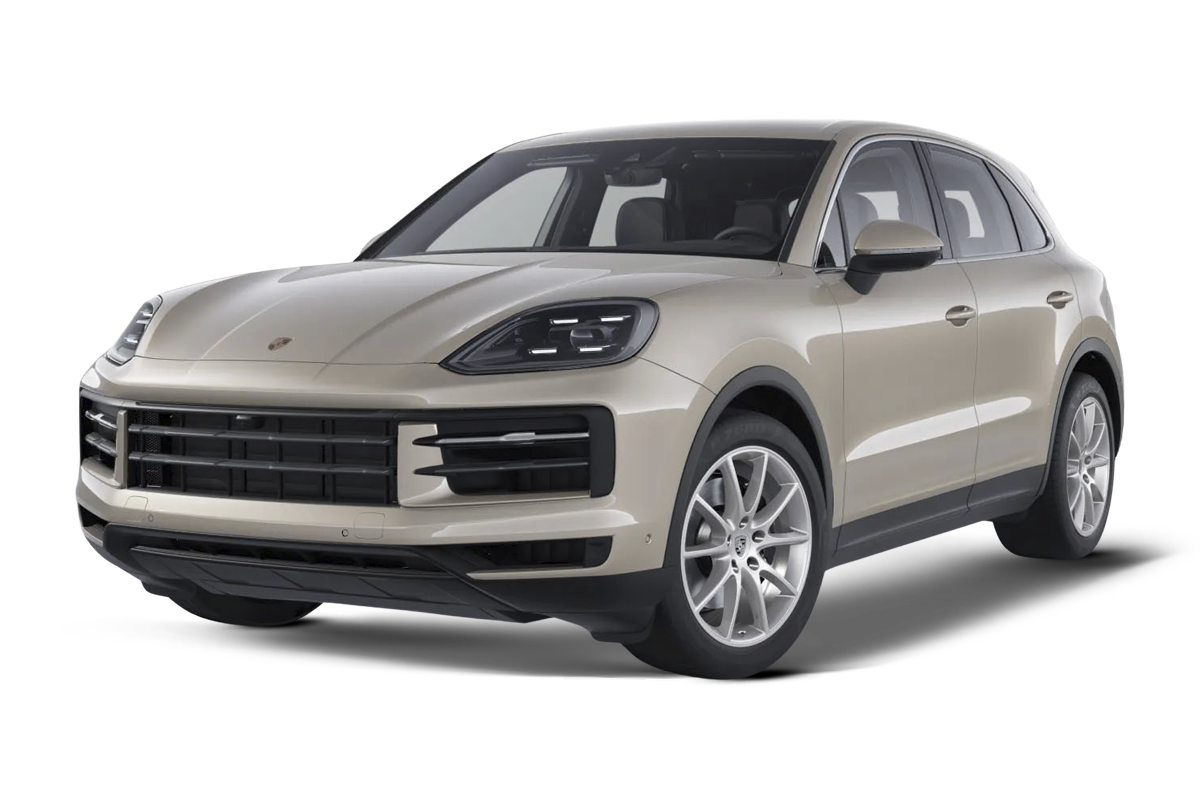
Porsche Cayenne review
Category: Sports SUV
Fine handling and epic performance in a surprisingly practical package.


What Car? says...
It's funny to think that the first Porsche Cayenne had car enthusiasts the world over incandescent with rage. They were appalled at the prospect of a thoroughbred sports-car brand sullying its reputation by building – shock, horror – an SUV.
Such scepticism was understandable, because until then the concept of a performance SUV didn’t really exist. Most 4x4s were off-road-focused vehicles with a distinct lack of performance and handling verve.
The Cayenne changed all that, and today remains arguably the definitive example of an SUV that's designed, above all, for performance. Car buyers seem to agree: the Cayenne is the best-selling Porsche model worldwide, and even Aston Martin, Ferrari and Lamborghini have SUVs in their line-ups now.
This third-generation Cayenne has already had a big mid-life update to keep it fresh, including a new interior and various chassis tweaks to make ride comfort and handling even more impressive. The engines have been given a power boost, too.
But is the Porsche Cayenne still the best sports SUV for spirited driving on your favourite road? Can it still make your neck hairs stand on end for all the right reasons? And how does it compare with the Audi Q7, the BMW X5 and the Range Rover Sport?

Well, we've driven them all, and in this review we'll let you know which is best in all the key areas.
What’s new?
April 2023: heavily facelifted Cayenne SUV launched, with Matrix LED headlights, a separate infotainment display for the front-seat passenger, and upgraded suspension
June 2020: Cayenne GTS hits the road, with a 454bhp 4.0-litre twin-turbo V8, a sports exhaust and a 20mm-lower ride height
August 2019: new plug-in hybrid version launched. It is the most powerful current Cayenne with 671bhp, and can travel 27 miles on battery power
August 2017: third generation of the Cayenne makes its world debut. Car is 65kg lighter than its predecessor, and has rear-wheel steering to help manoeuvrability
Performance & drive
What it’s like to drive, and how quiet it is
Strengths
- +Brilliant handling
- +Bombastic performance
- +E-Hybrid models have an impressive electric range
Weaknesses
- -E-Hybrid brakes could be more progressive
- -A shame air suspension isn’t standard on all model
Engine, 0-60mph and gearbox
There’s no such thing as a slow Porsche Cayenne. Even the entry-level version, with its 349bhp turbocharged 3.0-litre V6 petrol engine, can accelerate from 0-62mph in 6.0 seconds and pulls strongly from low engine speeds. It begins to feel a little strained at the top of the rev range, though, so if you can afford it, the Cayenne S – our pick of the range – is worth the extra.
That’s because the S has a 4.0-litre turbocharged V8 petrol engine with a colossal 468bhp. If you add the optional Sport Chrono Package (which adds launch control), you'll be able to do 0-62mph in just 4.7 seconds. Better still, the V8 sounds much more intoxicating than the V6. The 493bhp GTS is even faster, although not by much and it’s a big jump up in price.
There are also three plug-in hybrids (PHEVs), each with a petrol engine, an electric motor and a 21.8kWh (usable capacity) battery, which can officially be driven on electricity alone for at least 45 miles.
The E-Hybrid and the S E-Hybrid pair a 3.0-litre V6 engine with an electric motor, for 464bhp and 512bhp respectively. And then there's the 729bhp Turbo S E-Hybrid, which has a 4.0-litre V8, for a 0-62mph time of 3.7 seconds – quicker than a Porsche 911 Carrera.
You can no longer buy a new Cayenne with a diesel engine.
Suspension and ride comfort
You can have your Cayenne either with conventional steel springs or an air suspension set-up that incorporates Porsche Active Suspension Management (PASM).
So far, we've only tested cars with the air suspension system, and it delivers a largely comfortable ride, even if the Audi Q7 and the Range Rover Sport cushion you better. As the Cayenne reaches cambers in the road and tries to stay bolt upright, you feel your head tossing from side to side more than in those rivals.
Around town, it never crashes or jars. In fact, you'll hear the impacts more than you'll feel them, which is common with air suspension. More impressive is how the suspension performs on a country road, where body control is class leading. There's no float, even at high speeds, and any bounce from undulations is dealt with quickly and competently.

Handling
With the optional air suspension and active anti-rolls bars fitted, the Cayenne is top of its class for handling. The way it changes direction and resists body lean through corners is really quite remarkable. At times it genuinely feels as though it's defying physics.
Four-wheel steering is available as an option, and really helps manoeuvrability, making the car feel keener to turn in as you tackle tight low-speed bends. It's particularly useful in car parks – although it adds a hefty chunk to the price.
If you’re looking for the nimblest version, avoid the heavier E-Hybrid models. While they handle very well by SUV standards, they feel noticeably less alert than the non-PHEV versions, especially through tight twists and turns.
Noise and vibration
The V8 rumble in the Cayenne S fades to a barely perceptible background hum at motorway speeds (as long as you've switched off the sports exhaust, of course). Meanwhile, the 3.0 V6 in the entry-level Cayenne and the E-Hybrid is also respectably subdued at a steady cruise.
The E-Hybrid models are pretty hushed when running in electric-only mode, with just a bit of tyre roar and suspension patter disturbing the serenity. Unfortunately, they also have an inconsistent brake pedal.
The PHEVs' brakes are incredibly powerful and will stop you quickly from high speeds, but pushing the pedal activates a regenerative braking system that makes the pedal a bit spongy. The brake pedals in non-PHEV versions inspire far more confidence.
All Cayennes come with an eight-speed automatic gearbox that glides between ratios smoothly in normal driving, and is pretty responsive when you decide to take control of gear changes using the paddles behind the steering wheel.
‘The entry-level V6 engine is a bit more powerful than before, but I reckon the V8 S is the one you really want, combining power with a full-on V8 roar –’ Will Nightingale, Reviews editor
Interior
The interior layout, fit and finish
Strengths
- +Good infotainment system
- +Comfortable seats and driving position
- +Great build quality
Weaknesses
- -Some functions accessed via touch-sensitive pads
- -Interior can be a bit bland without options
Driving position and dashboard
The standard eight-way electrically adjustable driver's seat in the Porsche Cayenne doesn't have any lumbar adjustment, so it's worth forking out for at least the optional 14-way seats.
We'd be tempted to pay a bit extra again for the 18-way sports seats, because they have extra bolstering to hold you in place better through corners.
Regardless of which seats you go for, the steering wheel offers plenty of up-and-down and in-and-out adjustment, and you should have few problems viewing the curved digital instrument panel behind the steering wheel. A head-up display that projects information in the driver’s line of sight is optional.
The controls for the air-conditioning are placed unhelpfully low down on the dashboard, and some of its functions are accessed using touch-sensitive pads rather than physical buttons. You do at least get proper switches for tweaking the interior temperature.
Visibility, parking sensors and cameras
All Cayennes give you a lofty driving position on par with the Audi Q7 and the BMW X5 – although the Range Rover Sport perches you even higher up. The result is a good view down the road ahead, and a relatively clear one at junctions, with windscreen pillars that are not too chunky.
The rear pillars are pretty wide, though, so you’ll be grateful for the standard front and rear parking sensors and 360-degree view camera that also shows a 3D graphic of the vehicle.
Matrix LED headlights, which shape their beam automatically to avoid dazzling over drivers, come as standard. Alternatively, you can upgrade to even more precise HD versions (standard on GTS and above). Night vision is available as an option and can show an image feed from a forward-facing camera into the digital driver’s display.

Sat nav and infotainment
All Cayennes have a 12.3in touchscreen in the centre of the dashboard. It has sharp graphics and is responsive to prods and swipes, rarely lagging unless you zoom in and out of sat-nav maps really quickly.
Most of the icons are a decent size, although the sheer number means the system can be a bit distracting to operate while driving. That's why we prefer the infotainment system in the BMW X5. It adds a rotary controller interface so you don't have to take your eyes off the road to press the screen. A third 10.9in screen positioned ahead of the front passenger is optional and allows them to control certain functions as well.
Android Auto and Apple CarPlay smartphone mirroring is included, and the standard 10-speaker stereo can be upgraded to either a 710W 14-speaker Bose system, or a (very pricey) 21-speaker Burmester setup with 1455 watts.
Another clever feature is the Cayenne's optional air quality meter, which shows you the level of pollution outside the car, and inside (after it's been filtered by the air-conditioning system). The car can be set to switch on air-recirculation automatically as you approach a tunnel.
Quality
Porsche has earned a reputation for its upmarket interiors, and the Cayenne’s is a showcase of exactly why. You'll find dense, squidgy plastics, supple leather and switches that operate with slick precision.
If you want your surroundings to be even more indulgent, you can add an extended leather pack for the dash and doors. You can also choose from a variety of colour schemes and dashboard finishes.
Everything feels a little better assembled than in the rival Range Rover Sport – although if you want to splash the cash, the Bentley Bentayga has an even more opulent interior.
‘Cleverly, an optional polarised screen can be fitted ahead of the passenger, so they can watch a film and yet I won’t be able to see it from the driver’s seat. It’s a neat bit of kit.’ – Will Nightingale, Reviews editor
Passenger & boot space
How it copes with people and clutter
Strengths
- +Plenty of space for the driver and passengers
- +Rear seatbacks fold in a 40/20/40 split
- +Big boot
Weaknesses
- -PHEV models lose around 150 litres of storage
Front space
The Porsche Cayenne is a big SUV, so it comes as no surprise to find that there’s plenty of room in the front for even the loftiest of adults.
Even with a panoramic roof stealing a bit of space, there’s still no shortage of head room, and the front seats go back a fair way to accommodate long legs. Width is no issue, either – we doubt any elbows will clash on the wide centre armrest.
There's plenty of storage under that armrest, and the front doors have generous-sized pockets. There's also a dedicated smartphone storage compartment, which is cooled to allow the wireless charging pad inside to deliver more power.
Rear space
While the Cayenne is not quite as long as an Audi Q7, you'd have to be very tall to feel cramped in the back seats. There's even more leg room than you’ll find in the Volvo XC90.
Head room is impressive too, although the optional panoramic roof makes more of a difference to tall people in the back than in the front. There’s enough space for three to sit across the rear bench, but whoever is in the middle will have to straddle a hump in the floor. Unlike the seven-seater Q7, the Cayenne can only carry five.
The rear door bins aren’t as big as the ones up front, but you can get a 500ml bottle of water in. There’s also an armrest, containing a pair of cupholders, which folds down out of the rear bench.

Seat folding and flexibility
The rear seats can be slid forwards and backwards to prioritise leg room or boot space, depending on the job at hand. Your rear passengers also have the option of adjusting the angle of their backrest.
When you need more boot space (more on that shortly), you can fold down the rear seatbacks in a 40/20/40 split, which allows greater flexibility than the 60/40 split in some rivals.
Boot space
Non-PHEV versions of the Cayenne give you a usefully square 698-litre boot, while the E-hybrids have quite a lot less, with 545 litres. We managed to fit seven carry-on suitcases into the (smaller) boot of a PHEV car.
There's hardly any lip at the entrance to hamper you as you load in large, heavy items, and when you need more space, you can fold down the back seats for a mammoth, van-like space, with some underfloor storage.
Buying & owning
Everyday costs, plus how reliable and safe it is
Strengths
- +Slower predicted depreciation than rivals
- +E-Hybrid models have a competitive electric range
Weaknesses
- -You’ll want to add options to all versions
Costs, insurance groups, MPG and CO2
If you're buying privately, the non-PHEV versions make far more sense and should hold on to their value well, which will help to make monthly PCP repayments a little more palatable. Don't expect cheap fuel bills – you'll be lucky to average much more than 20mpg in the V8 Cayenne S.
The entry-level V6 Porsche Cayenne and the V8 Cayenne S are in the top bracket for benefit-in-kind (BIK) tax, so both will be very expensive to run as company cars. The PHEVs – called the E-Hybrids – make more sense because their relatively low CO2 emissions reduce the BIK rate. However, they’re still more expensive on salary sacrifice than the BMW X5 xDrive50e, Range Rover Sport P460e and even the VW Touareg R because those rivals attract an even lower BIK rating.
The E-Hybrids have potentially much better fuel economy, but you'll have to charge them up regularly to get close to the impressive official figures. They take just under four hours to charge up using a standard 7kW home wall box charger.
Equipment, options and extras
Compared with some family SUVs and luxury SUVs, the Cayenne isn't exactly dripping with standard equipment.
True, things have improved since its mid-life update, but even now you have to pay extra for adaptive cruise control, a heated steering wheel and adjustable lumbar support. You do get climate control, heated front seats and a powered tailgate, though.
If you're prepared to spend the cash, the Cayenne offers far more optional extras than most of its rivals, from features to improve the way it drives (i.e. the air suspension) to pure fripperies, such as Porsche crests embossed in the head restraints.

Reliability
As a brand, Porsche finished in a not particularly impressive 21st place out of 31 car makers in our 2024 What Car? Reliability Survey. BMW and Volvo did better, but Audi, Mercedes and Land Rover did worse.
For peace of mind, the Cayenne comes with a three-year, unlimited-mileage warranty, which is par for the course in this class. You get European breakdown cover for the first three years of ownership too.
Safety and security
The Cayenne received a full five-star safety rating from Euro NCAP in 2017. However, if you compare its scores with those of the safest rivals, you'll see that the Cayenne dropped quite a few points for the child occupant crash protection section.
All versions come with automatic emergency braking (AEB) with pedestrian detection as standard, as well as traffic-sign recognition and lane-keep assist. You have to pay extra for blind-spot monitoring, though.
All Cayennes come with an alarm, and the security experts at Thatcham Research awarded it five stars (out of five) for its resistance to being stolen and four stars for guarding against being broken into.
‘Be prepared to click through a long options list on the configurator. The good news is your Cayenne won’t look like anyone else’s, although I wasn’t expecting to see a fire extinguisher available as part of it.’ – Lawrence Cheung, New cars editor
For all the latest reviews, advice and new car deals, sign up to the What Car? newsletter here
FAQs
There's no electric car version of the Cayenne just yet, but you can choose between three E-Hybrid plug-in hybrid (PHEV) versions: the Cayenne E-Hybrid, the Cayenne S E-Hybrid and the Cayenne Turbo E-Hybrid.
The BMW X5 is fractionally longer and taller than the Cayenne, but the two rivals are so close in size you wouldn't be able to tell the difference by looking at them.
The Cayenne isn't cheap, and is priced above the Audi Q7 and the BMW X5 – especially when you factor in standard equipment. You can check the latest prices using our New Car Deals pages.
| RRP price range | £82,405 - £141,060 |
|---|---|
| Number of trims (see all) | 5 |
| Number of engines (see all) | 4 |
| Available fuel types (which is best for you?) | petrol, petrol plug-in hybrid |
| MPG range across all versions | 23.3 - 74.7 |
| Available doors options | 5 |
| Company car tax at 20% (min/max) | £5,735 / £7,962 |
| Company car tax at 40% (min/max) | £11,470 / £15,925 |

