BMW X7 review
Category: Luxury car
The X7 is an immensely practical seven-seater with a luxurious interior and plush ride


What Car? says...
The BMW X7 is kind of a big deal. So big, in fact, it lets you arrive at an event in a vehicle that seems larger than the venue – and you can take six other people along for the ride.
You see, the X7 is the biggest car that BMW makes, and it traverses two car classes – seven-seat SUVs and luxury cars. As well as offering seemingly endless interior space, it aims to pamper its driver and passengers as attentively as the BMW 7 Series limo.
BMW X7 Video Review
But is the BMW X7 really good enough to tempt you away from other premium-badged seven-seat SUVs, including the Audi Q7, Mercedes GLS and Range Rover?
What’s new?
- March 2025: Level 2 autonomy, controlling speed, distance and steering on motorways and allowing hands-off driving introduced as part optional Driving Assistant Professional pack
- January 2023: New Parking Assistant Professional feature allows drivers to park their X7 via the My BMW smartphone app. Optional headlights containing Swarovski crystals introduced
Performance & drive
What it’s like to drive, and how quiet it is
Strengths
- +Strong engines
- +Supremely comfortable ride
- +Remarkably tidy handling
Weaknesses
- -Not as much fun as a Porsche Cayenne
If you’re happy with a diesel, there’s the mightily impressive BMW X7 xDrive40d, which has a 347bhp six-cylinder engine. It helps this big SUV sprint from 0-62mph in a remarkably swift 5.9sec – faster than a Mercedes GLS 450d if not quite as quick as a Range Rover D350.

The cheapest petrol engine is the six-cylinder xDrive40i and it’s the one we’d go for. It's quiet when you want it to be and yet pleasantly snarly when you’re pressing on. It’s also very smooth and offers fractionally quicker acceleration than the 40d diesel (0-62mph in 5.8sec).
The most potent engine is under the bonnet of the M60i. There you'll find a 4.4-litre V8 petrol with a monstrous 523bhp, capable of hauling the X7 from 0-62mph in just 4.7sec – not quite fast enough to beat the Porsche Cayenne GTS, but faster than the Range Rover SV. All-in-all, it's a great engine, although hardly the sensible choice.
All engines are paired with an eight-speed automatic gearbox that shifts gears quickly and smoothly, but also allows you to take manual control using paddles behind the steering wheel. There can be a small delay when you plant your right foot to ask for a quick burst of acceleration, but it’s nothing compared with the pause that afflicts some rivals, including the Audi Q7.
When it comes to ride comfort, the standard air suspension does a fine job of soaking up whatever Britain's battered roads can throw at it. The X7 is more comfortable than the GLS and even edges the Range Rover, as long as you stick with 21in alloys (up to 23in wheels are available).
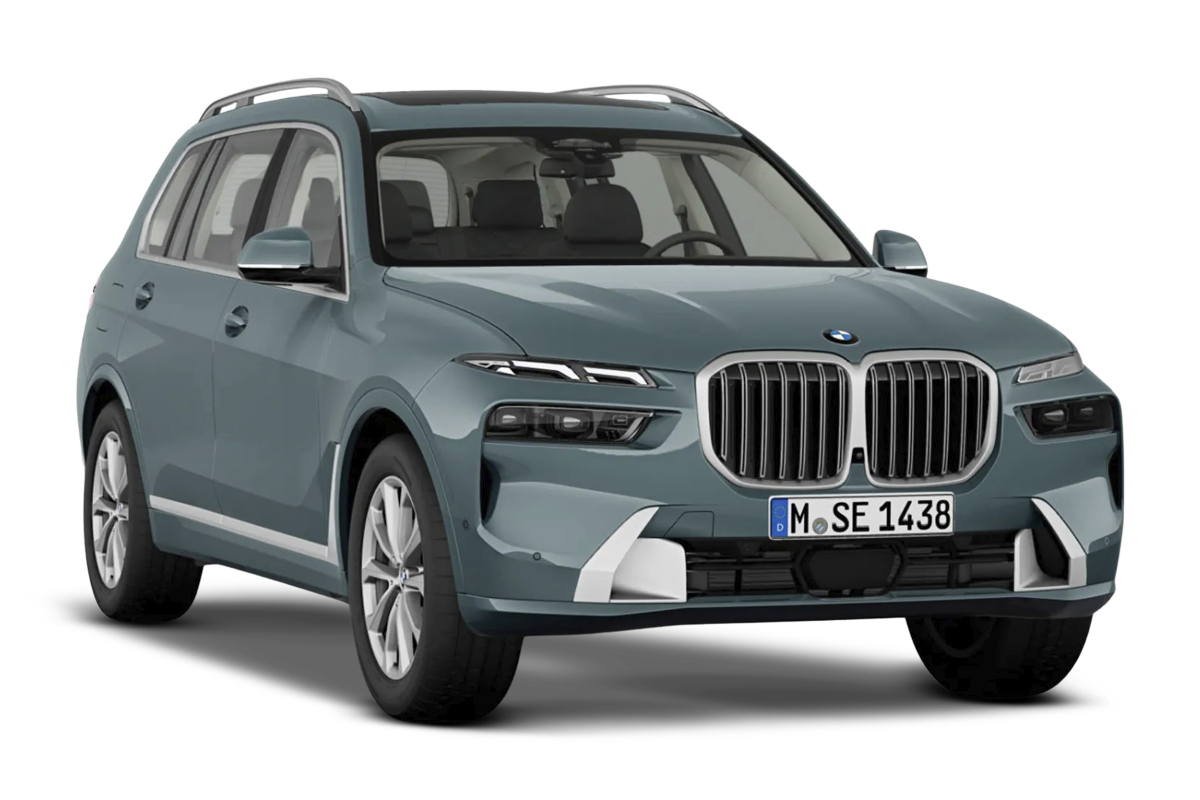
This is a big, heavy car, and it doesn't feel as light on its toes as a Cayenne or the smaller BMW X5 – even if you go for the M60i. Nevertheless, the X7 is surprisingly agile if you put the standard air suspension in its Sport setting and feels far more gainly than a Land Rover Discovery or Mercedes GLS. Executive Drive Suspension (standard on the M60i) makes the X7 tightens up body control even more, and comes as part of a part that brings rear-wheel steering, aiding manoeuvrability in town.
In common with other big BMWs, the steering is accurate, smooth and reassuringly weighted. You wouldn’t describe the X7 as great fun to drive along a meandering country lane, but then few big SUVs are. The exceptions are the Cayenne and, for even bigger spenders, the Aston Martin DBX – although those alternatives are far less practical.
The X7 is one of the quietest cars we've ever tested, with very little tyre or wind noise, whether you're munching through motorway miles or negotiating urban traffic.
Off-road, the X7 is able to tackle rougher terrain than most buyers will ever need it to. Even so, if you need to go further into the sticks, you’ll want a Land Rover Defender or Range Rover, because those alternatives are more capable in the rough stuff.
“For a huge seven-seat SUV weighing around 2.5 tonnes, I was astonished at how tidily the BMW X7 handles with Executive Drive Suspension fitted.” – Oliver Young, Reviewer

Interior
The interior layout, fit and finish
Strengths
- +Plush interior materials and superb build quality
- +Fantastic driving position
- +Relatively user-friendly infotainment
Weaknesses
- -Fiddly touchscreen climate controls
Every surface you touch inside the BMW X7 screams quality and craftsmanship, and no rival short of the vastly more expensive Bentley Bentayga can compete for build quality.
That said, we can see why you'd prefer the more restrained, conservative design of the Range Rover interior or the more flamboyant look inside the Mercedes GLS.
In terms of dashboard layout, the X7 is similar to the BMW X5, with the same curved 14.9in touchscreen and adjoining 12.3in digital driver's display.
The infotainment system is generally very easy to use, and can be operated using an intuitive rotary controller positioned between the front seats. When you're driving, the latter is less distracting than stabbing away at the touchscreen.
The only slight disappointment is that there are no physical controls for the air-conditioning. Instead, you have to adjust the interior temperature either by using the touchscreen or firing out voice commands. The physical switches in the Porsche Cayenne are much less distracting to use on the move.
Behind the wheel, you’ll find a typically high-set luxury SUV driving position. As standard you get electrically adjustable front seats, which are supremely comfortable and easy to fine-tune. Both front seats are heated, and you can add ventilation and massaging functions if you wish.
While there are no notable flaws when it comes to the X7’s visibility, a car this bulky can present a few manoeuvring challenges. Fortunately, front and rear parking sensors, all-round cameras and a self-parking system come as standard.
“I know the BMW X7's interior doesn't look as flashy as those of some rivals but, objectively speaking, it's impeccably finished.” – Dan Jones, Senior Reviewer

Passenger & boot space
How it copes with people and clutter
Strengths
- +Loads of interior space
- +More spacious third row than rivals
- +Enormous boot
Weaknesses
- -Not a lot
The BMW X7 is simply huge – bigger even than a standard-wheelbase Range Rover – and as a result it has masses of interior space. It’s tall and airy in the front, and so wide that the driver almost feels as though they’re in a different postcode to their front passenger.
There’s also plenty of room for those on the second-row seats to stretch out, and with no shortage of head, leg or shoulder room, even three adults sitting side-by-side here will be relatively comfortable.
The second row has a separate climate-control zone for each side of the car along with heated seats for the outer passengers. The seats can be moved forwards and backwards electrically in a 60/40 split, and the backrest folded down in a 40/20/40 configuration.
Like the Audi Q7 and Mercedes GLS, the X7 has a third row of seats as standard, meaning it can carry up to seven people. These rearmost seats can be raised or lowered electrically.
You can have seven seats in a Range Rover, too, but only if you go for the eye-wateringly expensive long-wheelbase version. And if you do, the third row still isn't as roomy as an X7's – particularly when it comes to head room.
The X7’s third-row seats are also far more spacious than those in a Q7 or Volvo XC90. Even a couple of six-footers will fit comfortably enough. Access to the third row is surprisingly good, too, and you can opt to add a further fifth climate control zone for your rearmost passengers.
As for the boot, the X7 – like the BMW X5 – has a split tailgate, with a lower section that flips out to serve as a handy perch to sit on when taking off muddy wellies. There’s space in the boot for a couple of suitcases, even when all three rows of seats are in use.
In five-seat mode, the boot is simply enormous, although its 750-litre capacity is a bit less than that of the Mercedes GLS. The X7's load bay is positively monstrous when the second-row seats are folded flat, and there are even some handy underfloor storage compartments.
“If you have the budget and simply need as much space as possible, I’d highly recommend the BMW X7.” – Lawrence Cheung, New Cars Editor

Buying & owning
Everyday costs, plus how reliable and safe it is
Strengths
- +Plenty of safety kit
- +Cheaper than a Range Rover
Weaknesses
- -More expensive than many seven-seat SUVs
- -Petrol engines aren't very efficient
- -No PHEV for company car users
If you want a premium-badged SUV that seats seven in comfort, the BMW X7 isn't the cheapest option: an Audi Q7 or Land Rover Discovery will both do the job for less.
Likewise, if you don't need that many seats but like the rest of the X7 package, you might be better off with the cheaper but still excellent BMW X5. However, if you’re looking for maximum space, versatility and luxury, the X7 is untouchable – and a far better buy than the similar-sized Mercedes GLS.
According to official figures, the X7’s fuel economy and CO2 emissions are a close match for those of its key rivals. If you have one eye on keeping your fuel bills down, go for the 40d diesel, which suits the X7 really well while also offering much better fuel economy than either of the petrols.
The X7 isn’t particularly attractive to company car drivers because there’s no plug-in hybrid (PHEV) version to keep BIK tax down. There are PHEV versions of the smaller Q7 and X5
The X7's entry-level Excellence trim comes loaded with kit, including soft-close doors, keyless entry/start, a panoramic glass roof and the air suspension, four-zone climate control and heated front seats that we mentioned earlier.
The M Sport model adds sporty cosmetic touches and upgraded brakes, while M Sport Pro goes one step further and brings a sports exhaust and further styling tweaks.
Meanwhile, the X7 M60i stands as a trim level in its own right, adding a limited-slip differential (LSD) on the rear axle to improve cornering, bespoke styling inside and out and the powerful V8 engine.
Our advice is to go for M Sport trim. It’s only slightly more expensive than Excellence but its extra desirability means it should be worth more when you come to sell, and monthly PCP finance costs aren't much higher.
While the X7 didn’t feature as a model in our 2025 What Car? Reliability Survey, BMW came sixth out of the 30 manufacturers rated. That's higher than premium rivals, including Audi, Mercedes and Land Rover. A three-year, unlimited-mileage warranty is provided as standard.
The X7 hasn't been crash-tested by Euro NCAP but it does come with lots of standard active safety technology, including automatic emergency braking (AEB) and rear cross-traffic alert, which warns you about approaching vehicles when you're backing out onto a road.
“I wouldn’t disagree with anyone who says the BMW X7 is pricey, but you’ll struggle to find anything that matches its range of talents – at any price.” – Will Nightingale, Reviews Editor
Buy one if...
- You want loads of interior space for seven people
- You’re after a big and luxurious car
- You’d like a brilliant mix of power and comfort
Don't buy one if...
- You want a plug-in hybrid
- You're looking for great value for money
For all the latest reviews, advice and new car deals, sign up to the What Car? newsletter here

FAQs
A lot. Indeed, the BMW X7 will cost you more as a cash buy than most of its rivals, including the Audi Q7 and Land Rover Discovery. Check out our BMW X7 deals for the latest prices.
Yes. In fact, the X7 is even bigger than the standard-wheelbase Range Rover. However, with optional four-wheel steering equipped, the X7 is surprisingly easy to drive along tight streets and in multi-storey car parks.
There’s no denying that the X7 is a really big car and it certainly feels it at times. That said, with the four-wheel steering equipped, it’s surprisingly agile at slow speeds, making tight car parks far easier than you’d expect.
While we don’t have specific data for the X7 as a model, BMW claimed sixth out of the 30 manufacturers included in the 2025 What Car? Reliability survey. That's encouraging.
| RRP price range | £93,280 - £118,305 |
|---|---|
| Number of trims (see all) | 2 |
| Number of engines (see all) | 3 |
| Available fuel types (which is best for you?) | petrol hybrid, diesel hybrid, petrol |
| MPG range across all versions | 23.3 - 35.3 |
| Available doors options | 5 |
| Company car tax at 20% (min/max) | £6,578 / £8,297 |
| Company car tax at 40% (min/max) | £13,156 / £16,593 |

