Renault 4 review
Category: Electric car
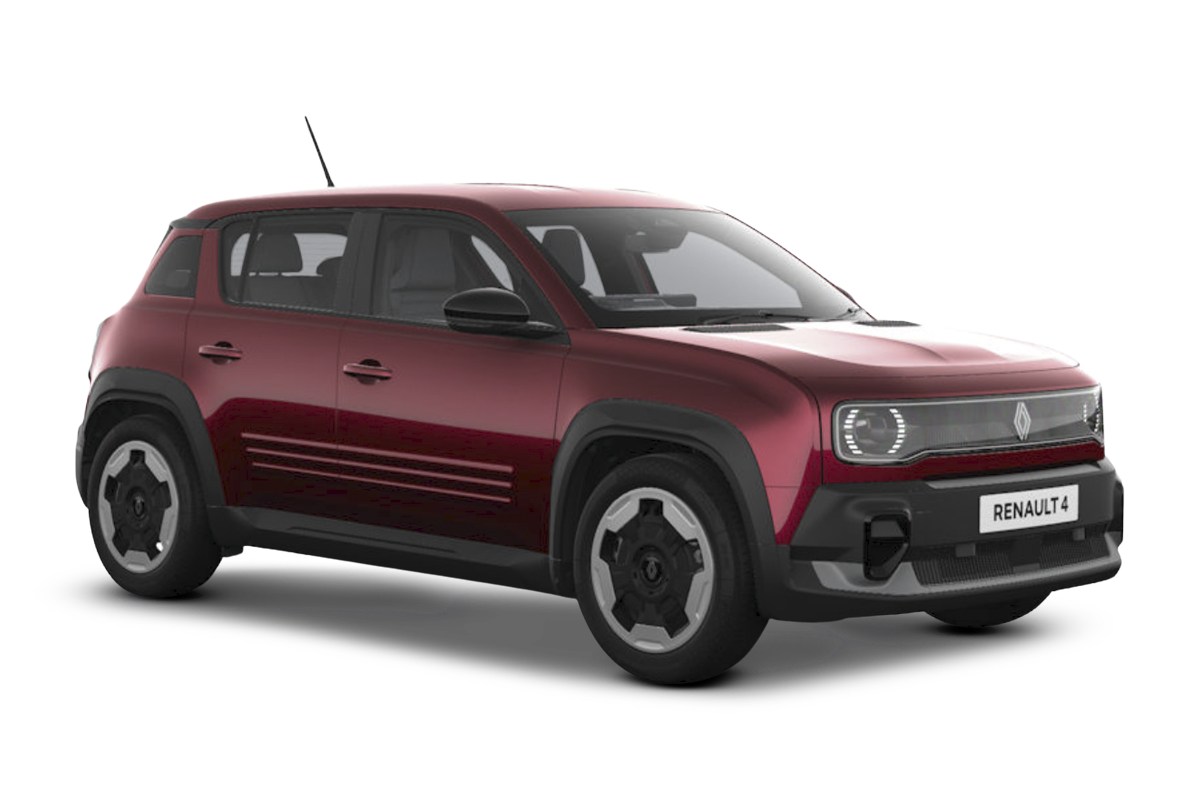
The Renault 4 is a great-value electric SUV that offers excellent refinement, a smart interior and a good range


What Car? says...
Are you a French farmer in the market for a cheap runaround? If you are, and you know your car history, then you might be drawn to this new Renault 4.
You see, the original, 1961 version was a rival to the legendary Citroën 2CV, aiming to provide affordable rural transport, and was such a hit it remained on sale for 30 years. But while the name is back, it's actually on a very different car this time.
Yes, the Renault 4 has morphed into a small electric SUV that shares its underpinnings with the fantastic Renault 5 – our 2025 Car of the Year. Expectations should be high, then, with the promise of the same fantastic qualities as the R5, but in a more practical SUV package. You can even get it with a folding canvas roof, which harks back to the 1960s original, and is aptly named the Renault 4 Plein Sud.
New Renault 4 video review
The Renault 4 isn't short on competitors, though. It’s up against the likes of the BYD Atto 2, Ford Puma Gen-E, Jeep Avenger Electric, Kia EV3, Mini Aceman, Vauxhall Mokka Electric and Volvo EX30. So, how does it compare?

What's new?
- June 2026 – we drive the new Renault 4 Plein Sud for the first time in Barcelona, Spain
- July 2025 – order books open for the Renault 4
- May 2025 – we drive the Renault 4 in Lisbon, Portugal
- October 2024 – Renault 4 revealed at the Paris Motor Show
Performance & drive
What it’s like to drive, and how quiet it is
Strengths
- +Comfortable and well controlled high-speed ride
- +One-pedal driving mode helpful in town
Weaknesses
- -Low-speed ride could be better
- -No regen braking paddles on cheapest trim
- -Occasionally grabby brake pedal response
Every Renault 4 comes with a 148bhp electric motor that drives the front wheels and draws its power from a 52kWh (usable capacity) battery.
The result of all this is an official range of up to 250 miles, depending on trim level, which is down on the 270-mile maximum of the Kia EV3 Standard Range. However, it’s virtually the same as what’s on offer from lots of other rivals, including the Ford Puma Gen-E, Jeep Avenger Electric and Vauxhall Mokka Electric, while beating the BYD Atto 2 (in Boost trim).
In addition, we achieved a 0-60mph time of 8.1sec, which is a little slower than the Atto 2, Puma Gen-E and EV3, but still nippier than a Peugeot e-2008. As a result, while it’s not class leading in performance and range, it’s comfortably competitive.
The Plein Sud model loses a small amount of range due to the addition of its 19kg folding fabric roof, which can open or close at the touch of a button at speeds of up to 55mph. These models can manage 242 miles officially, which is more than the rival Fiat 500e Cabriolet.
The Renault 4 delivers its power in a very smooth manner, although it's not quite as impressive in the way it slows itself down, because the brake pedal response is initially a little grabby.
Fortunately, you can use the regenerative braking system to help out, because there's a one-pedal driving mode that can slow the car to a complete stop when you lift off the accelerator pedal without you having to touch the brakes. It’s a handy system that works intuitively.
As a bonus, all but the entry-level Renault 4 get paddles behind the steering wheel that let you quickly adjust the braking strength, with four levels in total.
All that – as well as a tight turning circle – makes the Renault 4 a breeze to drive in town. Although there's a slight fidgetiness to the ride at low speeds, it’s supple enough to take out the sting from any harsh imperfections with less of a thud than the Atto 2. That said, it's not as comfortable as the EV3.
On the motorway, the Renault 4 remains calmer than the Atto 2 and the Puma, and smothers depressions more easily. What's more, the Renault 4 is very quiet, with a low amount of road and suspension noise. Only a mild amount of wind noise by the front window disturbs the peace.
With the Plein Sud’s fabric roof open, you don’t need to raise your voice to hold a conversation like you do in the 500e Cabriolet. Instead, things are impressively quiet, with very little buffeting thanks to a wind deflector at the front of the roof opening.
As for handling, there's less lean through corners than you get in an Atto 2, Avenger Electric, EV3 or Mokka Electric, and the steering responds consistently enough for you to place the Renault 4 with confidence. There’s also a good level of grip, although, if you're looking for fun, the Puma Gen-E has the edge.
“The range between charges should be fine for lots of buyers, but I think it’s a shame there isn’t the option of an even bigger battery.” – Darren Moss, Deputy Editor

Interior
The interior layout, fit and finish
Strengths
- +Fine driving position
- +Intuitive, feature-packed screen on higher trims
- +Physical air-con controls
Weaknesses
- -More basic infotainment on Evolution trim
- -Low-res image fed by parking camera
- -All-round visibility could be better
While the exterior styling of the reborn Renault 4 was clearly inspired by that of the original, inside it has more in common with today's Renault 5 – and that’s a good thing, because the original R4 was very basic, even by the standards of the day.
By contrast, in the new one, your speed, remaining range and other trip computer information are shown on a digital display, measuring 7.0in in entry-level Evolution+ trim. Meanwhile, Techno+ and Iconic+ versions up that to a 10.1in display, which is bright and configurable with a wide range of layouts on offer.
It’s housed in front of you, alongside the infotainment touchscreen, which is high up towards the centre of the dashboard and angled towards the driver – which makes it easy to see and reach.
The touchscreen measures 10.1in and has Android Auto and Apple CarPlay smartphone mirroring, whichever trim you go for. That said, the entry-level variant misses out on some built-in Google-based Technology (such as Google Maps) that the Techno+ and Iconic+ trims get as standard.
Still, the screen is responsive to inputs and relatively quick to get your head around – it’s certainly better than plenty of other fiddly touchscreens in the class, like the ones you’ll find in the Ford Puma Gen-E and Mini Aceman.
In addition, the climate controls are housed in a row of physical buttons just below the touchscreen. These are fantastically easy to use while driving, and far less distracting than being forced to use the touchscreen for the air-con.
The Plein Sud gets an extra control above your head to operate the roof. We found this easy to use, and timed the operation of opening and closing the roof at 11 seconds in either direction.
As for interior quality, the Renault 4 might be one of the cheapest options in the small electric SUV class – but you wouldn’t guess that from sitting in it.
Nothing feels flimsy or low-rent, and while there are some hard plastics on the dashboard, Renault has included enough plush materials to make it feel classy, particularly on the higher trim levels. True, the Smart #1 and Volvo EX30 are even swisher inside, but they're also more expensive.
Even though the driving position isn’t as commanding as some rivals (such as the BYD Atto 2 and Kia EV3) you still get lots of adjustment in the steering wheel and seat, including lumbar adjustment (manual on most versions; electric on the range-topping Iconic+).
That said, the raked-back windscreen pillars can slightly impede your view to the sides at junctions, and over-the-shoulder visibility is compromised by the relatively small rear screen and rear side windows.
To compensate, rear parking sensors and a rear-view camera both come as standard, even on entry-level Evolution+ trim, while Techno+ and Iconic+ add front and side sensors and hands-free parking. Our only real demerit is that the image fed from the reversing camera to the infotainment screen is a bit low-res.
“The gear selector is a long, wand-like stalk on the right side of the steering column. While this location frees up space between the front seats, on several occasions I pushed the stalk up to switch from drive to reverse (or down for the opposite), only to find that the direction of drive hadn’t changed.” – Steve Huntingford, Editor

Passenger & boot space
How it copes with people and clutter
Strengths
- +Practical boot space
- +Useful underfloor storage
Weaknesses
- -Rear seat space is cramped for adults
- -Big step up to folded rear seats from boot floor
A pair of six footers will have no problem fitting into the front of the Renault, although the BYD Atto 2 and Kia EV3 are even more generous in every dimension for those who are particularly tall.
Storage options aren’t bad, but again, there are better rivals out there. You get a small but deep cubby under the central armrest, a pair of cupholders and a storage tray on the centre console. Even so, the glovebox is quite small and the door bins are minuscule, while rivals, such as the Atto 2 and Ford Puma Gen-E come with a two-tier centre console.
Getting into the rear is harder than it should be, due to the narrow door openings and smaller footwells forcing you to thread your feet through the gap instead of being able to put them in sideways.
Once inside, you'll find knee room is decent, although there isn’t much room to slot your feet under the front seats and head room is disappointing. If you're tall, you'll probably find your head is pressed up against the roof if you try to sit up straight. Bigger rivals, such as the Atto 2, EV3 and Smart #3, are more comfortable for adults in the rear seats.
The middle seat is slightly raised compared with the outer two (both of which get Isofix mounts for child seats), so head room is even more reduced here. This is not a particularly wide car, either, making it a real squeeze for three people sitting side by side. At least the flat floor offers the middle passenger a good amount of foot space.
You can’t slide or recline the rear seats, and the tops of the rear side windows are rather low, meaning adults will need to duck down for a better view of the outside world.
The issue of head room is only exacerbated in the Plein Sud, so taller passengers will find their heads craned slightly.
The Renault 4 scores better for its boot. With 375 litres of storage, it beats what’s on offer in a Jeep Avenger Electric, Smart #1, Vauxhall Mokka Electric and Volvo EX30. We managed to fit six carry-on suitcases below the parcel shelf, which matches the Atto 2 and EV3, while beating the Peugeot e-2008’s ability to take five cases. The Puma Gen-E’s ability to swallow nine cases makes it the class champion, though.
It’s not just the overall boot space that’s good, either; access to it is fantastic thanks to a very wide and tall opening, which is also very low to the ground with virtually no loading lip. It’s the easiest car in the class to lift a suitcase in and out of. Meanwhile, an electrically-powered tailgate is standard with the range-topping Iconic+ trim level.
There’s an additional 36 litres of storage on offer under the boot floor in a removable plastic well, which is a handy spot for the charging cables (there’s no front boot, unfortunately).
For even more space, you can fold down the rear seats very easily from the boot by reaching in and pushing them down after pressing buttons on the tops of the backrests. That does leave a big step up from the boot floor to the flattened seats, though, and there’s no height-adjustable floor to mitigate it. The seats split and fold 60/40, rather than in the more versatile 40/20/40 configuration.
Removing the parcel shelf is a simple process, but there isn’t a specific storage solution to keep it neatly tucked away when not in place.
“The boot is cleverly packaged, and I think it’s great that all its practical features, such as the removable underfloor storage, and the hooks and straps in the load bay, come as standard.” – Darren Moss, Deputy Editor

Buying & owning
Everyday costs, plus how reliable and safe it is
Strengths
- +Tempting pricing
- +Generous equipment levels
- +Renault has a good reliability record
Weaknesses
- -Warranty is nothing special
If you’re buying outright, the Renault 4 manages to undercut the vast majority of its electric SUV rivals, including the BYD Atto 2, Ford Puma Gen-E, Jeep Avenger Electric and Kia EV3.
At the same time, equipment mostly mirrors that of the Renault 5, so even entry-level Evolution+ trim gives you climate control, cruise control, automatic lights and wipers, keyless entry and an EV heat pump for more efficient warming of the interior in cooler weather. A vehicle-to-load function (V2L) is available as an optional extra, allowing you to power external electrical devices using the car’s battery.
Techno+ adds the Google-based infotainment system, wireless phone charging and adaptive cruise control, while the most expensive Iconic+ trim brings a different alloy wheel design, a heated steering wheel and heated front seats.
The Plein Sud costs £1500 more than the regular car, but is only available in Techno+ and Iconic+ trims.
When it comes to topping up the battery, you can get from 10-80% in ideal conditions in around half an hour from a 100kW charger, which is pretty standard for the class. A 7kW home EV charger can top up the battery from flat to full in just under eight hours.
It’s too early to have any specific reliability data for the Renault 4, but Renault finished in 20th place out of the 30 brands in the 2025 What Car? Reliability Survey. That’s not a brilliant showing, with Vauxhall and Kia ranking higher. Even so, it’s still better than Volvo and Ford.
Every version of the car gets a three-year, 100,000-mile warranty on most components, which is a long way off the fantastic seven-year cover offered by Kia. The main battery has the industry-standard eight years of cover, though.
The Renault 4’s safety equipment also mirrors that of the Renault 5. That means automatic emergency braking (AEB), a driver attention monitor and lane-keeping assistance come as standard, with Iconic+ trim adding blind-spot monitoring. Both cars were awarded four stars out of five for safety when they were tested by Euro NCAP. It generally performed well but better protection for the driver and rear passenger’s chest would have helped towards achieving the maximum five-star rating.
“Most of the Renault 4’s optional extras are 3D printed cosmetic upgrades for the interior, which I find quite cool. But I’m more excited for the electronically-folding canvas roof that’ll be added to the list in the future.” - Dan Jones, Senior Reviewer
Buy it if...
- You want a something that has user-friendly tech
- A smart interior that doesn’t feel like a budget option
- You need a usable boot
Don’t buy it if…
- You regularly carry people in the rear seats
- You frequently travel far and need a long range
- You want punchy straight-line acceleration
For all the latest reviews, advice and new car deals, sign up to the What Car? newsletter here

FAQs
As a cash purchase, the R4 will cost you less than pretty much all of its rivals and, thanks to the Government EV grant, has a temptingly low price tag.
Yes, it’s very good. It’s agile, comfortable and will have enough range for most people. Its only real issue is a lack of rear space, with the BYD Atto 2, Kia EV3 and Smart #3 featuring more room for adults.
While the Renault 4 is a great car, it’s hard to ignore that the Renault 5 is cheaper while still offering an almost identical package - even interior space is around the same.
The R4 has four-levels of regenerative braking, including a one-pedal driving mode. You control them with paddles that sit behind the steering wheel.
| RRP price range | £27,195 - £33,195 |
|---|---|
| Number of trims (see all) | 3 |
| Number of engines (see all) | 1 |
| Available fuel types (which is best for you?) | electric |
| MPG range across all versions | 0 - 0 |
| Available doors options | 5 |
| Company car tax at 20% (min/max) | £54 / £62 |
| Company car tax at 40% (min/max) | £108 / £124 |

