Nissan Townstar review
Category: Small Van
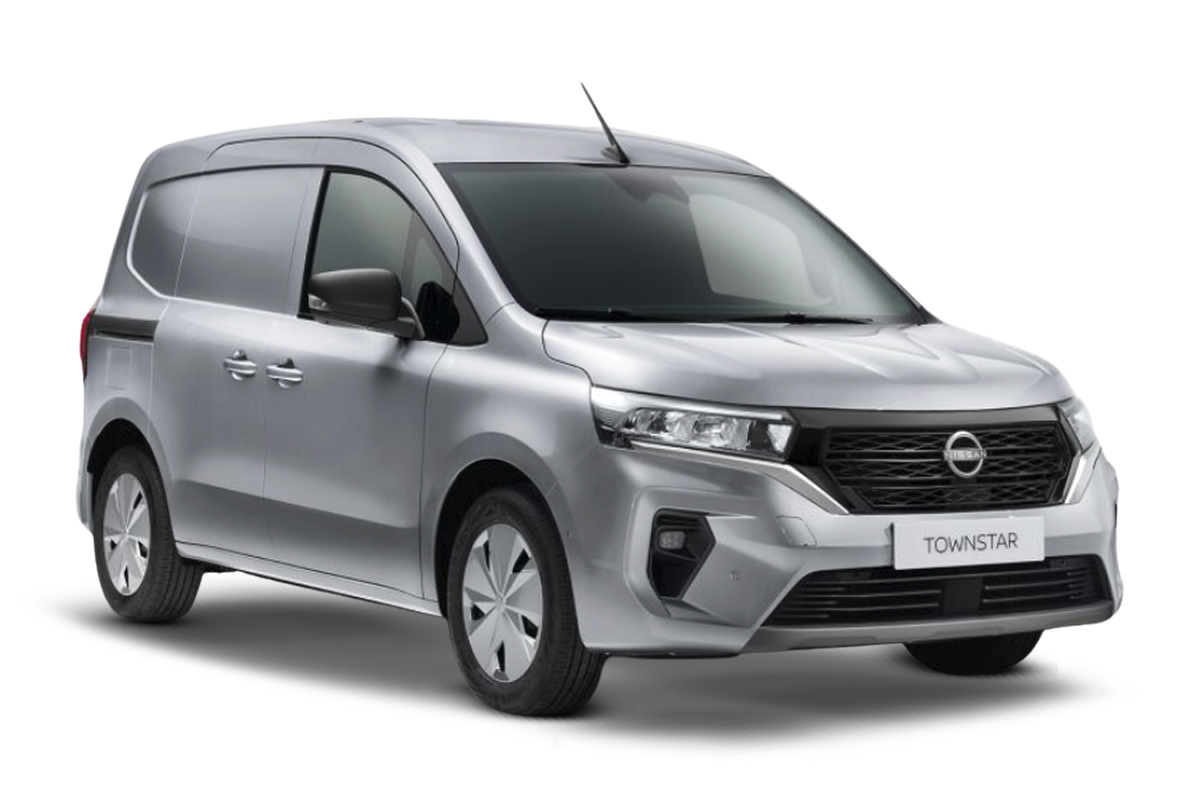
The Nissan Townstar is a small van with a big payload and lengthy warranty


What Car? says...
The Nissan Townstar will be appreciated by anybody who’s ever been driven nauseous in work training sessions by the phrase “teamwork makes the dream work”. It’s apposite here, though, because the Townstar was developed in conjunction with the Mercedes Citan and Renault Kangoo, and it shares much of those vans’ star quality.
Unfortunately for the Townstar, though, those two models are rivals as well as siblings, and the Kangoo has the advantage of having a very well-known name. In other regards, though, there seems little to separate them. Both offer lots of load space despite relatively compact overall dimensions, and both are generously equipped given their reasonable price tags. The Townstar is definitely a value for money small van.
Of course, as well as the Citan and Kangoo, the Townstar has to fend off a long list of rivals, including the Citroën Berlingo Van and Vauxhall Combo, as well as the Ford Transit Connect and its Volkswagen Caddy Cargo sister. There’s also the fully-electric Nissan Townstar EV, which we’ve reviewed separately.

In this review, we'll tell you how the Townstar's performance compares to those rivals, and which version we recommend.
Read more: How we test vans
Performance & drive
What it’s like to drive, and how quiet it is
Strengths
- +The sole engine option has plenty of power
- +Steering and clutch are nicely weighted
- +Ride is well controlled by small van standards
Weaknesses
- -No diesel power option
- -You’ll need to shift down on motorway inclines
Other than the fully electric Nissan Townstar EV, the Nissan Townstar shares its sole engine option with the Renault Kangoo – the 1.3-litre TCe 130 petrol.
So far, we’ve tried the TCe 130 only in the longer L2 version of the Townstar. It produces 128bhp and has a surprising amount of pulling power at relatively low revs, so you can make good progress around town without revving the engine out.
You’ll need to wind it up a bit more to accelerate to motorway speeds; Nissan quotes 0-60mph in 13.1sec for the L2 and 11.8sec for the smaller L1. Once up to speed, we found the L2 happy to sit at the national speed limit. You’ll need to drop a gear or to escape from being caught behind a slower vehicle, though; or if you encounter an ascent when the van has a bit of freight on board.
The engine does boom a bit when pushed hard, but it’s pretty subdued at motorway speeds. In fact, noise levels are very modest all round; the tyres only become vocal on rough concrete surfaces and wind noise is far from intrusive. The Townstar is quieter than the Volkswagen Caddy Cargo, and the radio easily cuts through the hubbub.
The Townstar isn’t quite as sharp around corners as the Caddy or its Ford Transit Connect twin; those two also have tighter body control and lean less in bends. The Townstar is far from untidy, though; rural delivery work can be tackled with confidence. In fact, the steering is more pleasingly weighted than it is in some family SUVs. The Townstar is also generally comfier than the Transit Connect or Caddy, courtesy of its softer suspension set-up.
So far, we’ve tested only the slick six-speed manual gearbox, which has a quick, precise action and a selector placed just a hand’s span from the steering wheel. An automatic gearbox option is also offered.
“Although you have to work the engine quite hard to get the most out of it, that’s made a pleasure by the slick gearbox and progressive, nicely weighted clutch.” – Chris Haining, Sub-editor

Interior
The interior layout, fit and finish
Strengths
- +Well-designed dashboard with conventional controls
- +Supportive, comfortable driving seat
- +Lots of charging sockets at hand
Weaknesses
- -Very long-legged folk will feel cramped
- -Materials are more robust than they are plush
- -Infotainment system can be flaky
Inside, the layout of the Townstar is virtually identical to that of the Mercedes Citan and Renault Kangoo, and that means a supportive driving seat with height adjustment, lots of steering wheel adjustment (reach and rake) and a driving position that lines the seat, pedals and steering wheel up neatly. Our six-foot-five road tester found leg room a little cramped, though; the seat’s rearward travel is limited by the cargo bulkhead.
None of the interior materials are what you’d call plush (the Citan makes use of more upmarket materials inside), but nothing feels flimsy. The physical climate control dials are a welcome touch, too; they make quick temperature adjustment the work of an instant, they feel good to use and they’re chunky enough to operate with gloves on.
There are also easy-to-use buttons on the steering wheel for cruise control and, on Tekna models, to change what’s displayed on the right hand side of the 7.0in digital instrument cluster.
All models get a touchscreen infotainment system. Its 8.0in screen is of a lower resolution than is typical in family cars these days, and the graphics aren’t especially crisp. The menus are relatively intuitive to find your way around, but there can be a lag between entering a command and anything happening. The Bluetooth phone connection on our test van was a bit flakey, too, with audio drop-out and a refusal to disconnect when asked to. The wireless Android Auto connection worked well, though, and there’s also Apple CarPlay.
Hidden behind the steering wheel, there’s a handy remote-control for volume and other media functions. Tekna trim adds sat nav, as well as a smartphone holder with a choice of two anchoring points; this doesn’t incorporate wireless charging, but there are two USB-A sockets and a 12V socket very close to it.
“Although most of the interior surfaces are made from hard, dark-coloured plastic, the Townstar seems anything but cheap and dowdy inside. On the contrary, it feels like it’s ready for business.” – Chris Haining, Sub-editor

Passenger & boot space
How it copes with people and clutter
Strengths
- +Oodles of well-designed interior storage
- +Wide sliding side door apertures on L2 models
- +Load area is well illuminated at night
Weaknesses
- -Rear doors don’t open 270deg
- -Glovebox is very small
The Nissan Townstar is significantly more spacious inside than its predecessor, the Nissan NV250. That model was based on the previous-generation Renault Kangoo, which was a smaller van than the latest Kangoo, and of course the Townstar. From behind the steering wheel, that feels most apparent in the generous elbow room.
There’s no shortage of storage up front, either. The door pockets will each take a 1.0-litre drinks bottle with room left over for snacks, there are two moulded-in cup holders between the seats, big enough for a large drive-through drink, and there’s a deep lidded cubby that doubles as a centre arm rest.
There’s also a rubberised tray below the gearstick, with a 12V socket adjacent, and a further rubberised tray atop the dashboard, this being big enough to take an A4 notepad or clipboard, while a tray below the air-con controls makes a good place for pens or pencils. Immediately ahead of the driver, meanwhile, is a lidded, carpeted compartment that, with two USB-A sockets and a 12V socket, is ideal for charging mobile phones.
Tekna models and above provide a smartphone holder that can be positioned on one or the other side of this compartment. The glovebox isn’t huge, though; it’s largely filled by the owner’s manual.
Finally, there’s a capacious shelf above the windscreen; this bears twin interior lamps beneath, with room for books, maps or other documentation above.
The load compartment of the L1 van measures 3.3m3, the long-wheelbase L2 grows to 4.3m3. Unsurprisingly, that’s a match for the corresponding versions of the Kangoo, and is among the most capacious in the small van class. The loadbay has two, bright, switchable LED floodlights and a 12V socket. Plastic mouldings clad the bulkhead and lower sidewalls, and our test van had well-fitted optional ply lining to the floor and upper side walls. There are eight sturdy load tie-down points, too.
L2 models have sliding side doors that provide an opening of 720mm at the narrowest point, where the bulkhead intrudes. The asymmetrical rear doors (that on the nearside being the widest) open through 90deg, after which releasing a catch enables a further 90deg of travel.
The maximum load length of L1 vans is 1810mm measured at the floor; L2 takes this to 2230mm. The maximum width is 1540mm, or 1248mm between the wheelarches. L2 models offer only a modest increase in maximum payload over L1, though; 763kg vs 725kg.
“The lidded compartment above the instrument cluster is a really thoughtful touch, giving you somewhere to charge devices while hiding them away, and providing a power source for the adjacent smartphone holder.” – Chris Haining, Sub-editor

Buying & owning
Everyday costs, plus how reliable and safe it is
Strengths
- +Petrol engine is fairly economical
- +List price is lower than diesel-engined rivals’
- +Five year warranty is long for the class
Weaknesses
- -Nissan’s reliability record is mediocre
The Nissan Townstar is a big improvement over the NV250 that went before, and it’s very well priced among small vans. It’s fairly economical, too; cruising at the speed limit on a motorway run, the on-board computer suggests 40mpg is realistic, and that’s not far from the 40.9mpg official figure.
There are three trim levels to choose from, and even entry-level Accenta gives you such niceties as automatic dual-zone air conditioning, automatic LED headlamps (and auto wipers), cruise control, rear parking sensors and the infotainment system mentioned earlier.
With such a lot of standard kit, Accenta offers the best value of the line-up, but Tekna could be worth stepping up to if its extra features appeal. It adds sat-nav and a rear-view camera, keyless entry and start, and parking sensors at the front and on the side. Whether Tekna+ trim is worth the extra is more debatable; we like the extra safety kit it brings, including blind-spot assistance and an automated parking feature, but we’re less bothered about the alloy wheels and gloss-black exterior mirrors.
While the entry-level Townstar Acenta L1 is a touch pricier than the cheapest Kangoo, it also trumps that model on standard kit. You also get a five-year, 100,000-mile warranty (the Kangoo gives you three years and the same mileage limit). Also, bear in mind that the long-wheelbase Kangoo Maxi is offered only with diesel power, putting the price up over the equivalent Townstar. The Ford Transit Connect and Volkswagen Caddy Cargo are pricier still, as is the posher but fundamentally similar Mercedes-Benz Citan.
If you’re after a diesel engine, you’re out of luck. However, for many operators, the lower price of petrol makes the latter fuel attractive, and petrol power gives the Townstar’s a pretty tidy asking price. Its five-year warranty is longer than most rivals’, too – including the Renault Kangoo.” – Chris Haining, Sub-editor
Buy it if...
- You need a van with a spacious load area
- A comfortable ride at motorway speeds is important to you
- You prioritise a lengthy list of standard kit
Don't buy it if...
- You want a diesel-powered small van
- You prefer a van that's entertaining to drive
- An up-to-the-minute infotainment system is a priority
For all the latest reviews, advice and new car deals, sign up to the What Car? newsletter here

FAQs
Not exactly the same, but they are related: the Nissan Townstar was developed in partnership with Renault in partnership with Mercedes-Benz, so it shares parts with the Mercedes-Benz Citan and the Nissan Townstar.
The Townstar is a small van, but the vehicle it’s based on – the Renault Kangoo – was previously sold as a van and as an MPV. Rivals Citroën and Peugeot sell van-based MPVs such as the Berlingo and Partner, but Nissan isn’t following suit.
The Townstar L1 is 4488mm long, 2159mm wide (including the door mirrors) and 1864mm tall. It has a maximum load volume of 3.3 cubic metres and a maximum payload of 725kg. The L2 version takes overall length to 4910mm, increases the load volume to 4.4 cubic metres and lifts maximum payload to 763kg.
There is; the Nissan Townstar EV, which we’ve reviewed separately, is virtually identical to the petrol-engined version from the outside but offers the efficiency and quietness of electric power.
While we don’t have any reliability statistics for the Nissan Townstar itself, Nissan as a brand finished in 29th place – out of 30 brands in the most recent What Car? Reliability Survey. Bear in mind, though, that the Townstar is a mechanical twin to the Renault Kangoo, and that brand finished in 20th place – ahead of 22nd-place Mercedes-Benz, and beating Ford Volkswagen (which shared 24th place).

