BYD Atto 3 Evo review
Category: Electric car
The Atto 3 Evo is an electric SUV with plenty of power and a long list of standard kit


What Car? says...
You’d be forgiven for thinking the BYD Atto 3 Evo is just a light facelift of a car launched back in 2023, but appearances can be deceiving. This is, in fact, a very different car. It’s been massively overhauled to fix some of the biggest weaknesses of the original Atto 3.
That was the car that introduced Chinese brand BYD – now the world’s biggest electric car maker – to the UK. However, the original Atto 3 was always let down by slow charging and sloppy handling, and its range between charges wasn’t that great, either. In short, it was closer to the bottom of the class than the top.
BYD Atto 3 Evo video review:
So, has this highly “evolved” (hence the ‘Evo’ in its name) version of the Atto 3 got what it takes to compete with the best electric family SUVs, including the Renault Scenic, Skoda Elroq and Smart #5?
Read more: Complete the What Car? Reliability Survey now and you could win a prize
What’s New?
- April 2026: Atto 3 Evo driven in the UK
- February 2026: Atto 3 Evo debuts. Rear-wheel drive and four-wheel drive options, better performance, larger boot, longer range from new 74.8kWh (usable capacity) battery

- March 2023: Atto 3 debuts in UK, orders open, first deliveries made. An electric SUV with a 60.48kWh battery and 201bhp motor, there are Active, Comfort and Design trims, all with a heat pump as standard
- October 2022: Atto 3 achieves five-star Euro NCAP rating, with 91% for adult occupant protection
Performance & drive
What it’s like to drive, and how quiet it is
Strengths
- +Rapid acceleration, even in the entry-level model
- +Respectable range
- +Fast charging
Weaknesses
- -Steering feels remote and disconnected
- -Ride isn't as settled or comfortable as key rivals
- -Noticeable wind and tyre noise at higher speeds
How fast is it and which motor is best?
Perhaps the biggest change from the old Atto 3 is the switch from front to rear-wheel drive. What’s more, it has a more powerful electric motor now, producing 309bhp (instead of the previous 201bhp).
The Atto 3 Evo is genuinely quick – much more so than a Renault Scenic, Skoda Elroq 85 or Smart #5 Pro+ – and we’re just talking about the entry-level Design version.
There’s also the Excellence, which has two motors, four-wheel-drive and an impressive 443bhp. It’s very sprightly, even if it doesn't kick you in the back with the same force as a Tesla Model Y Performance.
Version | 0-62mph | Top speed |
Design (RWD) | 5.5sec | 112mph |
Excellence (AWD) | 3.9sec | 124mph |
Is it agile and is the ride comfortable?
The Atto 3 was never an agile or fun-to-drive choice, and this Evo follow-up still isn’t – regardless of whichever version you choose. The Skoda Elroq feels much more alert and composed when making quick changes of direction, and it’s more accurate, feelsome steering gives you a better sense of connection with the front wheels.
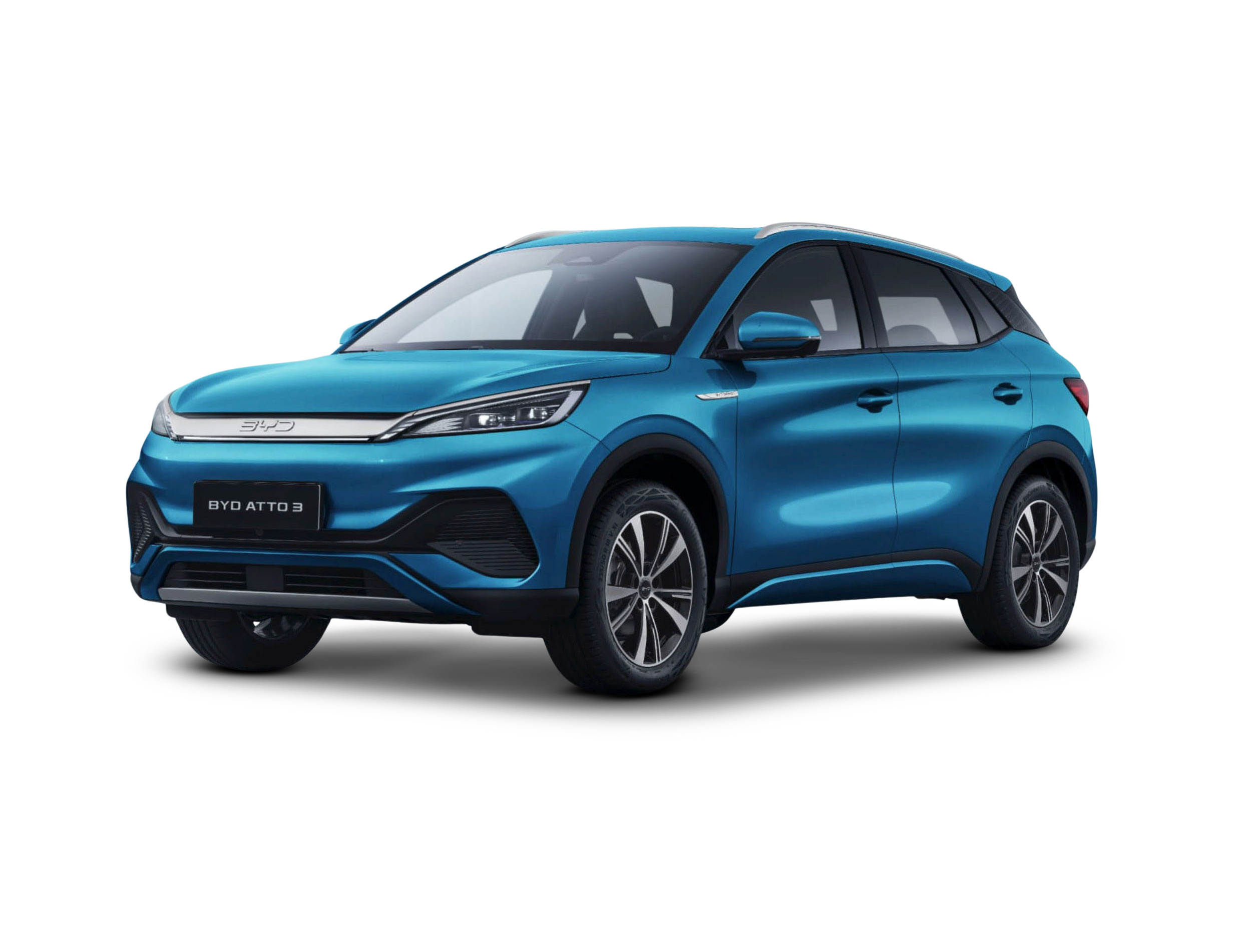
Unremarkable handling wouldn’t be such an issue is the payoff was a smooth ride, as is the case with the slightly pricier Smart #5. Sadly, while the ride is never outright harsh, the Atto 3 Evo struggles to iron out bumps in the road as well as many alternatives, including the #5, Elroq and Renault Scenic. Over uneven surfaces, you’ll experience some noticeable head toss.
Is it quiet and how easy is it to drive smoothly?
You’ll find the Atto 3 Evo easy to drive smoothly, thanks to its predictable response to accelerator inputs. That’s especially true when you’re in the Normal or Eco driving mode; switching to Sport sharpens up the accelerator response but not to the point you’ll find it tricky to build speed smoothly.
It’s a similar story with the brake pedal, which makes it easy to slow down smoothly. That isn’t a given in an electric car because the regenerative braking system often makes the pedal feel spongy and unpredictable. That’s certainly the case in the Renault Scenic.
Sadly, refinement in the Atto 3 Evo is less impressive. At faster speeds, you can hear a noticeable amount of wind noise around the windscreen pillars, plus there’s a rumble as the tyres slap away at the road surface.
What’s the range and efficiency like, and how quickly can it charge?
The Atto 3 Evo has a 74.8kWh (usable capacity) battery, and its official range is 316 miles. That isn’t as far as a Renault Scenic (381 miles) or Skoda Elroq 85 (up to 355 miles), but it should still be enough for most buyers. Plus, every Atto 3 Evo gets a heat pump to help maintain range during winter.
Version | Official (WLTP) range | Real-world range (est.) |
Design | 316 miles | 200-280 miles |
Excellence | 292 miles | 185-265 miles |
You could also argue that the Atto 3 Evo’s fast charging helps make up for its unspectacular range, though. It can pull a peak of 220kW from the grid – far more than a Scenic, Elroq or entry-level Pro version of the Smart #5 – and means you can charge from 10-80% in as little as 25 minutes.
Version | Peak charging rate | Minimum 10-80% charge time |
Design | 220kW | 25min |
Excellence | 220kW | 25min |
The charging port has also been (sensibly) moved from the front wing to the rear quarter panel, making it easier to use many public charging points.
“The tabloid stories about EVs catching fire are wildly overexaggerated, but the lithium-iron-phosphate (LFP) chemistry of the Atto 3’s battery makes it even safer. It also means it should degrade at a slower rate over time, particularly if you regularly charge to 100%.” – Will Nightingale, Reviews editor

Interior
The interior layout, fit and finish
Strengths
- +Lofty driving position
- +Electric seats and lumbar support are standard
- +Huge 15.6in screen features built-in Google tech
Weaknesses
- -Steering wheel rim can block driver display
- -Native voice assistant is quite limited
What does the interior look like and is it well made?
When the Atto 3 first arrived in 2023, it had a curious-looking interior that was heavily inspired by gyms. That’s been toned down slightly over the years, but the central air vents are still supposed to look like weight plates and the door handles like dumbbells.
The interior feels pretty well screwed together. True, it isn’t as solid or plush-feeling inside as a Smart #5, but that’s a slightly more expensive car – especially if you’re buying a really upmarket Premium or Pulse version. Overall quality in the Atto 3 Evo is roughly on a par with Renault Scenic and Skoda Elroq.
Is the driving position comfortable and is it easy to see out?
You sit slightly higher up than you do in a Skoda Elroq, and that gives you a commanding view straight down the road. It's just a pity the windscreen pillars block a fair amount of your view at junctions and roundabouts.
To help with parking, all versions come with front and rear parking sensors and a 360-deg surround view camera.
The driver’s seat doesn’t have a huge amount of side support, but it’s otherwise comfy and has fully electric adjustment, even if you go for the entry-level Design version. There’s adjustable lumbar support, too.
The 8.8in digital display behind the steering wheel puts plenty of information in front of you. If you’re tall, however, you might find the upper section of it blocked by the rim of the steering wheel – unless you raise the steering wheel to an unnatural-feeling position.
Are the dashboard and infotainment system easy to use?
When the Atto 3 first arrived on the scene, it had a rotating touchscreen infotainment system. You would press an icon and the whole display spun itself from portrait to landscape orientation (and vice-versa). It was a fun and quirky feature, but it was never particularly useful – so it’s no great loss that it’s been dropped.
The screen still measures a whopping 15.6in and the operating system is fairly logical and easy to get to grips with. What’s more, it has built-in Google Maps and Google voice assistant, which is a good thing because BYD’s proprietary voice control function is limited in its functionality.
Apple CarPlay and Android Auto smartphone mirroring also come as standard, as does a wireless phone charging pad. So, overall the Atto 3 Evo has a better infotainment system than the Smart #5, although it’s not quite as user-friendly as the one in a Renault Scenic.
You have to use the touchscreen (or voice control) to control the air-conditioning, which isn’t ideal; we’d rather have physical knobs and buttons. However, you can swipe three fingers across or down the screen to tweak the temperature or fan speed. That’s easier than prodding away at small icons while you’re driving.
“I found the seats in the old Atto 3 lacking in lower back support. Thankfully the adjustable lumbar support in the new Atto 3 Evo fixes this issue.” – Will Nightingale, Reviews editor

Passenger & boot space
How it copes with people and clutter
Strengths
- +Large main boot
- +Big front boot
- +Rear seatbacks can be reclined (slightly)
Weaknesses
- -Rivals offer more rear space
- -No height-adjustable boot floor
- -Big load lip at the boot entrance
How much space does it have for people?
The Atto 3 Evo is roughly the same size as its two main rivals, the Renault Scenic and Skoda Elroq. However, it has less rear leg and head room than both of those cars, let alone the larger Smart #5.
That doesn’t mean adults will struggle to fit in the back, but a six-footer won’t have a huge amount of space to stretch out – particularly if someone similarly lofty is sitting in front of them. Foot space is also tight by class standards, although the completely flat rear floor avoids a middle rear passenger having to straddle an annoying hump.
The rear seats don’t slide back and forth. However, the seatbacks can be reclined by a very small amount – a feature that’s offered in the #5 but not the Elroq or Scenic.
Occupants in the front will find plenty of space in all directions, and the “floating” centre console arrangement offers plenty of storage for your odds and ends. The door bins (front and rear) even have mock guitar strings stretched across them to stop taller bottles from falling out. If your kids are bored on a long journey, expect them to pluck annoyingly out-of-tune basslines for hours on end.
How much room does it have for luggage?
Because the battery cells are now integrated into the chassis, the boot floor has been lowered, increasing the capacity by around 10% compared with the old Atto 3. That means there’s more space for luggage (below the parcel shelf) than in a Skoda Elroq, if not quite as much as in a Renault Scenic.
The lower floor does mean there’s a fairly big lip at the boot entrance, plus a step in the floor of the extended load bay when the 60/40 split-folding rear seats are dropped. It’s a shame there’s no height adjustable boot floor to solve these issues, but there is a reasonable amount of stowage under the floor for the charging cables.
Trim level | Boot space |
BYD Atto 3 Evo | 490 litres (rear) + 95 litres (front) |
Even better is the big 95-litre front boot under the bonnet. This boosts overall luggage capacity beyond the Scenic’s, although the larger Smart #5 will allow you to take even more on your annual family holiday.
“There’s no doubt the boot is impressively roomy. We managed to lug mountains of camera gear around while testing the Atto 3 Evo on the international launch in Madrid” – Will Nightingale, Reviews editor

Buying & owning
Everyday costs, plus how reliable and safe it is
Strengths
- +Loads of standard equipment
- +Six-year warranty
Weaknesses
- -Starting prices are higher than key rivals
- -Doesn't qualify for a Government EV grant
- -Relatively unknown reliability
How much does it cost and what equipment do you get?
The Atto 3 Evo has a higher starting price than the Renault Scenic and Skoda Elroq, especially when you factor in the Government EV grant that both of those alternatives are available with.
However, there are some mitigating factors. Firstly, the Elroq is available with a choice of battery sizes and the smallest has a relatively short range of around 265 miles. Second, the entry versions of the Elroq and Scenic come with significantly less standard kit than the Atto 3 Evo.
Indeed, even the cheaper Design version has 18in alloys, adaptive cruise control, electrically adjustable and heated front seats, ambient interior lighting, vehicle to load (V2L), and a heat pump for more efficient warming and cooling of the interior. That’s on top of all the visibility aids we mentioned earlier.
Upgrading to the ridiculously powerful Excellence adds a head-up display that projects key information onto the windscreen in front of you, heated rear seats and a panoramic sunroof with an electric blind.
Is it reliable, and how long is the warranty?
Like other fully electric BYD models, the Atto 3 Evo comes with six-year, 93,750-mile warranty as standard on most components. Meanwhile, the battery is covered by a longer eight-year warranty (capped at 155,350 miles), guaranteeing a minimum of 70% of its original capacity during that period. Oh, and if you’re wondering why the mileages aren’t nice round numbers, it’s because they’re conversions from kilometres.
Sadly, we can’t tell you how likely it is you’ll need to call on that warranty because not enough BYD owners responded to the 2025 What Car? Reliability Survey to meet our minimum sample sizes. Expect that to change in the next year or two, though, as more BYD cars hit the UK roads.
How safe is it, and is it easy to steal?
The original Atto 3 was awarded a five-star overall Euro NCAP safety rating back in 2022, shortly before its UK launch. That’s encouraging, especially given the high level of crash protection it was found to offer kids sitting in the back. It scored even better marks than the Renault Scenic in this area.
However, Euro NCAP’s testing protocol has become tougher in the past few years, making the Atto 3’s scores hard to compare with newer models, including the Skoda Elroq and Smart #5. Plus the Atto 3 Evo has a heavier battery and a different layout than the original Atto 3.
To help you avoid an accident in the first place, all versions of the Atto 3 Evo come with automatic emergency braking (AEB), front and rear Cross traffic alert, blindspot monitoring and traffic sign recognition.
The Atto 3 Evo also has plenty of anti-theft features. To prevent key cloning, it comes with an encrypted NFC key card and smartphone access. There’s a digital ‘engine’ immobiliser that prevents hotwiring. Additionally, integrated GPS enables live tracking via the BYD app and a 360-degree camera system monitors the vehicle's perimeter when parked.
“BYD claims the new “Cell-to-body” construction has improved crash protection over the original Atto 3. I hope we see a Euro NCAP test result soon to verify this.” – Will Nightingale, Reviews editor
Buy it if…
- You want loads of standard kit
- You need to carry lots of luggage
- You’ll regularly take advantage of the fast charging capability
Don’t buy it if…
- You want the cheapest entry price for a family electric SUV
- You want a car that’s enjoyable to drive
- You want super-quiet cruising manners
For all the latest reviews, advice and new car deals, sign up to the What Car? newsletter here

FAQs
It can pull a peak of 220kW from a rapid charger which, in ideal conditions, is enough to take the battery from 10% to 80% in just 25 minutes.
Not anymore. The Atto 3 was originally front-wheel drive, but BYD switched to rear-wheel drive when launching the heavily updated Atto 3 Evo. The top-spec version features dual motors and four-wheel drive.
Yes. Unlike the original Atto 3, the latest Evo version has a front boot or “frunk” – and a big one at that.
| RRP price range | £37,730 - £39,730 |
|---|---|
| Number of trims (see all) | 2 |
| Number of engines (see all) | 1 |
| Available fuel types (which is best for you?) | electric |
| MPG range across all versions | 0 - 0 |
| Available doors options | 5 |
| Company car tax at 20% (min/max) | £75 / £79 |
| Company car tax at 40% (min/max) | £151 / £159 |

