Isuzu D-Max Commercial review
Category: Pick-up
The Isuzu D-Max Commercial is a two-seater pickup with financial advantages for businesses


What Car? says...
The double-cab pick-up market was thrown into turmoil by changes to tax legislation in April 2025. Under the new HMRC rules, double-cab pick-ups — including the Isuzu D-Max — are treated as cars rather than commercial vehicles, dramatically increasing the tax bill for company drivers and removing some financial advantages for businesses.
Rather than risk buyers switching to big SUVs or vans, Isuzu has taken a pleasingly direct approach with the new Isuzu D-Max Commercial. Based on the range-topping D-Max V-Cross, it is a factory-approved, permanently converted two-seat pick-up designed specifically to meet HMRC’s definition of a commercial vehicle.
Compared with the regular D-Max, the D-Max Commercial’s rear seats have been replaced with a secure, enclosed load area, complete with structural changes that prevent easy re-conversion. As a result, the D-Max Commercial remains a commercial vehicle in HMRC’s eyes while retaining the D-Max’s core strengths. But how does it compare with the best pick up trucks on the market?

Performance & drive
What it’s like to drive, and how quiet it is
Strengths
- +Strong off-road ability with diff lock
- +Stable and predictable handling
- +Automatic gearbox suits towing and low-speed work
Weaknesses
- -Engine is noisy and lacks refinement
- -Modest performance compared with newer rivals
- -Unladen ride can feel firm
The D-Max Commercial uses the same engine as the rest of the Isuzu D-Max range, and that means a familiar mix of strengths and compromises. Power comes from a 1.9-litre four-cylinder diesel engine producing 162bhp and 266lb-ft of torque, paired exclusively with a six-speed automatic gearbox and a selectable four-wheel-drive system.
Those figures look modest, but the D-Max pulls strongly enough at low speeds, especially when unladen. It’s never quiet or smooth, though, with a pronounced diesel clatter at idle that’ll upset the neighbours early in the morning, and under acceleration the engine needs to be worked hard, becoming coarse as revs rise. Compared with the Ford Ranger, it feels distinctly agricultural and a generation behind.
Performance is adequate rather than brisk. Officially, 0-62mph takes around 13.0sec, which feels about right from behind the wheel and is reasonable for a vehicle of this size. Still, the Ranger and Toyota Hilux are quicker off the mark, reaching 62mph in 9.2sec and 10.7sec respectively. The automatic gearbox shifts smoothly (and does a decent job of masking the engine’s lack of refinement), but overtaking requires planning, and the D-Max is happiest when driven at a steady pace rather than pushed.
That said, uniquely amongst UK pick-ups, the D-Max weighs less than 2040kg, which means it’s allowed to travel at 70mph on dual carriageways, while every other pick-up is limited to 60mph. Not that you’ll ever see that, of course.
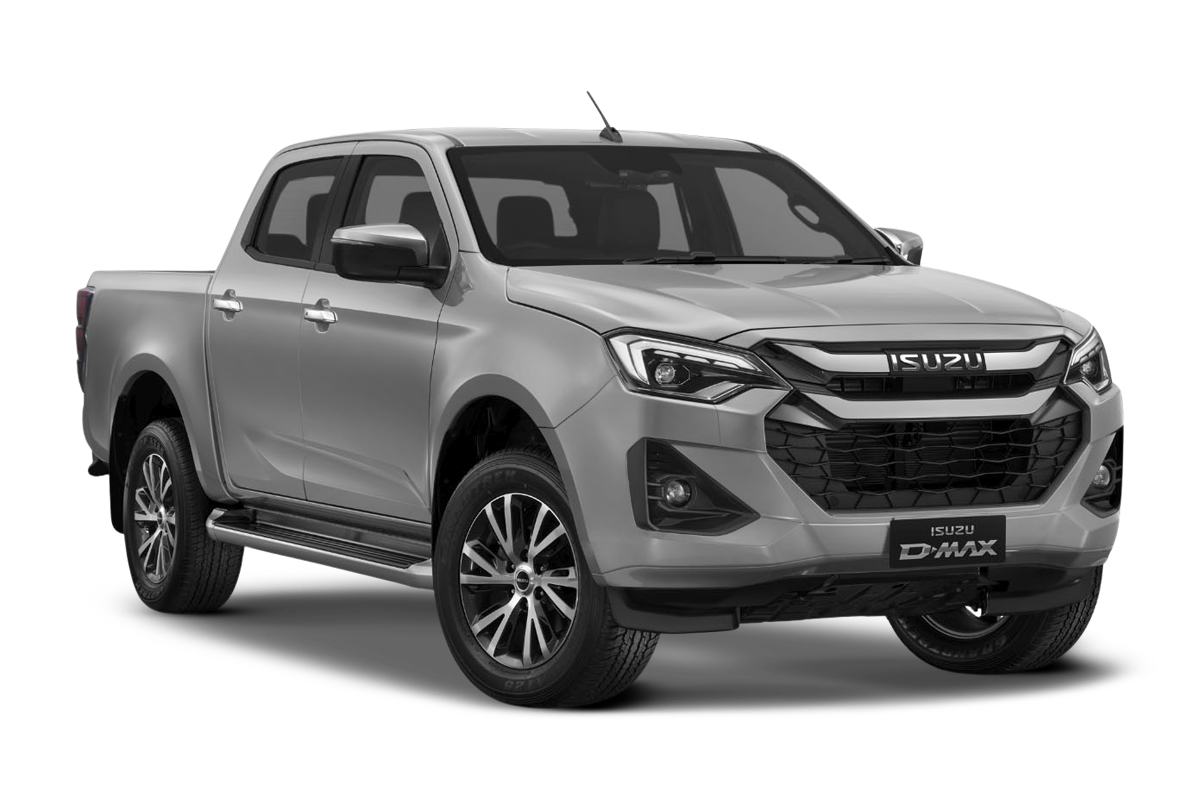
Ride quality is better than you might expect from a ladder-frame pick-up, particularly given its one-tonne payload capability, which necessitates stiff springs at the back. Around town and on A-roads, the suspension deals well with potholes and broken surfaces, while motorway cruising is stable if not especially refined. As with most pick-ups, the rear end can feel firm when unladen, but it never becomes unsettled or uncomfortable. It’s not as comfortable as a Ranger or Volkswagen Amarok, but doesn’t suffer the constant jiggling you’ll find in a KGM Musso.
Off-road, the D-Max Commercial is very much in its element. A shift-on-the-fly four-wheel-drive system, a rear differential lock, and Rough Terrain Mode give it genuine ability on slippery tracks, muddy fields, and steep inclines. Even in poor conditions, it feels predictable, capable, and confidence-inspiring. It’ll certainly get to as many places as any other pick-up, with similar specs to the Ranger — 230mm ground clearance (7mm less than the Ranger), broadly similar approach and departure angles, and an identical 800mm wading depth.
Steering is light and accurate enough at low speeds, making the D-Max easy to manoeuvre despite its size.
“The engine never lets you forget you’re driving a working pick-up. It’s gruff, noisy and completely uninterested in refinement, but if you treat it like a tool rather than a toy, it does the job without complaint.” – Phil Huff, Van reviewer

Interior
The interior layout, fit and finish
Strengths
- +Comfortable front seats with good adjustment
- +Simple, user-friendly infotainment system
- +Secure and well-executed rear storage conversion
Weaknesses
- -Interior materials functional rather than premium
- -Less interior storage than some newer rivals
Because the D-Max Commercial is based on the range-topping V-Cross, it offers a higher level of cabin equipment than many working pick-ups. That makes it an easy vehicle to live with day to day, particularly for owner-operators or company drivers spending long hours behind the wheel.
The driving position is upright and comfortable, with plenty of adjustment in the front seats, including lumbar support and heating. Leather upholstery is standard, although in Commercial form the seats are protected with rugged fabric covers — it’s a working vehicle, and these will keep daily detritus off the seats, ready for a weekend away.
Visibility is helped by large mirrors, and the standard-fit parking sensors and reversing camera. The additional rear storage area doesn’t compromise rearward visibility as much as it could, but that bar is set low: despite the glazed panel behind the cab, the bulkhead and multiple reflections make rearward visibility a little tricky.
The D-Max Commercial comes with a clear 7.0in digital driver’s display and a 9.0in touchscreen, which is generous for a commercial vehicle. The infotainment system is straightforward to use, with logical menus and quick smartphone pairing, but it’s a dated system that, despite its neat integration, feels very much like an aftermarket addition. Happily, there’s a good number of physical buttons for frequently used functions, making it easier to operate on the move than some touch-heavy rivals. It’s also compatible with Apple CarPlay and Android Auto.
Practical storage is decent rather than exceptional. There are useful door bins, cupholders and centre-console storage, but fewer clever solutions than you’ll find in the Ford Ranger. Overall build quality feels solid and hard-wearing, although most interior plastics look and feel utilitarian, especially when compared with newer, more refined competitors, especially the Volkswagen Amarok and next-gen Toyota Hilux.
“You get the sense that Isuzu has prioritised durability over delight. Nothing feels fragile, but there’s also nothing here that’s trying to impress you in the way some more lifestyle-focused rivals do.” – Phil Huff, Van reviewer

Passenger & boot space
How it copes with people and clutter
Strengths
- +One-tonne payload and 3.5-tonne towing retained
- +Lockable canopy and load-bed liner are standard
- +Useful, secure internal storage behind the seats
Weaknesses
- -No rear seating limits flexibility
- -Rear doors give limited access to internal storage
The D-Max Commercial’s practicality is defined by its dual-purpose layout. Up front, it’s a regular pick-up, but instead of rear seats, there’s a secure internal load area.
Farther back, it retains a full-sized pick-up load bed. For the right kind of business, that combination is more useful than a conventional double-cab or even a panel van.
A one-tonne payload and 3.5-tonne towing capacity match the standard Isuzu D-Max V-Cross, and, frankly, every other diesel-powered pick-up on the market. Only the limited electric models available, like the Maxus T90 EV and KGM Musso EV, lack that kind of capability. The tow bar and electrics are fitted as standard, so it’s ready to pull trailers, plant or livestock from day one.
The external load bed is protected by a durable liner and covered by a lightweight commercial canopy. This turns the rear into a weatherproof, lockable cargo area. The canopy’s side-opening panels are easy to operate and make loading from multiple angles straightforward, while tinted glazing adds a layer of security without affecting driving visibility too seriously.
Where the D-Max Commercial differentiates itself from every other pick-up is inside the cab. With the rear seats removed entirely, the space behind the front seats becomes a secure internal storage area. This is ideal for valuables, power tools or equipment you wouldn’t want left in the load bed overnight. A solid bulkhead separates it from the cab, and additional underfloor storage makes good use of the former footwell area.
The quality of the conversion is impressive and feels designed-in rather than improvised. It’s a comprehensive conversion, carried out at Isuzu’s workshops as the vehicles arrive from the factory in Thailand.
Of course, this layout comes with compromises. The opening isn’t especially wide — you’re limited to accessing the area through the regular rear doors — and, of course, there’s no rear seating at all, so carrying extra passengers is off the table. If you regularly need to transport a crew as well as equipment, a traditional double-cab or a panel van will make more sense.
But for sole traders, site managers or businesses prioritising secure storage over passenger space, the D-Max Commercial offers a genuinely practical alternative.
“That secure space behind the seats is the D-Max Commercial’s secret weapon. It’s exactly where you want expensive tools or kit you don’t trust to leave in the load bed overnight.” – Phil Huff, Van reviewer

Buying & owning
Everyday costs, plus how reliable and safe it is
Strengths
- +Full commercial vehicle tax treatment
- +Strong standard equipment reduces upgrade costs
- +Long warranty and roadside assistance
Weaknesses
- -Higher upfront cost than basic working pickups
- -Fuel economy lags behind newer diesel rivals
- -Limited appeal outside business use
The Isuzu D-Max V-Cross Commercial makes a compelling financial case, particularly in the context of the April 2025 benefit-in-kind (BiK) tax changes that reclassified double-cab pick-ups as cars. None of those changes affects a private buyer, but then the D-Max Commercial is unlikely to be a vehicle considered by private buyers. It’s a working truck, and thanks to the changes, it retains full commercial vehicle status.
As such, it avoids the steep benefit-in-kind charges that now affect its double-cab rivals and restores much of the financial logic that originally made pick-ups attractive to businesses.
Prices for the D-Max V-Cross Commercial are around £42,500 plus VAT, which is roughly £1,000 more than the regular five-seater V-Cross with the automatic gearbox. Crucially, because it is registered from new as a commercial vehicle, VAT is reclaimable for VAT-registered businesses, and road tax is charged at the flat commercial vehicle rate.
While that’s true of most pickups, what moves the needles is that company drivers also benefit from a fixed BiK charge, rather than a CO₂-based calculation linked to list price — that will save a company driver thousands of pounds per year on tax, with the bill for a 40% taxpayer dropping from around £7000 to around £1600.
Businesses will also be able to claim 100% plant and machinery capital allowance against the D-Max Commercial, helping to reduce corporate tax bills.
Standard equipment also helps keep whole-life costs in check. Items that are often expensive, dealer or aftermarket options, such as a tow bar with electrics, load-bed liner, and canopy, are all included in the price. You also get a decent amount of creature comforts, such as dual-zone climate control, keyless entry, and – rather unusually for a new vehicle – a CD player.
Fuel economy is acceptable rather than impressive. Official figures suggest low-30mpg combined, but real-world consumption will depend heavily on load, driving conditions and towing. Driven gently, it’s possible to match and even beat that official figure.
Servicing costs are kept in check by Isuzu’s durability rather than cutting-edge technology, and every D-Max comes with a strong five-year/125,000-mile warranty, plus five years of UK and European roadside assistance. Only Toyota can get close to that, with its service-activated warranty that can cover the Hilux for up to 10 years, although only up to 100,000 miles.
“On paper it looks expensive, but once you factor in tax, warranty and the amount of kit included as standard, the numbers start to make a lot more sense for business users.” – Phil Huff, Van reviewer
Buy it if...
- You want a pick-up truck HRMC considers a commercial vehicle
- You need a full-size bed and a spacious interior storage compartment
- A lengthy list of standard features is important to you
Don't buy it if...
- You might need to carry rear passengers
- You want to save money on your fuel bills
- You prioritise pick-up trucks with a refined engine
For all the latest reviews, advice and new car deals, sign up to the What Car? newsletter here

FAQs
Yes. The D-Max V-Cross Commercial is registered from new as a two-seat commercial vehicle and meets HMRC’s definition of a van. The rear seats are permanently removed and replaced with a secure load area, with structural changes that prevent easy re-conversion. As a result, it qualifies for VAT reclaim, flat-rate road tax, 100% plant and machinery capital allowance, and a fixed benefit-in-kind charge for company drivers. Other models in the D-Max range are considered cars, though.
All Isuzu D-Max models are covered by a five-year or 125,000-mile warranty, whichever comes first. This is backed by five years of UK and European roadside assistance, plus a 12-year anti-corrosion warranty, making it one of the strongest ownership packages in the pick-up market.
Mechanically, there’s no difference. Both use the same 1.9-litre diesel engine, automatic gearbox, four-wheel-drive system and retain a one-tonne payload and 3.5-tonne towing capacity. The key change is inside the cab, where the rear seats are removed and replaced with a secure internal load area, allowing the Commercial to retain full van tax status.

