Peugeot e-408 review
Category: Electric car
The Peugeot e-408 is very well priced, but it falls short of rivals for range and ride comfort


What Car? says...
Choosing the Peugeot e-408 is a bit like swapping a gas hob for an induction one. The kitchen hasn’t changed, the cookware is the same and it’s still doing the same job, but the way the energy is delivered is smoother, quieter and more environmentally friendly.
You see, the e-408 follows the same recipe as the petrol-powered Peugeot 408, with the two cars sharing the same underpinnings, design and interior. The difference lies beneath the surface: where one burns fuel with an engine, the other draws its power from a battery and electric motor.
The question is, does the recipe work? After all, the e-408 has a lot of electric car rivals to contend with. There’s the hugely impressive Tesla Model 3, as well as the BYD Seal, Hyundai Ioniq 6 and Volkswagen ID 7.
To keep things simple, there’s only one version of the e-408 to choose from. In this review, we’ll be telling you everything you need to know about it, including how it fares for performance, ride comfort, practicality and more. We’ll also compare it with rivals where appropriate.

What’s new?
- April 2026: We drive the e-408 facelift for the first time in Marseille, France
- January 2026: Peugeot e-408 facelift is revealed with revised styling, new seat materials and upgraded tech. The drivetrain is unchanged
- October 2024: Fully electric version of the Peugeot 408, called the e-408, is revealed
Performance & drive
What it’s like to drive, and how quiet it is
Strengths
- +Decent performance
- +Quiet to drive
- +Good high-speed ride
Weaknesses
- -Thumpy low-speed ride
- -Lots of body roll
- -Rivals have longer ranges
How fast is it and which motor is best?
The e-408 has a single 207bhp electric motor that drives the front wheels. It’s the sole motor option, delivering 0-62mph in 7.6sec. While that’s slower than the BYD Seal Design (5.9sec), Tesla Model 3 (6.2sec) and Volkswagen ID 7 Pro Match Plus (6.5sec), it’s more than quick enough for everyday driving. It just might not give you the level of punch you expect from an electric car.
Is it agile and is the ride comfortable?
The e-408 is heavier than the petrol-powered Peugeot 408 because of the large battery pack and, as a result, it’s not as agile in the bends. The small steering wheel and weighty steering attempt to inject a sense of sportiness, but pronounced body lean and limited grip tell a different story, giving it a cumbersome feel on a country road. Rivals such as the Seal and Model 3 are sharper, more balanced and more composed.
The ride quality isn’t great, either. Around town, the suspension struggles to smooth out smaller imperfections, causing you to shift about in your seat, while larger bumps are dealt with a noticeable thump. While it irons out bumps better at motorway speeds, the ID 7 delivers a more comfortable and refined ride overall.
Is it quiet and how easy is it to drive smoothly?
The e-408 is a quiet car to travel in. There’s very little motor whine when pulling away, and wind and road noise are well suppressed at motorway speeds.
The power delivery is smooth and predictable, too, with a progressive accelerator pedal that makes it easy to drive smoothly. The brake pedal is less convincing, though. It feels natural and easy to modulate at higher speeds, but in town it becomes more grabby as you come to a stop. The long pedal travel also takes some getting used to.
There are three levels of regenerative braking to choose from. In its weakest setting, the system gently slows the car when you lift off the accelerator, while the strongest mode delivers more abrupt deceleration. Even then, it won’t bring the car to a complete stop, like the one-pedal driving mode in the Model 3.
What’s the range and efficiency like and how quickly can it charge?
The e-408 is powered by a 58kWh (usable) capacity battery that delivers an official range of 281 miles. That’s not great, being quite a lot less than the Seal Design (354 miles), Model 3 Standard RWD (332 miles) and ID 7 Pro Match Plus (368 miles).
With its maximum charging rate of 120kW, the e-408 can do a 20-80% top-up in around 30 minutes with a suitably powerful charger. That’s on-par with the Seal, but the Model 3 and ID 7 Pro Match Plus can do a 10-80% charge in a similar time to the e-408. A 20-80% charge from a 7kW home charger should take approximately 5hr25mins.
“I drove the regular 408 and the electric e-408 back-to-back. Unfortunately, the 408’s conversion from mild hybrid to electric power has shown some compromises, particularly for ride and handling.” – George Hill, Used Cars Writer

Interior
The interior layout, fit and finish
Strengths
- +Good material quality
- +Decent forward visibility
Weaknesses
- -Driving position might not suit everyone
- -Laggy infotainment system
- -No physical climate controls
What does the interior look like and is it well made?
One of the standout features in the Peugeot e-408’s interior is the high-mounted digital driver’s display, called i-Cockpit. It’s designed to be viewed over the top of the compact steering wheel rather than through it, as has been the case in other Peugeot models for a number of years now. Whether this layout works for you depends on your seating position and height; some drivers may find the wheel partially blocks the display. It’s something worth checking on a test drive.
The design of the interior is striking. There are multiple layers to the dashboard itself, as well as the sharp angles and creases. The dashboard is angled towards the driver, helping to give a sporty feel.
In terms of quality, the 408 makes a strong impression, with plenty of soft-touch and padded materials on the dashboard and doors, but there are some hard, scratchy plastics lower down. It feels more upmarket than the Hyundai Ioniq 6 inside, but the Tesla Model 3 has a more generous use of soft-touch materials. It’s on par with the BYD Seal and VW ID 7 for quality.
Is the driving position comfortable and is it easy to see out?
The e-408 places you slightly higher above the road than many of its electric car rivals, including the Seal and Model 3. Seat height adjustment is available, while every version comes with manual lumbar adjustment for the driver to help improve comfort on longer journeys.
Forward visibility is generally good, making it easy to judge junctions and traffic ahead. Looking over your shoulder isn’t quite as easy, though, because the thick rear pillars create some blind spots. Thankfully, all models come equipped with rear parking sensors and a reversing camera as standard. Mid-spec GT versions add front parking sensors, while top-spec GT Premium gives you a 360-degree reversing camera.
Is the dashboard and infotainment system easy to use?
There are some elements of the e-408’s interior that are easy to get along with. The digital driver’s display is configurable and simple in operation, being controlled via a physical button on the indicator stalk. Meanwhile, the physical shortcut buttons and customisable ‘i-Toggle’ display help with quick access to key menus on the touchscreen. That’s a bonus, being a bit more straightforward to use than the sole, menu-heavy touchscreens in the Seal and Model 3, but the set-up is still a bit fiddly.
As for the infotainment system itself, every 408 comes with a 10.0in touchscreen. While the system offers plenty of features, the menu layout feels a little cluttered, with lots of small icons. The screen is laggy and slow to use, too, falling short of the slick systems in the Seal and Model 3. Like those two cars, the climate controls are integrated into the screen, which isn’t as intuitive as dedicated physical controls. All cars come with Android Auto and Apple CarPlay smartphone mirroring.
“I like the look and feel of the e-408’s interior, but it’s worth noting there’s considerable part sharing from other Stellantis brands, including Vauxhall, for the indicator stalks, door handles and gear selector.” – George Hill, Used Cars Writer

Passenger & boot space
How it copes with people and clutter
Strengths
- +Good rear leg room
- +Lots of storage space
- +Practical hatchback boot opening
Weaknesses
- -Tight rear head room
- -No flat floor in the back
- -No front boot
How much space does it have for people?
The Peugeot e-408 has lots of room up front, with generous head, leg and shoulder space for both the driver and passenger. The front seats also slide a long way back, making it easy for taller occupants to get comfortable.
Rear-seat space is good for leg room, as is foot space for the outer two passengers. However, for a middle seat rear passenger, a hump in the floor limits foot space, which isn’t the case in the Tesla Model 3 or Volkswagen ID 7 with their flat floors.
When it comes to rear head room, passengers around six feet tall may find space a little tight because of the sloping roof. If carrying taller passengers is a priority, the Model 3 and ID 7 are better options.
How much room does it have for luggage?
The e-408 has plenty of storage space for various odds and ends. Up front, there’s a spacious centre storage compartment, a pair of cupholders and generously sized door pockets. Rear passengers also benefit from useful storage options, including cupholders and a small tray built into the folding centre armrest. There’s also seatback storage nets and large rear door bins.
In the boot, there’s 468 litres of space. While that’s more than the BYD Seal (400 litres) and Hyundai Ioniq 6 (401 litres), the Model 3 (594 litres) and ID 7 (532 litres) have even more cargo capacity. The Ioniq 6, Model 3 and Seal have front boots, too, whereas the e-408 doesn’t. It does, at least, have some underfloor storage for the charging cable.
To help with practicality, the e-408’s boot has useful features such as hooks and retaining straps to secure loose items. Its wide hatchback opening also makes loading bulkier luggage easier than with the more traditional saloon-style opening of the Seal, Ioniq 6 and Model 3. Higher-spec GT and GT Premium models also include a powered tailgate.
When it comes to versatility, the rear seats have a 60/40 split with a ski hatch. That gives the e-408 a small advantage over the Ioniq 6, Seal and Model 3, which have a similar setup with no hatch, but the ID 7 has more flexible 40/20/40 seats.
“I’m 6ft2in and had no trouble with rear leg room in the e-408 behind my driving position. Head room was a little tight, however, with my head brushing the ceiling.” – George Hill, Used Cars Writer

Buying & owning
Everyday costs, plus how reliable and safe it is
Strengths
- +Competitive price
- +Well equipped
Weaknesses
- -So-so warranty
- -Four-star Euro NCAP safety rating
How much does it cost and what equipment do you get?
If you’re looking to buy the car outright, the Peugeot e-408 undercuts the BYD Seal, Hyundai Ioniq 6, Tesla Model 3 and Volkswagen ID 7 by a significant margin, making it excellent value for money. That’s before you include the £1500 Government electric car grant as well.
The e-408 is available in three trim levels: Allure, GT and GT Premium. The entry-level Allure is the standout choice for value. Standard features include 19in alloy wheels, keyless entry and start, a heated steering wheel, dual-zone climate control, tinted rear windows, electrically folding mirrors, rear parking sensors and a reversing camera.
Stepping up to GT adds several desirable upgrades, including Matrix LED headlights with automatic high-beam adjustment, an upgraded navigation system, a powered tailgate, front parking sensors, an illuminated grille, a perforated leather steering wheel, aluminium pedals and GT-specific styling details.
At the top of the range, GT Premium adds heated and part-electrically adjustable front seats, wireless phone charging, a Focal sound system, a battery heat pump (for more efficient warming of the interior) and a 360-degree reversing camera. The jump in price makes it harder to justify over the lower trims, though.
Is it reliable and how long is the warranty?
In the 2025 What Car? Reliability Survey, Peugeot finished joint 11th out of 30 manufacturers alongside Dacia. That placed it behind BMW and Tesla, but ahead of Audi, Skoda and Volkswagen.
While we don’t have any data yet on the electric e-408, the regular 408 ranked 13th out of 23 executive cars, scoring 91%. That put it ahead of the Mercedes C-Class and older petrol-powered Skoda Superb models, although it trailed cars such as the BMW 3 Series, BMW 5 Series, and diesel versions of the previous-generation Superb.
Warranty cover is fairly typical for this class, with Peugeot offering three years or 60,000 miles of protection. This matches Volkswagen, but BYD, Hyundai and Tesla offer cover for longer. The battery, electric motor and main electrical components are covered separately for up to eight years or 100,000 miles.
How safe is it and is it easy to steal?
The e-408 comes with a generous list of standard driver-assistance systems, including autonomous emergency braking (AEB) and lane-departure warning. However, when the regular version of the 408 was tested by Euro NCAP in 2022, it received a four-star safety rating rather than the maximum five.
“While there are some useful extras available in GT and GT Premium trim, I’d stick to the entry-level Allure trim to make the most of the e-408’s competitive price.” – George Hill, Used Cars Writer
Buy it if...
- You want an affordable electric car
- You value a plush interior
- You want a quiet car for motorway driving
Don’t buy it if…
- You need an electric car with a long range
- You want a car with slick interior tech
- You regularly carry tall back-seat passengers
For all the latest reviews, advice and new car deals, sign up to the What Car? newsletter here

FAQs
The Peugeot e-408 has some good elements, including its quiet driving manners and plush interior, but ride comfort, interior tech and rear head room disappoint. It also falls short of the BYD Seal, Tesla Model 3 and VW ID 7 for official range figures.
Yes, the e-408 is a big car. With a length of 4.69m, it's almost as long as the seven-seater Skoda Kodiaq (4.76m).
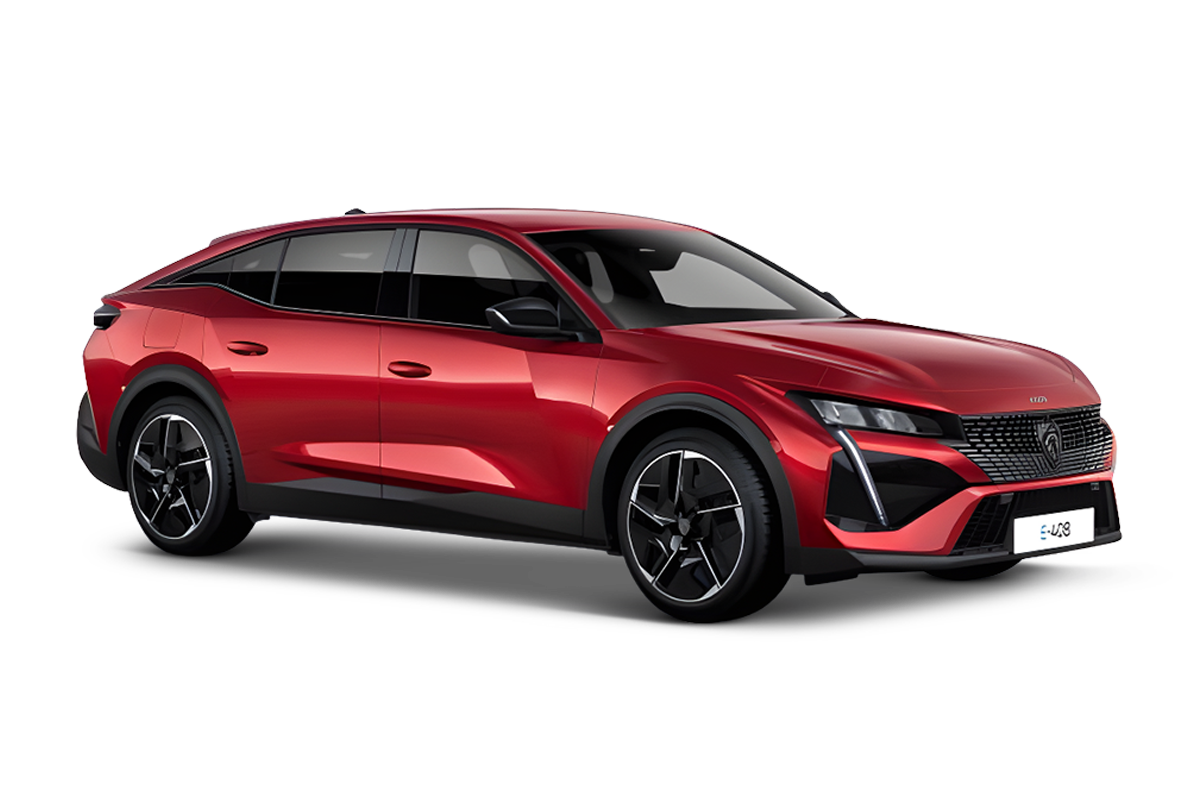
The Peugeot e-408 blends elements of several body styles, combining the raised ride height of an SUV, the proportions of a saloon and the sleek roofline of a coupé. Overall, it fits into the executive car class, competing with electric models such as the Tesla Model 3 and the Volkswagen ID 7.
| RRP price range | £36,170 - £41,785 |
|---|---|
| Number of trims (see all) | 3 |
| Number of engines (see all) | 1 |
| Available fuel types (which is best for you?) | electric |
| MPG range across all versions | 0 - 0 |
| Available doors options | 5 |

