Aston Martin DB12 review
Category: Coupé
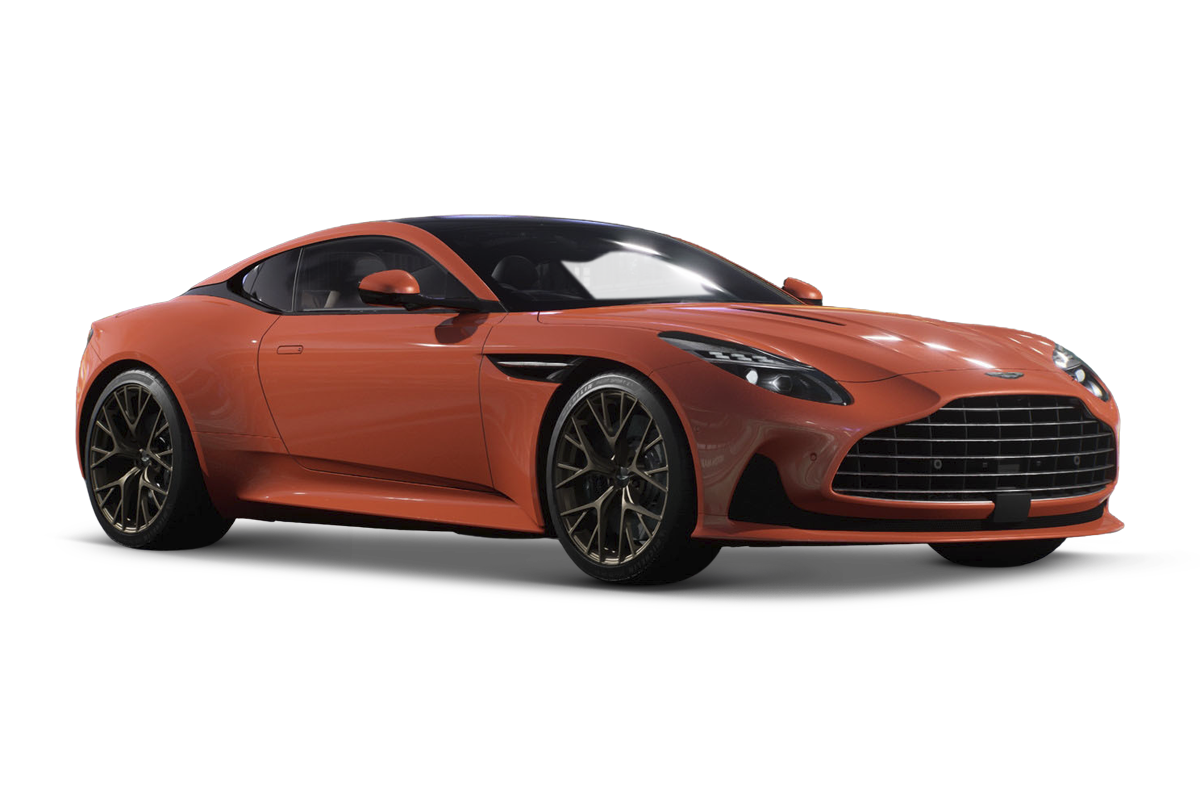
The DB12 is a luxurious and very fast long-distance cruiser with a beautiful interior and great handling


What Car? says...
The Aston Martin DB12 marks a turning point for what is, let’s face it, a much-loved manufacturer with a chequered financial past. Aston Martin has changed hands more times than a dodgy poker player, and past owners include a man who made tractors, called David Brown. Incidentally, even though you’ve probably never heard of him, it’s his initials that put the ‘DB’ in DB12. You will have heard of Ford, though, which also owned Aston Martin for a while, but even a multinational automotive giant like the Blue Oval decided, eventually, to cut its losses and move on.
Now Aston Martin is owned by a Canadian chap called Lawrence Stroll, who, according to some estimates, is worth about four billion dollars. That means he has more in the bank than…well, some small banks…and he’s pouring some of his enormous wealth into making Aston Martin successful on all fronts: on track, with its Formula 1 team, and, hopefully, on the road, too.
The DB12 is the first road car to have been completely developed under Stroll’s tenure, and it represents a huge philosophical change. For the first time ever, the company's developed nearly everything in house – even the infotainment system. And one of the key dictates from the boss was to improve the quality of everything, including the interior.

That said, under the DB12’s eye-catching bodywork is effectively a development of the previous DB11. And not everything is made in-house, because, like the DB11, the 4.0-litre twin-turbocharged V8 petrol engine that powers the DB12 is sourced from Mercedes-AMG. However, even the carryover bits were revised heavily, with the aim of making this the ultimate grand tourer – as a coupé or convertible, in the form of the Aston Martin DB12 Volante.
So, what about rivals? Well, the Bentley Continental GT is, arguably, less about the last word in handling and more about covering ground quickly, comfortably and effortlessly. The Ferrari Amalfi, meanwhile, is a Ferrari, so raising adrenaline levels tenfold is hardwired into its DNA. Think of the DB12 as sitting somewhere between those two poles: a fun, fast, sporty coupé that you can use every day. Mind you, the Porsche 911 Turbo S has long-been considered the benchmark for balancing sports car performance with everyday usability, so is the DB12 as good as that?
What’s new?
- April 2026: more powerful DB12 S launched with 690bhp, standard carbon-ceramic brakes, revised suspension, aerodynamics and sportier styling inside and out
- May 2023: DB12 launched with 671bhp twin-turbo 4.0-litre V8 engine and an eight-speed automatic gearbox
Performance & drive
What it’s like to drive, and how quiet it is
Strengths
- +Amazing performance and V8 sound
- +Sweet steering and handling
- +Quiet, comfortable, long-distance GT car
Weaknesses
- -Porsche 911 Turbo S is quicker still
- -Feels big on narrow roads
How fast is it and which engine is best?
This is a relatively easy one to answer because…there is only one basic engine. And, thankfully, it’s a good’un. As you’ll know if you’ve read the intro, it’s the 4.0-litre twin-turbo V8 that you'll also find in the Mercedes-AMG GT, as well as the DB12’s smaller sibling, the Aston Martin Vantage. Aston Martin has tuned the V8 to create the character it wants for the DB12, though, and offers you a choice of power outputs.
Even in its lower state of tune, the V8 engine produces 671bhp. That’s enough oomph to get the DB12 from 0-62mph in 3.6sec and on to a top speed of 202mph, which, if you’re all about bragging rights, makes it a lot faster than the entry-level Bentley Continental GT.
If you’re more interested in what that feels like, rather than how it stacks up on a spreadsheet, let’s just say the acceleration is frenetic. But the way the acceleration builds in intensity from 2000rpm all the way to the red line, so you'll want to rev it out, is a huge chunk of the excitement.
While its ultimate performance is mind-blowing, this is not some highly strung hypercar. Like the Continental GT, the DB12 is perfectly capable of bumbling around town without getting tetchy and, thanks to a huge glut of mid-range grunt, it gallops up to the motorway limit with seemingly zero effort. It helps that the changes from the eight-speed automatic gearbox are swift and smooth, although they're not quite as quick-fire as the 911's dual-clutch auto.
The more powerful DB12 S has an extra 19bhp, which means it is technically quicker, but only by one-tenth of a second. It drops the 0-62mph time down to 3.5sec, which edges it slightly nearer to the Ferrari Amalfi’s potential of 0-62mph in 3.3sec. Can you feel that small difference from behind the wheel? Yes, if you’re a highly sophisticated and sensitive measuring device. But if you're a simple, fleshy human being, of course not. It’s still jolly quick, though, and no less usable as an everyday sports car. The DB12 S is actually our favourite version, but for reasons beyond its mild performance upgrade – we’ll get to those elements later.
Is it agile and is the ride comfortable?
The DB12 feels bigger on the road than a Porsche 911 Turbo S, which, yes, makes it less adept on narrow B roads. But get it on wider, sweeping A roads, and, oh boy, is it a lovely, wieldy thing. The steering is close to perfection for a big GT car, and imparts a strong sense of connection to the front wheels – even more so if you go for the S, which is tuned to deliver more feedback and a bit more heft. But in either version, the steering builds weight naturally as you apply lock, it feels direct and accurate, and more intuitive than the Amalfi’s hyper-alert set-up. In the DB12 you slot subconsciously into a rewarding rhythm that has you carving from one apex to the next with joyous ease.
All the sensations coming through the steering wheel and seat of your pants give you the confidence to push and have some fun, too. In that sense, the DB12 – and more so the DB12 S, with its bespoke suspension settings –feels more alive and engaging to drive than the Continental GT. In part, the confidence comes from the strong grip levels that allow you to carry plenty of speed into turns. And, while it’s not four-wheel drive like the Continental GT or 911 Turbo S, the DB12’s clever, electronically controlled limited-slip differential maximises traction at its driven rear wheels. As a result, you can get on the power surprisingly early at the exit of turns without things getting twitchy. And, being rear-wheel drive, the DB12 is more playful than its four-wheel-drive rivals; you can dial back the variable traction control and revel neat, progressive slides under power if you want.
The DB12’s supple suspension helps with cornering stability on rough roads, and it gives it the requisite GT-esque ride comfort, too. Now, if long-distance comfort is your top priority, the Continental GT is still a better bet, but the DB12 isn’t far behind when it comes to massaging you over potholes or sleeping policemen. In fact, you might find it’s too supple when the adaptive suspension is at its softest – if the road’s strewn with multiple peaks and troughs, and you’re carrying a bit of speed, you can feel it take a moment to settle after bumps. Pop it into Sport or Sport+, which stiffens the dampers, and that takes out much of the unwanted movement without making the ride overly harsh.
Is it quiet and how easy is it to drive smoothly?
As with ride comfort, the Bentley Continental GT has the edge when it comes to cruising manners, but only just – the DB12 is still a relaxing option for dashing across Europe. For a start, it’s much quieter on motorways than the Porsche 911 Turbo, which has way more annoying road noise. There’s very little wind noise in the DB12, and the V8 engine fades (mostly) into the background when you’re bowling along steadily at the legal limit.
Obviously, when you pin the throttle expecting some V8 boisterousness, the engine pipes up like a church organ at Sunday Service. Amen to that. It sounds utterly fantastic at full chat, and if you want more theatre, the switchable sports exhaust amplifies everything at the touch of a button. The DB12 S takes this even further; it’s offered with an optional titanium exhaust system that reduces weight and adds another 1.5dB of aural drama – your neighbours will love you for ticking that box.
The brakes are super powerful but also dead easy to modulate, so you can slow the the DB12 down smoothly. That’s the same whether you’re in the regular DB12 with iron discs or the DB12 S, which has carbon-ceramic discs as standard.
“If you’re after a halfway house between the comfort of a Bentley and the dynamism of a Ferrari, then I think the Aston Martin DB12 is a better choice than the very rapid but slightly clinical Porsche 911 Turbo S.” – John Howell, Deputy Reviews Editor

Interior
The interior layout, fit and finish
Strengths
- +Comfortable and supportive seats
- +Lots of lovely leather
- +Decent infotainment system
Weaknesses
- -Visibility isn’t the best
- -Offset steering wheel
- -Bentley feels plusher
What does the interior look like and is it well made?
To an extent, you can make the interior look how you want, because Aston’s more than happy to add bespoke touches in exchange for your cash. The default theme is soft, neatly stitched leather covering most interior surfaces, from the doors and dashboard all the way up to the headlining.
That’s accompanied by gloss-black and silver trim highlights, which you can swap for carbon-fibre for a more modern twist; other nice touches include the stainless steel speaker grilles on the doors, and the red anodised drive mode controller on the DB12 S. It feels more luxurious than the slightly austere ambience in a Porsche 911.
The fit and finish is, generally, to a high standard, but not up to Bentley Continental GT standards. Why? While most elements feel substantial and solid, the flexing trims along the sides of the centre console rather let the side down. Also, the switches operate with a tinny twang rather than the satisfying click you get when you press a switch or twiddle a knob in the Continental GT.
Is the driving position comfortable and is it easy to see out?
The DB12’s standard 16-way electrically adjustable driver’s seat and steering wheel offer plenty of adjustment, so you should have no issues fitting behind the wheel. The seat feels plusher than the Ferrari Amalfi’s, and more supportive in corners than the big, armchair-like seats in a Continental GT.
The pedals line up nicely with the seat but the steering wheel doesn't: it’s offset slightly. But, while that's a little disconcerting, it’s not actually a huge issue as far as long-distance comfort is concerned.
You feel fully ensconced by the DB12's high dashboard and window line. That bolsters the sense of sportiness but does limit your all-round visibility – at least compared with the Porsche 911 Turbo S. On the plus side, you get a 360-degree parking camera and all-round parking sensors to take the stress out of low-speed manoeuvres.
Are the dashboard and infotainment system easy to use?
There’s a theme with high-end sportscars and luxury cars, and it’s a good one. While run-of-the-mill models continue to consign more and more physical controls to the history books – so operating anything is miles more frustrating as a result – expensive models, such as the DB12, provide you with some good ol’ fashioned buttons.
Hallelujah to that. When you’re driving along you can find them by feel, rather than looking away from the road to pinpoint a little touchscreen icon. It makes adjusting the interior temperature or the stereo volume so much easier.
The 12.3in touchscreen infotainment is Aston Martin’s own system, and if you’ve ever used an Aston Martin equipped with the old Mercedes-sourced infotainment from a decade ago, you’ll find this a big improvement. The screen looks sharp and it responds reasonably quickly to inputs, although it’s not as snappy as the Continental GT’s system. It’s well equipped, though, and that includes wireless Apple CarPlay and wired Android Auto. Also, it’s one of the few cars available right now with CarPlay Ultra, which integrates more of the car’s features into Apple's CarPlay system.
An optional 15-speaker Bowers & Wilkins stereo with 1170 watts is clear and punchy, if not quite as head-pounding as the optional Naim stereo in the Continental GT.
"There’s no doubt the Aston Martin DB12’s interior is a massive improvement for quality over the previous DB11 and feels up to standard – but, no question, I do prefer the Bentley Continental GT’s opulence." – John Howell, Deputy Reviews Editor

Passenger & boot space
How it copes with people and clutter
Strengths
- +Roomy enough in the front
- +Reasonable boot space
- +Rear seats offer addition luggage space
Weaknesses
- -Rear seats are largely pointless for people
- -Bentley Continental GT is much more practical
How much space does it have for people?
The Aston Martin DB12 is a big car – over 4.7m from nose to tail and more than 2m wide, if you include the mirrors. But it’s low and, as we mentioned in the driving position section, has a high window line, which makes the interior feel tighter than you might think. That’s the perception, but when it comes to actual, measurable space, there’s actually plenty of head and leg room for a couple of tall adults in the front.
Storage space includes a wireless charging tray for your phone (tucked away on the lower tier of the centre console), two small cupholders, a centre armrest cubby and door bins that can hold a drinks bottle horizontally.
What about the rear? Well, the DB12 has a pair of rear seats, which represents an immediate improvement over two-seat sports cars, including the Ferrari 296 GTB and Lamborghini Temerario. They give you the flexibility offered by its GT brethren, such as the Ferrari Amalfi and Porsche 911. But, like those rivals, you won’t get anyone other than children or small adults in the DB12’s back seats, and they’ll probably whinge.
We would say the DB12’s sloping rear roofline is the main issue because it limits head room, but the fact is leg room is pretty awful, too. If you regularly need to carry people in the rear, and you want to keep them in your life, we’d suggest looking at the roomier Bentley Continental GT instead.
How much room does it have for luggage?
The DB12’s 262-litre boot space is roughly on par with the Amalfi’s and big enough for a few carry-on suitcases. And, because the rear seats are pretty much useless for humans, they’re become useful extra luggage space. If you struggle to pack light then the Continental GT’s 358-litre boot is likely better suited to you, though.
“I’m over six-feet tall and fit easily in the front of the Aston Martin DB12. And if you use the rear seats as extra luggage space, it’s more than practical enough for a long road trip.” – John Howell, Deputy Reviews Editor

Buying & owning
Everyday costs, plus how reliable and safe it is
Strengths
- +Expensive to buy
- +Expensive to run...
Weaknesses
- -...but so is everything else at this level
How much does it cost and what equipment do you get?
Whichever version you choose, the Aston Martin DB12 costs a fortune, but, no doubt, you’ve considered that point already. The fact is, nothing of its ilk is going to come at a knockdown price. We reckon the DB12 S is the version to buy. Why? Well, it’s not actually that much more expensive, it’s slightly quicker, slightly sharper to drive, and comes with carbon-ceramic brakes as standard, which are an expensive option on the standard DB12. The fact is, the DB12 S will be the version buyers will hanker after on the used market, so you’ll more than likely get your money back when you come to trade it in.
The prospect of day-to-day running costs for a car with eight cylinders and two turbos is no less intimidating than the asking price. CO2 emissions put it in the top BIK tax band, road fund licence incurs the premium rate for the first five years, and fuel consumption is…well, let’s just say it's no Toyota Prius. And then there is insurance and annual servicing to consider – a new set of 21in tyres certainly won’t come cheap. But, again, exactly the same is true of any of the luxury coupé, including a Bentley Continental GT and Ferrari Amalfi.
You get a long list of equipment in return for your outlay, though, including heated front seats, two-zone climate control, keyless entry and start, adaptive cruise control, a DAB radio, LED headlights and an Alcantara suede headliner. Options include ventilated front seats, a heated steering wheel and privacy glass.
Is it reliable, and how long is the warranty?
Funnily enough, the sample size for the Aston Martin DB12 or the Aston Martin brand wasn’t big enough for either to feature in our latest What Car? Reliability Survey – who’d have thought it? So, as far as reliability goes, your guess is as good as ours.
All we can say for sure is that, if something does goes wrong, your new, shiny DB12 is covered for parts and labour for three years, with no mileage limit.
How safe is it, and is it easy to steal?
The DB12 hasn’t been crash-tested by Euro NCAP, but it comes with automatic emergency braking (AEB), blind-spot monitoring, lane-departure warning, lane-keep assist, traffic-sign recognition and cross-traffic assist.
Anti-theft considerations include a standard alarm, immobiliser, and vehicle tracker
"The Aston Martin DB12 is an expensive car to buy and run. When it comes to costs, sorry, there’s not a lot we can say to make that any sweeter." – John Howell, Deputy Reviews Editor
Buy it if...
–You want to feel like James Bond
–You want a sports car with a proper V8 soundtrack
–You fancy something sportier than a Bentley and a little less in-your-face than a Ferrari
Don't buy it if...
–You want to carry more than two adults
–You think it won’t be that expensive to run – it just will
–You want the ultimate poise and balance of a sports car
For all the latest reviews, advice and new car deals, sign up to the What Car? newsletter here

FAQs
The DB12 costs nearly £200,000.
No, but the latest Aston Martin Vanquish does have a V12.
The top speed of the DB12 is 202mph.
| RRP price range | £196,745 - £282,752 |
|---|---|
| Number of trims (see all) | 2 |
| Number of engines (see all) | 1 |
| Available fuel types (which is best for you?) | petrol |
| MPG range across all versions | 0 - 23.2 |
| Available doors options | 2 |
| Company car tax at 20% (min/max) | £14,134 / £14,134 |
| Company car tax at 40% (min/max) | £28,268 / £28,268 |

