New Volkswagen Transporter review
Category: Medium Van
The VW Transporter is a great choice of medium van – whether you go for a diesel or all-electric version


What Car? says...
The new Volkswagen Transporter is the result of one of the most significant transformations in the van’s long-running history.
For the first time, the Transporter shares much of its underpinnings with a model from another manufacturer: Ford. The seventh generation of this medium van was developed alongside the Ford Transit Custom as part of a wide-reaching collaboration between the two manufacturers.
It's not the first time the two automotive giants have worked together: the Volkswagen Amarok pick-up is based on the Ford Ranger and the Ford Transit Connect is based on the VW Caddy Cargo. And now we have the Transporter rolling off the same production line in Turkey as its mechanically identical twin.
That doesn’t mean the Transporter is just a rebadged Transit, though. Volkswagen has worked hard to retain a sense of identity, with a distinct front-end design, VW-specific interior elements, and a trim structure that caters to brand loyalists. That includes a new UK-only Sportline version, which adds more visual drama and equipment for buyers who want their van to double as a bit of a statement piece.

But is it still a VW Transporter at heart, and can it go head to head with the best medium vans including the Mercedes Vito, Renault Trafic, Toyota Proace and Vauxhall Vivaro? And is it better than its Transit Custom twin?
Performance & drive
What it’s like to drive, and how quiet it is
Strengths
- +Impressive ride in urban areas
- +Spritely performance, especially in EV version
- +Sportline trim adds slightly sportier handling
Weaknesses
- -Manual gearbox is a little vague
- -Can be noisy under hard acceleration
The VW Transporter impresses on the road, but then we had a good reason to suspect it would: the closely related Ford Transit Custom is great to drive, too.
The steering is light yet accurate, making urban manoeuvres easy, while the suspension offers a fine balance between comfort and body control.
Transporter buyers have a choice of three 2.0-litre TDI diesel engines, with 108bhp, 148bhp, and 168bhp. The 108bhp model is paired with a six-speed manual gearbox, which is smooth if a little springy.
The 148bhp unit offers the most versatility, with the option of manual or an excellent eight-speed automatic gearbox. The 168bhp version comes exclusively with the auto ‘box, and also underpins the Transporter Sportline, where it feels punchy enough to suit the model’s sportier image without changing the van’s core character.
There’s also a 4Motion four-wheel-drive variant, although this is only available with the 148hp engine, not with the range-topping 168hp, which seems like an odd oversight.
All the engines feel strong and willing, even if they are Ford-sourced units beneath Volkswagen TDI badging. They’re not the quietest diesels on the market, particularly under heavy load, but refinement is notably good at cruising speeds.
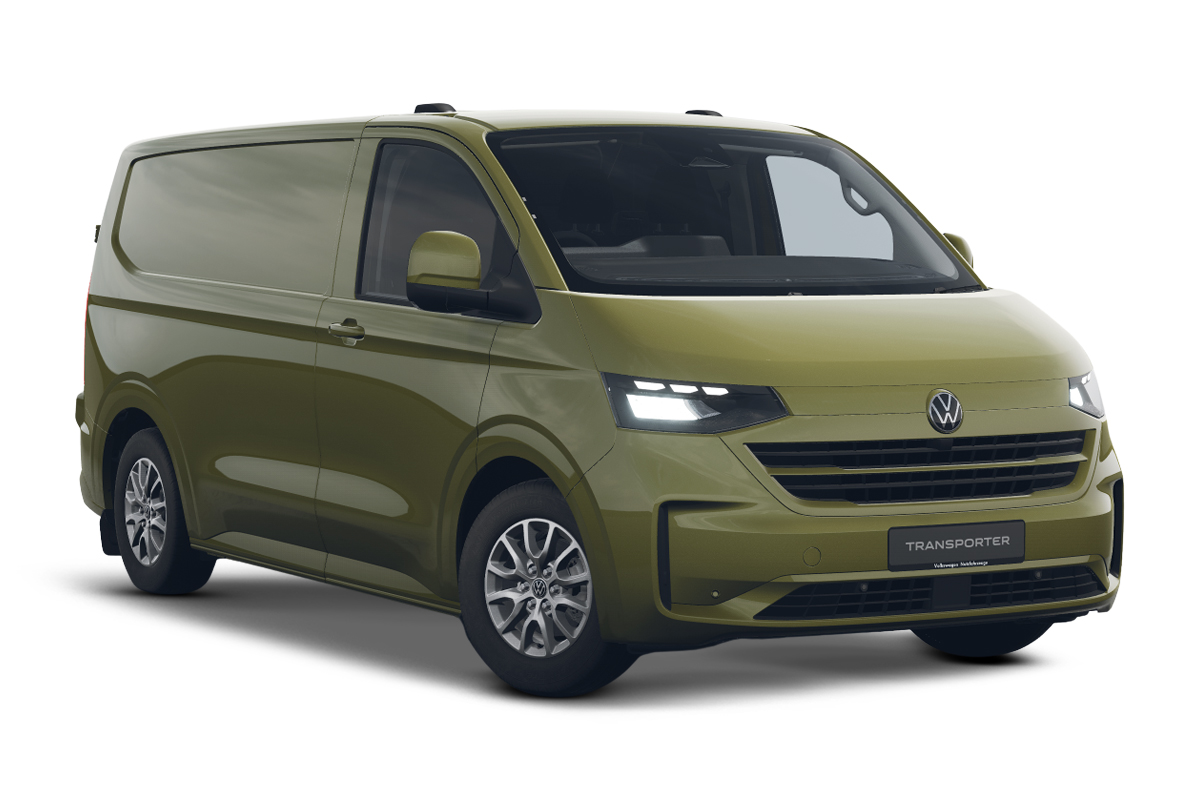
The Sportline doesn’t feel radically different from any other well-specced Transporter on the move. It sits 29mm lower, thanks to some upgrades from Eibach, but ride comfort remains impressively well judged, so the extra visual aggression doesn’t come at the expense of everyday usability. It’s no Transporter GTi, though, with the 0–62mph dash taking around 14 seconds.
The all-electric version – the VW e-Transporter – is available with either a 134bhp or 215bhp motor and a 70kWh (usable capacity) battery. It delivers smooth, near-silent performance and is ideal for city driving.
The 215bhp model accelerates briskly in town, although its throttle response is deliberately gentle to prevent aggressive driving, and (rightly) electronically restrained if you start to get a little enthusiastic.
The e-Transporter's official range is quoted as up to 225 miles (WLTP figure). In the real world, 170 to 200 miles is more realistic, depending on what you carry, how you drive and what the weather is like.
The plug-in hybrid (PHEV) Transporter eHybrid pairs a 2.5-litre petrol engine with an electric motor and battery. From our drive, we reckon this version of the Transporter will manage around 30 miles of EV driving on a full charge.
“As is so often the case, the mid-range model offers the best balance between cost, performance and economy, and if your budget can stretch to it, pick the automatic gearbox.” – Phil Huff, Van Reviewer

Interior
The interior layout, fit and finish
Strengths
- +Flat floor allows for a complete walkthrough
- +Plenty of USB sockets for your tech
- +Lots of shelves and cubbies
Weaknesses
- -Cupholders are a bit of a stretch away
- -Air-con controls are on the touchscreen
- -High-gloss black plastics will show up dirt
The new VW Transporter’s cab shares much of its lay-out with the Ford Transit Custom but features several Volkswagen-specific changes that make it feel more unique.
That includes a distinctive steering wheel, revised cupholder positions, a covered glovebox on all trim levels and rubber-lined door pockets. While the fundamentals are familiar, the tweaks give the cabin a more recognisably VW feel.
The range-topping Sportline pushes that further with hand-finished eco-leather sports seats, red stitching and gloss black trim details. It’s a niche within a niche, but if you want your van to feel more like a lifestyle vehicle than a tool, it certainly makes its case.
The driving position is excellent, though taller drivers may find the seat doesn’t slide back quite far enough in manual models. The flat floor, present across the range, makes cross-cab movement easy and adds to the car-like atmosphere. Automatic versions, with their column-mounted gear selectors, get extra leg room.
A 13.0in infotainment touchscreen and a 12.0in digital driver's display are standard. Both use Ford’s operating systems, but are reskinned with Volkswagen fonts and branding, and convincingly so.
The interface is largely intuitive, with a persistent climate control bar that improves usability. However, the reliance on touchscreen inputs, especially for heating and ventilation, can be frustrating when wearing gloves on a cold winter’s day.
Storage space is generous, with two gloveboxes, multi-level door bins, and additional USB ports in higher trims.
However, the absence of overhead storage will disappoint those used to the practicality of older models. Still, there are more places to put your daily detritus than you’ll find in a Vauxhall Vivaro.
“Entry-level Commerce models are well equipped and Sportline looks great, but my money would go into the mid-spec Commerce Plus. A small uplift in price brings extra comfort, safety and style.” – Phil Huff, Van Reviewer

Passenger & boot space
How it copes with people and clutter
Strengths
- +Long cargo bay can take three pallets
- +Side door is wide enough to slide a pallet through
- +Huge flexibility with optional fittings
Weaknesses
- -High roof option is not available yet
- -Payloads are competitive but not class-leading
- -Only one sliding side door
The business end of a van is where it earns its keep, and the VW Transporter doesn’t disappoint. With a choice of short-wheelbase (5050mm) and long-wheelbase (5450mm) bodies and the promise of high-roof and chassis cab versions on the way, there’s solid flexibility.
The load area is wider than before, allowing the Transporter to easily accommodate three Euro pallets, with just over three metres of load length available in the LWB. Load volume starts at 5.8m3 in the SWB and stretches to 6.8m3 in the LWB, and will rise to a class-leading 9.0m3 in the high-roof LWB variant, due later.
Maximum payloads are good rather than class-leading. Diesel models can carry up to 1280kg, while the e-Transporter manages 1038kg. That puts it behind the likes of the Peugeot Expert and Vauxhall Vivaro, which offer more than 1400kg in some versions. Still, it’s a step up from the Mercedes Vito and more than enough for most tradespeople.
Access is excellent via wide twin rear barn doors – or a no-cost top-hinged tailgate – and a generous-sized single-side sliding door. A second door and electrically assisted doors are available from the options list. Additional loading features such as ply lining, floor rails, 12-volt outlets, super-bright LED lights and integrated racking systems are available.
Towing capacity ranges from 2000kg to 2800kg for diesel models, and up to 2300kg for the e-Transporter.
The Ford Transit Custom is offered in an intriguing Multicab variant with five seats. The rear seats are boxed into one side, leaving a full-length but narrower cargo area for work tools – or a kayak for the weekend. It could be ideal as a dual-purpose cargo carrier and family transport, and there's likely to be a Transporter version.
However, for those needing something a little less commercial for moving friends and family, there’s also the Volkswagen Multivan to consider (which is closely related to the VW Tiguan SUV).
“The cargo bay is identical to the equivalent Ford's, which means the vast array of third-party up-fitting options should be compatible with the Transporter.” – Phil Huff, Van Reviewer

Buying & owning
Everyday costs, plus how reliable and safe it is
Strengths
- +Impressive support package includes servicing
- +Undercuts closely related Ford Transit Custom
- +Competitive lease and finance rates
Weaknesses
- -More expensive than Stellantis rivals
Despite the VW Transporter's incremental improvements over the Ford Transit Custom, the Transporter costs less. Not by much and ultimately not enough to overcome discounts from Ford, but strong resale values also come into play, which keeps monthly payments competitive.
Although pricier than Stellantis rivals like the Citroën Dispatch, Fiat Scudo, Peugeot Expert and Vauxhall Vivaro, the Transporter counters with an impressive standard specification and added value through its extensive aftersales support. Meanwhile, the e-Transporter is competitively priced against rival electric vans.
Buyers wanting something more image-led can also step up to the UK-exclusive Sportline, although it’s not cheap. At more than £50,000 plus VAT, that’s a hefty premium over the regular range, and makes it tough to justify on value alone for professional users.
Where the Transporter moves clear of its rivals is with its "5+ Promise", which is included in the price of the vehicle. What does it cover? The first five scheduled services, three MOT tests, five years of roadside assistance and a comprehensive five-year, 124,000-mile warranty.
When you compare it with Ford’s rather more conventional three-year or 100,000-mile warranty, you can see how it could reduce operating costs for up to five years of ownership.
Stellantis gives its vans a three-year or 100,000-mile warranty, while Toyota covers its Proace for up to 10 years or 100,000 miles if you jump through a few easy hoops. But none of them include five years of maintenance like VW.
Service intervals are every two years or 25,000 miles so low-mileage users might only need to see their service centre once every 24 months.
Fuel efficiency across the Transporter range is commendable, with the entry-level 108bhp manual achieving up to 40.9mpg, closely followed by the 148bhp manual at 40.4mpg. The eight-speed automatic gearbox slightly reduces efficiency, averaging around 37.7mpg.
The Transporter plug-in hybrid also shows promise. In an early drive of the forthcoming model, I managed 94.6mpg, with 23 miles of EV running despite starting without a fully charged battery. Extrapolating the economy figures over a 100-mile trip in the same conditions, that would work out at roughly 49mpg.
“More kit, improved backup, and a lower cash price? Even a die-hard Ford fan must be tempted by the Transporter…” – Phil Huff, Van Reviewer
Buy it if…
- You want a van that’s sharp to drive and refined
- A smart, car-like interior is important to you
- You’d like a comprehensive after-sales package
Don’t buy it if…
- You’re on a limited budget
- Physical climate controls are a must-have
- You need the biggest possible payload from a medium van
For all the latest reviews, advice and new car deals, sign up to the What Car? newsletter here

FAQs
Not exactly. While it shares its underpinnings, engines and many components with the Transit Custom, Volkswagen has made meaningful changes to styling, cabin layout, trim levels, and aftersales support. The result is a van that feels distinctively Volkswagen in use, despite its Ford underpinnings.
There are three 2.0-litre diesel options with 108bhp, 148bhp and 168bhp, plus the option of a four-wheel-drive variant. The e-Transporter electric van is available with either 134bhp or 215bhp, and a plug-in hybrid is on the way, offering electric driving for shorter trips.
Simply put, the Sportline is the sharpest-looking, most distinctive version of the Transporter, it could be. It gets extra styling kit, a plusher cabin and a stronger sense of occasion than the regular trims. But it is expensive, and mechanically it remains much the same van underneath, so most buyers will still be better served by a mid-range Commerce Plus or Commerce Pro.
| RRP price range | £41,403 - £55,867 |
|---|---|
| Number of trims (see all) | 3 |
| Number of engines (see all) | 1 |
| Available fuel types (which is best for you?) | diesel |
| MPG range across all versions | 33.2 - 39.8 |
| Available doors options | 5 |

