Citroën ë-C3 review
Category: Electric car
The ë-C3 is keenly priced and roomy inside but there are better all-round electric SUVs


What Car? says...
In a world where electric cars are often defined by dizzying performance figures, super-long ranges and ultra-rapid charging, the Citroën ë-C3 is a welcome breath of fresh air, instead championing simplicity and affordability.
This is Citroën's smallest and cheapest electric car (discounting the minuscule Citroën Ami, which isn't technically a car at all), yet it has a surprisingly roomy interior and can officially travel up to 202 miles between charges.
Citroën ë-C3 vs rivals video review
Of course, “cheap” is a relative term. The ë-C3 is priced above rivals including the Dacia Spring and Leapmotor T03, but those are noticeably smaller cars. In reality, the ë-C3 sits closer to models such as the BYD Dolphin Surf, Hyundai Inster and Renault 5. Like those alternatives, it’s offered with a choice of battery sizes to suit different needs.
So, how does the Citroën ë-C3 stack up against its best electric car rivals?
What’s New?
- April 2026: We drive the e-C3 Urban Range. It’s a new entry-level version with a 30kWh battery and an official range of 130 miles.
- July 2024: Orders open for e-C3. Choice of Plus or Max trims
- October 2023: e-C3 first shown, with 44kWh battery and 112bhp electric motor giving up to 199 miles. Head-up display and small steering wheel replace traditional instrumentation

Performance & drive
What it’s like to drive, and how quiet it is
Strengths
- +Standard Range has a decent range
- +Quieter than many rivals on the motorway
- +Fairly smooth high-speed ride
Weaknesses
- -Wallowy handling
- -Disappointing real-world efficiency
- -So-so performance
How fast is it and which motor is best?
There are two versions of the Citroën ë-C3 to choose from: Urban Range and Standard Range. The batteries for these are different, but the 111bhp electric motor driving the front wheels is the same.
Performance isn't as electric as you might be hoping and, on paper, the 0-62mph times are identical (10.4sec). In our own tests on a private track, we managed a 0-60mph time of 10.4sec in the Standard Range, compared with 9.0sec in the Renault 5 Urban Range (R5) and 8.0 seconds in the most powerful (Comfort) version of the BYD Dolphin Surf. So the ë-C3 isn't as quick as many rivals – but it's still nippy enough up to about 50mph.
Is it agile and is the ride comfortable?
The ë-C3’s soft suspension makes for a supple high-speed ride so you can waft along a motorway in relative comfort. Things tend to get a bit bouncy on rural roads with lots of undulations, though, and the ë-C3 isn't as settled around town as some rivals, including the R5.
There's a much bigger difference when it comes to handling. While the R5 feels light on its toes and eager to change direction, the softer ë-C3 is much happier going in a straight line. In tight corners you'll notice plenty of body roll, and the light steering and tiny steering wheel conspire to rob you of confidence. In short, the Dolphin Surf, Hyundai Inster and R5 offer a more impressive ride and handling balance.
Is it quiet and is it easy to drive smoothly?
The ë-C3 is quiet for a car of this price. It drums up a bit less tyre noise than the Renault 5, and wind noise isn't too bad at a 70mph cruise.
It’s also easy to drive smoothly. The accelerator pedal feels linear and well judged, allowing you to build speed progressively. The brakes, however, can be a little grabby, which makes smooth braking trickier – though this is a criticism that also applies to the BYD Dolphin Surf and R5.
What’s the range and efficiency like and how quickly can it charge?
The ë-C3 Urban Range has the shortest official range in the line-up, being designed for short, urban commutes. It’s powered by a 29.8kWh (usable capacity) battery that delivers an official range of 130 miles, which is less than the Dolphin Surf Active (137 miles) and R5 Urban Range (193 miles). In real-world driving, expect a range of around 100 miles, depending on weather conditions.
The ë-C3 Standard Range has a 43.7kWh (usable capacity) battery that’s good for an official range of up to 202 miles. That's about the same as a Dolphin Surf Boost and a few miles further than an R5 Urban Range.
However, in our real-world testing of the Standard Range, the ë-C3's disappointing efficiency of between 3.5 and 3.8 miles per kWh means a range of 155-170 miles is more realistic – or even less in wintery weather conditions.
The 43.2kWh battery versions of the Dolphin Surf can deliver better real-world efficiency and a slightly longer range, while the R5 Urban Range uses its energy in an even more efficient manner, although its smaller 40kWh (usable capacity) battery means its real-world range is similar to the ë-C3's.
The ë-C3 Standard Range can theoretically accept up to 100kW from a suitably powerful public EV charger, which is quicker than an equivalent Inster or R5. It also means a 20-80% charge can take as little as 26 minutes.
However, in our tests charging took considerably longer than that. We waited 39 minutes for a 19-80% top-up. At the same time and location an R5 Urban Range went from 17-80% in 28 minutes and a Dolphin Surf Comfort went from 29-80% in 25 minutes.
The ë-C3 Urban Range has a maximum charging rate of 30kW. This allows for a 20-80% charge in approximately 36 minutes with a 50kW public charger. That’s similar to the R5 Urban Range, which can do a 15-80% top-up in around 30 minutes on paper. The Dolphin Surf Active can do a 10-80% charge in around the same time with a suitably powerful charger officially.
“The Citroën ë-C3’s official 0-62mph time of 10.4sec may not look impressive but I didn't find acceleration too sluggish.” – Lawrence Cheung, New Cars Editor

Interior
The interior layout, fit and finish
Strengths
- +User-friendly air-con controls
- +Easy to see out
- +Interior doesn't feel overly cheap
Weaknesses
- -So-so infotainment system
- -Some will find the driving position awkward
- -Renault 5 feels more upmarket inside
What does the interior look like and is it well made?
The interior of the Citroën ë-C3 isn't exactly plush but it doesn't feel too austere either. While plenty of hard plastics are on show (more than in a BYD Dolphin Surf, Hyundai Inster or Renault 5), it feels more upmarket inside than a Dacia Spring or Leapmotor T03.
Is the driving position comfortable and is it easy to see out?
The driving position in the ë-C3 is pretty comfortable. The seats are nicely padded, but they could have more bolstering to keep you in place when cornering. There’s a good level of adjustment in the seat and steering wheel, too.
Mounted to the upper dashboard in front of the driver, there's a small digital driver’s display. None of our testers had a problem seeing the display over the top of the wheel, although the arrangement does feel a bit unnatural, and you sit relatively high up in the car.
Combined with tall side windows and relatively narrow pillars, visibility is generally good. Rear parking sensors come as standard, while the top-spec Max models gain a rear-view camera.
Is the dashboard and infotainment system easy to use?
The dashboard is very easy to use, with proper physical knobs and buttons for controlling the air-conditioning settings. They're quite low down on the dashboard, so it's a bit of a stretch to adjust them, but they're still preferable to touchscreen-based air-con controls, which you get in many new cars.
Talking of the touchscreen, it measures 10.3in and has Android Auto and Apple CarPlay smartphone mirroring. It's not as easy to use or sophisticated as the one in the Hyundai Inster or Renault 5, but it does the job. Our only real gripe is that there's sometimes a lengthy pause between you pressing the touchscreen and the infotainment system responding.
“I found the ë-C3's oblong-shaped steering wheel fine to hold when driving in a straight line but a bit awkward to use when turning into corners.” – Lawrence Cheung, New Cars Editor

Passenger & boot space
How it copes with people and clutter
Strengths
- +Roomier in the back than many rivals
- +Boot is a decent size
- +Can carry five (unlike a Dolphin Surf)
Weaknesses
- -Three adults in the back will be a squeeze
- -No height-adjustable boot floor
How much space does it have for people?
The Citroën ë-C3 obviously isn't the biggest car on the road but there’s still plenty of head and leg room up front, with enough elbow room to prevent awkward elbow-bashing with your passenger.
The news is just as positive in the back – you'll find more head room than you would in a BYD Dolphin Surf or Renault 5, and there's far more leg room than in the latter. Translation? Even taller adults can sit in the back of the ë-C3 without feeling cramped.
You can technically carry five people but the three in the rear will be squeezed together like sardines in a tin. The Dolphin Surf has only two seatbelts in the back so it's limited to four occupants in total.
How much room does it have for luggage?
We managed to slot five carry-on suitcases into the ë-C3's 310-litre boot below the parcel shelf, which is one more than we squeezed into the boot of a Hyundai Inster or R5.
There was even some space left over for a small soft bag and the charging cable. That's a good thing because there's no hidden storage compartment under the boot floor or under the bonnet, so the charging cable has to go in with the rest of your luggage.
When you need more storage space, you can drop the ë-C3's rear seat back in a 60/40 split. When folded down they leave a step in the floor of the extended load bay, because there's no height-adjustable boot floor. There's a hefty lip at the boot entrance, too.
“On paper, the ë-C3's boot is only fractionally larger than a Dolphin Surf's but I found it much more usable.” – Lawrence Cheung, New Cars Editor

Buying & owning
Everyday costs, plus how reliable and safe it is
Strengths
- +Competitive list price
- +Max trim gets plenty of kit
- +Decent official charging speed
Weaknesses
- -No Euro NCAP safety rating
- -Some rivals have a longer warranty
- -PCP deals are as competitive as the list price
How much does it cost and what equipment do you get?
The Citroën ë-C3 has a lower starting price than the Hyundai Inster and Renault 5. In fact, the only electric cars that cost less to buy outright are the BYD Dolphin Surf, Dacia Spring and Leapmotor T03.
That isn't necessarily the case if you're signing up to a PCP finance agreement, though. The R5's slower depreciation means it can actually work out slightly cheaper per month, although that could change depending on the interest rates and deposit contributions each manufacturer offers.
Just two trims are offered: Plus and Max. The Plus model gets the basics, including touchscreen infotainment, manual air-conditioning and rear parking sensors. We think it offers the best value for money. It’s also the only trim you can get with the Urban Range model.
Max is tempting, because it adds tinted rear windows, automatic climate control, wireless phone charging, a rear-view camera, electric rear windows, electrically folding and heated door mirrors and automatic high-beam assist for the headlights.
Is it reliable and how long is the warranty?
In terms of reliability, Citroën fared well in our 2025 What Car? Reliability Survey, finishing 10th out of 30 brands in the overall league table. That should be good news for owners, although we don't yet have specific data for the ë-C3 yet.
Citroën gives you a standard three-year, 60,000-mile warranty on most components. That's on a par with the R5, but both the Dolphin Surf and Inster have longer warranties. The ë-C3's drive battery is covered for eight years or 100,000 miles, with a guarantee that it will be refurbished or replaced if it drops below 70% of its original capacity.
Is it safe and is it easy to steal?
The ë-C3 hadn't been appraised by the safety experts at Euro NCAP at the time of writing, but as standard it comes with lane-keep assistance, speed-limit recognition, a driver attention alert system and automatic emergency braking (AEB).
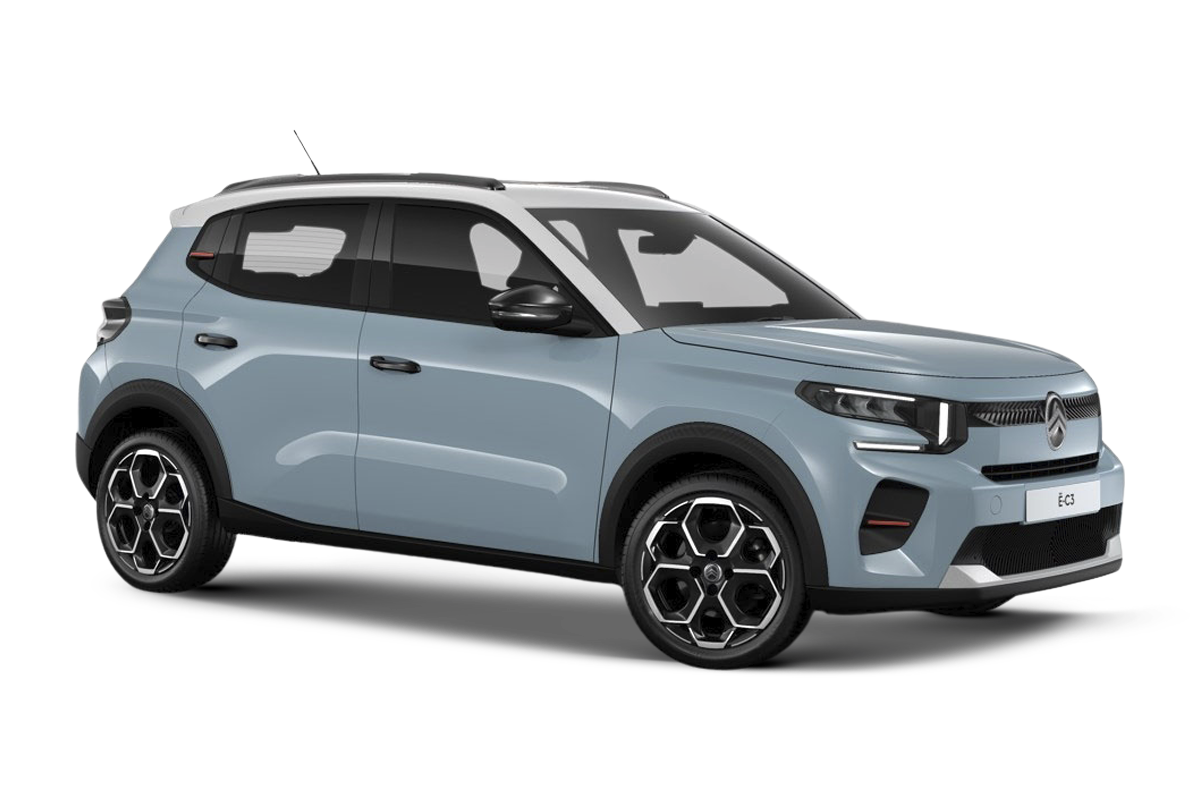
"I find it quite novel that the ë-C3 comes with either a black or white roof finish as standard, and that you can opt to have it body-coloured as a no-cost option. Usually it’s the other way around." – Lawrence Cheung, New Cars Editor
Buy it if…
- You want a cheap electric car
- You don’t need a long range
- Space is a priority
Don’t buy it if…
- You regularly do long journeys
- A smart interior is a must
- You want a quick electric car
For all the latest reviews, advice and new car deals, sign up to the What Car? newsletter here

FAQs
The ë-C3 Urban Range has an official range of 130 miles. If you need a longer range, the Standard Range model can do 202 miles officially. In real-world driving, expect around 100 miles for the Urban Range and 155-170 miles with the Standard Range, but only if the weather isn't too chilly.
There are better small electric cars when you consider all-round abilities, but the ë-C3 stacks up well for practicalities and is a relatively cheap option if you're buying outright.
| RRP price range | £19,995 - £24,175 |
|---|---|
| Number of trims (see all) | 3 |
| Number of engines (see all) | 1 |
| Available fuel types (which is best for you?) | electric |
| MPG range across all versions | 0 - 0 |
| Available doors options | 5 |
| Company car tax at 20% (min/max) | £44 / £1,066 |
| Company car tax at 40% (min/max) | £88 / £2,132 |

