Lexus RZ review
Category: Electric car
The RZ is the brand’s first bespoke electric car that’s good to drive and practical, but some rivals have longer ranges


What Car? says...
In the satirical TV show, Parks and Recreation, the concept of ‘Treat Yourself’ is a day dedicated to self-indulgence by spending money on lavish and luxurious goods as a form of self care. Now, if that’s a concept you can get on board with, the Lexus RZ could be one of those luxurious items you’d choose to splurge your money on over more humdrum rivals.
That’s especially true if you’ve been looking at the RZ alongside the Toyota bZ4X and the Subaru Solterra because they all share the same basic underpinnings. However, the RZ is longer, more powerful, has a more upmarket interior and a slightly larger 77kWh (total capacity) battery to go with its slightly higher price tag.
That means if it’s going to be a success, it’ll need to tempt buyers away from another upmarket rival - the Genesis GV60 – as well as more popular electric SUVs, including the Hyundai Ioniq 5, the Kia EV6 and Tesla Model Y.
Lexus RZ video review
We’re reviewing the updated version of the RZ that was available to order from the end of 2025, with deliveries arriving in early 2026. These come with a bit more power than earlier versions, while tweaks to the suspension and strengthened underpinnings improve the way it drives. There’s also a bigger battery that addresses its (formerly) disappointing range. This is also the first time a Lexus can be had with an aeroplane-style ‘yoke’ steering wheel that allows you to fully turn the wheels without the need to apply a large amount of lock.

But is that enough to tempt you away from its rivals? Read over the next few sections to find out.
What’s new?
- October 2025: facelifted Lexus RZ announced, and order books open
- October 2024: new front-wheel drive RZ 300e announced
- July 2024: new pricing announced, reducing the price of the RZ
- September 2023: Lexus RZ award five-star safety rating by Euro NCAP body
- April 2022: all-new Lexus RZ pure-electric SUV revealed
Performance & drive
What it’s like to drive, and how quiet it is
Strengths
- +Quiet on the move
- +Good ride and handling balance
- +Punchy performance
Weaknesses
- -Doesn’t ride as smoothly on larger wheels
- -Steer-by-wire system takes time to get used to
There are three versions of the Lexus RZ to choose from. The entry-level 350e has a 221bhp electric motor driving the front wheels and provides ample performance for most buyers. It may not leap off the line, but there’s plenty of shove on the move to get up to motorway speeds.
The 500e has an extra motor that drives the rear wheels to give it four-wheel drive and is considerably more lively, producing 375bhp and cutting the 0-62mph time to 4.6sec. While it doesn’t deliver its power with the neck-jarring G-force you can experience in a Genesis GV60 or a Tesla Model Y, who actually needs that from a family SUV?
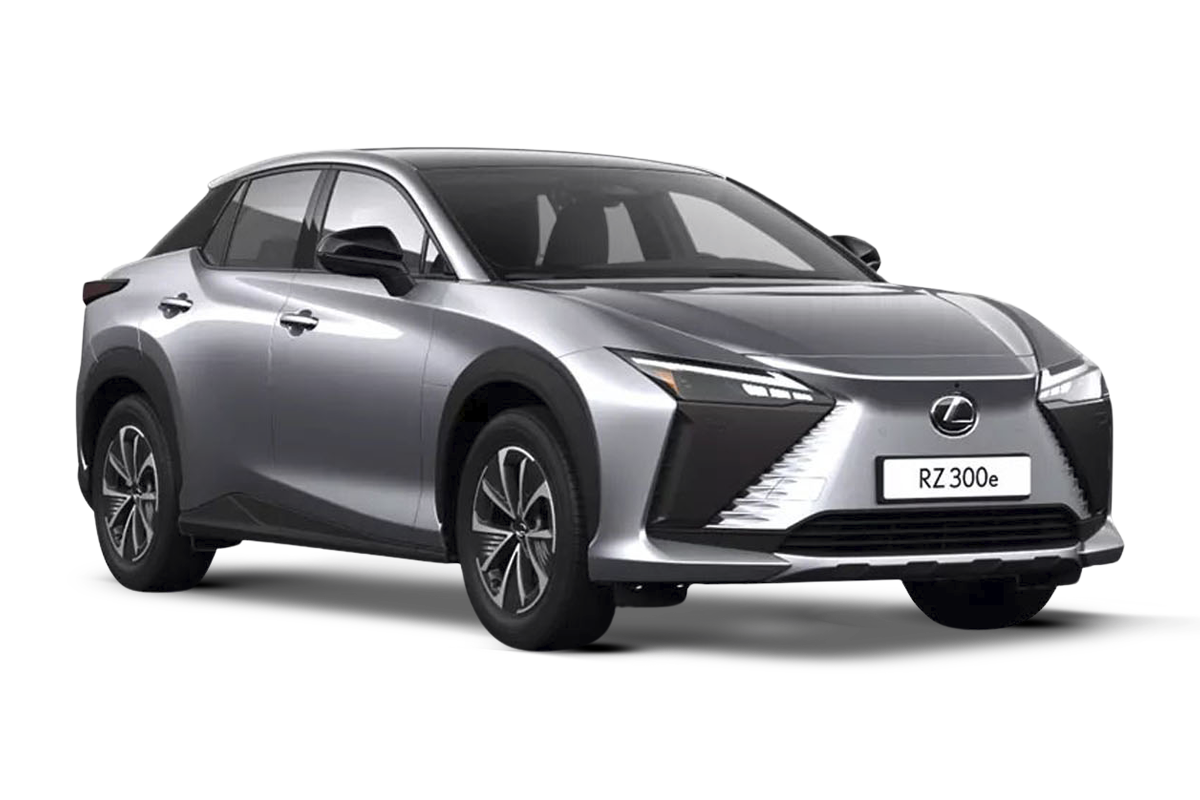
With 402bhp, the range-topping 550e AWD doesn’t feel noticeably quicker than the 500e, reflected by a 0-62mph time that’s barely any quicker, at 4.4sec. As a result, we don’t think it’s worth paying more based on performance alone.
However, what may entice you to splash the cash on the 550e is the Interactive Manual Drive function. Press the M button on the center console and it makes the RZ drive as though it has an eight-speed gearbox. The paddles used to adjust the regenerative braking now shift up and down the simulated gears and it responds quickly, while a small kick is accompanied with each “shift” to make it feel like a proper mechanical gear change.
It’s quite realistic in that you can’t change down too many “gears”, and when you’re in too high a gear, it takes time to build up power again before getting into its stride - behaving like a petrol or diesel engine would. If anything, the downshifts are more convincing than the upshifts, because you also experience some (imitation) engine braking.
Overall, it works better than the Kia EV6 GT’s virtual gearshift, helped by a digitised sound that changes tone as it builds up towards the limiter to help you judge the timing of your gear shifts.
At most speeds, the RZ is generally a pleasure on a sweeping country road. There's plenty of grip from the tyres, the nose turns in accurately and the steering wheel gives a reasonable sense of connection with the front wheels, with weight building reassuringly as you apply lock on the way into a corner.
The four-wheel drive versions maintain a high level of traction to help you make use of the extra power when exiting a corner, with the system actively shuffling power to deliver a neutral 50:50 bias.
There's a bit more body lean than in a Kia EV6 and the RZ doesn't feel quite as well tied down as that car when tackling crests and troughs in rapid succession. However, it’s still tidier than the Hyundai Ioniq 5 and slightly taller Nissan Ariya. F Sport trim (limited to the 550e) comes with firmer suspension to benefit handling, but it makes little difference.
A feature that has been introduced with the 550e is the steer-by-wire system, which replaces the conventional (round) steering wheel with an aeroplane-style yoke that has no upper or lower section. The "wheel" doesn’t have a physical connection with the front wheels and your inputs are sent electrically to a motor on the steering rack, which moves the wheels at a varied rate.
There’s a back-up controller in the unlikely event the first one fails, and the system does bring some advantages. For one thing, you only need to apply 200 degrees of steering angle to go from the wheels pointing straight ahead to full lock, so you never need to take your hands off the wheel or feed it through your hands.
The steering ratio is incredibly quick at low speeds – something that takes additional concentration and a bit of time to get used to because tiny inputs have a big say on the direction of the car. However it never makes the car feel twitchy or nervous. At higher speeds the response calms down significantly and feels natural enough so that you can build up a rhythm easily on a sweeping country road.
We’re not entirely convinced the benefits are worth the premium, but we can see this being a novelty that some owners will be willing to commit to.
The RZ’s suspension setup is firmer than a Genesis GV60’s, but it deals with bumps in a well controlled manner, especially when fitted with 18in wheels. The larger 20in alloy wheels do transmit lumps and bumps a bit more, especially over sharper ridges, but it still manages to take the sting out of them. This is the same for the stiffer F Sport trim, even if it doesn’t settle down as often.
In fact, you’ll hear a thump from the larger tyres more than feel it, otherwise there’s very little road noise. The RZ is quiet on the move, even by electric car standards, with hardly any motor whine or wind noise. The consistent brake pedal response makes it easy to come to a smooth stop as well.
Meanwhile the regenerative braking system activates smoothly. Even in its strongest setting (there are four levels to choose from), the braking effect kicks in gradually and makes it easy to modulate your speed.
With a total battery capacity of 77kWh (usable capacity has yet to be confirmed), the RZ travels the furthest when fitted with 18in wheels on the 350e (353 miles) and 500e (311 miles). That means the 350e is a little better than the Toyota bZ4x (up to 317 miles), the Genesis GV60 (up to 321 miles) and Tesla Model Y Rear-Wheel Drive (311 miles). Go for the 20in wheels and this drops to 316 miles and 283 miles respectively, while the 550e has the shortest official range of 280 miles. However the Model Y Long Range can travel even further (387 miles) while costing slightly less.
We calculated a real-word range of around 285 miles with the 500e on a mixture of motorway and country roads, which is an improvement over the previous version’s official 251-mile range.
“In some EV’s, the Eco drive mode completely dulls down the car’s performance and can leave you floundering when you need to go for a gap in traffic, but I’m glad even the least powerful RZ still drives with enough gusto.” – Lawrence Cheung, New Cars Editor

Interior
The interior layout, fit and finish
Strengths
- +Excellent seating position
- +Clever heating system
- +Great material used throughout
Weaknesses
- -Control layout on ’Yoke’ steering wheel take time
- -The GV60’s infotainment rotary controller is easie
One of the reasons the efficiency (and range) of electric cars plummets in cold weather is because lots of energy is used to keep the interior warm. To help with this, Lexus has fitted small infrared heaters to all versions of the Lexus RZ.
They radiate heat to your legs and those of your front passenger to make you feel as though you’ve got warm blankets on your knees – and they use just 170W. Around 5000W is used if you fire up the main climate control system, so the potential savings are huge. We found we needed the heated seat and steering wheel on as well to stay comfortable without wearing a coat, but even with those working, you’ll be quids in on your energy usage.
That means you’ll get to spend more time in the RZ’s interior between charging pit stops. And that’s a good thing, because it feels really robust inside, with plenty of classy materials on the dashboard and the insides of the doors. The upholstery in range-topping Takumi versions does a passable impression of suede, but is in fact made out of a combination of recycled and biodegradable materials.
The 14.0in infotainment touchscreen in the centre of the dashboard is decent enough, but does have the disadvantages of any touchscreen-only system. That means it’s more distracting to use on the move than the system in the Genesis GV60 – which has a rotary dial interface so you don’t need to worry about pressing icons while driving. At least the screen is positioned within close reach and the menu layout is mostly logical.
The fundamental driving position in the RZ is superb, thanks to a comfortable and supportive seat, and plenty of electric adjustment. Although you sit closer to the road than in most rivals, the RZ still just about feels like an SUV.
That means you also get a clear view ahead and it’s easy to see over the bonnet. While the front pillars don’t obscure your view at junctions, the rear pillars are very wide, so the view over your shoulder is compromised. The rear windscreen is also quite narrow, but all versions come with a rear-view camera and front and rear parking sensors to help out. Go for Premium Plus trim and this adds a 360-degree view camera.
Regardless of whether you have the conventional steering wheel or the small aeroplane-style yoke version on the 550e version, it’s easy to see the digital driver’s display. This is one area where the RZ has the advantage over the Toyota bZ4X, because you view the display in a binnacle that’s positioned lower down (in the bZ4X, it’s positioned high up and can be obscured by the top of the wheel). There’s also a head-up display that’s clear and easy to read as standard on Premium Plus trim and above.
Sadly, while the positioning of the yoke steering wheel makes it easy to hold, the control layout could be better. You still have stalks for the indicators and wipers in the conventional ‘nine and three’ position, but because they’re located on the back of the wheel, it’s easy to mistake them for paddles you’d normally use to adjust the regenerative braking (or activate the manual gearbox mode to change gear) in other EVs. As a result, some drivers may need time to readjust their muscle memory to prevent, for example, flashing the headlights when they actually want to change down a gear.
Instead, you adjust the regenerative braking (or the simulated gears), by using two slightly shorter stalks mounted higher up on the back of the wheel. At this point, some may find it’s like they’re operating something similar to a gaming controller.
What’s more, the fact that all the stalks move with the wheel as you turn will initially feel awkward, and while it does get easier over time, the overall set-up feels more like a novelty, rather than something that makes life more convenient.
“The controls on the yoke steering wheel take time to get used to, but I reckon simply swapping the centrally placed indicator/wiper ones with the higher-set ones for the regenerative braking ones would help it feel more intuitive.” – Lawrence Cheung, New Cars Editor

Passenger & boot space
How it copes with people and clutter
Strengths
- +Vast rear leg room
- +Bigger boot than many rivals
- +Lots of interior storage spaces...
Weaknesses
- -...but no glovebox
- -Rear seats don't slide
The Lexus RZ is based on the Toyota bZ4X and like that car, provides plenty of head, leg and elbow room for a pair of six-footers up front.
There’s also lots of storage space on the two-tier centre console, with a pair of cupholders, a large cubby under the centre armrest and a wireless charging tray for your phone on the upper section. The only slight flaw is that there isn’t anything to stop your device from sliding out when cornering. While there is a long storage area on the lower section, the door bins are fairly small and, unusually, the RZ doesn’t have a glovebox. Like in the Toyota bZ4X and Subaru Solterra, that space has been taken up by a radiant heater to warm up the passenger’s knees.
For those sitting in the back, the RZ has a frankly ridiculous amount of leg room for a six footer, while a flat floor makes life easy for a middle rear seat passenger and there’s more than enough head room to accommodate tall people. The only area that feels a bit limited on space is under the front seats, so you can’t tuck your feet underneath them. That said, many rivals, including the Kia EV6, also suffer from this.
Overall, the RZ is one of the most practical electric SUVs on sale, and while the rear seats don’t slide back and forth (as they do in the Hyundai Ioniq 5), you can adjust the angle of the rear seatbacks slightly.
At 522 litres, the RZ has a slightly bigger boot than its bZ4x stablemate (452 litres), with plenty of underfloor storage for the charging cables. That makes the absence of any additional stowage under the bonnet less of an issue and should mean you have space for more than eight carry-on suitcases (the amount the bZ4X swallowed in our tests).
There’s no lip at the entrance of the boot, and the load bay is broad towards the very back of the car – ideal for carrying golf clubs. All versions come with 60/40 split-folding rear seats and a powered tailgate.
“Even though all versions of the RZ come with a panoramic glass roof, it doesn’t eat into head room and there’s plenty of clearance for my height of 5ft 11in.” – Lawrence Cheung, New Cars Editor

Buying & owning
Everyday costs, plus how reliable and safe it is
Strengths
- +Plenty of standard equipment
- +Lexus has a superb reputation for reliability
Weaknesses
- -Tesla Model Y is cheaper
- -So-so charging speeds
The starting price of the Lexus RZ undercuts that of the Genesis GV60 and costs significantly more than entry-level versions of the Hyundai Ioniq 5, the Kia EV6 and Tesla Model Y, so it’s hardly a budget electric SUV option. Even the most expensive version of the slightly smaller Tesla Model Y (which has a longer range and quicker charge time) costs about the same as an entry-level RZ.
For company car drivers, that means the slightly higher P11D price makes it a touch more expensive per month when paying via salary sacrifice, although the difference will be small.
In terms of charging speed, the RZ's maximum rate of up to 150kW means a 10-80% top-up can be completed in around half an hour with a powerful enough charger. That’s provided the battery has been pre-conditioned, which can be activated manually in the infotainment system (or automatically if a charger has been set as a waypoint on the sat-nav). Without it, this will take more time to charge, especially in colder temperatures. A Tesla Model Y takes a few minutes less, although the Audi Q6 e-tron Sportback and Genesis GV60 can perform the same top-up in around 20 minutes. A full 0-100% charge at home using a regular 7kW wall box will take around 10 hours.
You get plenty of standard equipment, with entry level Premium fitted with 18in alloy wheels, dual-zone climate control, heated front seats, a heated steering wheel, keyless entry, a panoramic roof and faux-leather upholstery. Head up to Premium Plus and this adds ventilated front seats, and the head-up display, 360-degree parking camera and memory seat function for the driver’s seat.
The range-topping Takumi gets 20in wheels, gloss back wheel arches, additional ambient lighting, suede upholstery and heated rear seats. Tempting as all this might seem, we reckon this trim is too expensive to recommend.
F Sport and F Sport Takumi bring a sportier appearance, with tweaked bumpers, blue brake calipers, a rear spoiler, plus the steer-by-wire system. The two Takumi versions also come with a dimmable panoramic roof.
All trims come with loads of safety features, including nine airbags, automatic emergency braking (AEB), blind-spot monitoring, a driver attention monitor and a system that warns you of approaching vehicles when you’re reversing out onto a road. They helped the RZ score the maximum five-star safety rating when it was tested by Euro NCAP.
Lexus did very well in our 2025 What Car? Reliability Survey, coming second out of 31 brands (it had been at number one for several years, but was beaten by Mini this time round). The RZ comes with a three-year warranty but that can be extended to 10 years/100,000 miles if you have your car serviced each year at an official centre.
“I like how well the bi-tone paint finish works with its black roof and bonnet contrasting against the more vibrant colours. Go for Premium Plus trim and above to get this as an option.” – Lawrence Cheung, New Cars Editor
For all the latest reviews, advice and new car deals, sign up to the What Car? newsletter here

FAQs
The starting price of the RZ is significantly less than the Genesis GV60 and about the same as an entry-level Kia EV6. You can check the latest prices using our New Car Deals pages.
Total range depends on which wheel size you have. The entry-level version on 18in alloys can officially cover up to 353 miles, while cars on the larger 20in wheels have an official range of 280-316 miles, depending on trim level.
| RRP price range | £48,395 - £69,995 |
|---|---|
| Number of trims (see all) | 5 |
| Number of engines (see all) | 1 |
| Available fuel types (which is best for you?) | electric |
| MPG range across all versions | 0 - 0 |
| Available doors options | 5 |
| Company car tax at 20% (min/max) | £100 / £134 |
| Company car tax at 40% (min/max) | £200 / £267 |

