Volkswagen Amarok review

Category: Pick-up

The Amarok is a fine pick-up truck that's good to drive by class standards

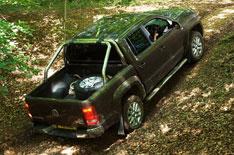
VW Amarok front cornering
  • VW Amarok front cornering
  • VW Amarok rear cornering
  • VW Amarok interior dashboard
  • VW Amarok tailgate
  • VW Amarok driver display
  • VW Amarok left driving
  • VW Amarok front driving off road
  • VW Amarok front driving
  • VW Amarok rear right driving
  • VW Amarok rear right driving off road
  • VW Amarok front detail
  • VW Amarok alloy wheel detail
  • VW Amarok side detail
  • VW Amarok rear detail
  • VW Amarok front seats
  • VW Amarok interior seat detail
  • VW Amarok interior back seats
  • VW Amarok interior infotainment
  • VW Amarok interior detail
  • VW Amarok front cornering
  • VW Amarok rear cornering
  • VW Amarok interior dashboard
  • VW Amarok tailgate
  • VW Amarok driver display
  • VW Amarok left driving
  • VW Amarok front driving off road
  • VW Amarok front driving
  • VW Amarok rear right driving
  • VW Amarok rear right driving off road
  • VW Amarok front detail
  • VW Amarok alloy wheel detail
  • VW Amarok side detail
  • VW Amarok rear detail
  • VW Amarok front seats
  • VW Amarok interior seat detail
  • VW Amarok interior back seats
  • VW Amarok interior infotainment
  • VW Amarok interior detail

What Car? says...

The Volkswagen Amarok is something of a legend in the world of pick-up trucks, even though it’s been around for only a decade or so – but this newest version is a bit different in a number of ways.

You see, the latest Amarok is the result of a commercial vehicle partnership between Volkswagen and Ford, and is very closely related to the Ford Ranger (they're even built at the same factory). Don’t worry though – there’s more than just a badge to distinguish the two models. For starters, they look very different to each other.

As with its rivals, you get four-wheel drive and a diesel engine as standard but – unlike the Ranger, Isuzu D-Max – the Amarok is only available in a larger double-cab bodystyle (with four doors and rear seats).

So, is the VW Amarok good enough to negate that fact and take on the best pick-up trucks? That's what we’re going to find out in this review, as we test it in all the important areas, including performance, payload and towing ability.

Overview

The VW Amarok is a very fine pick-up truck that’s strong, practical and good to drive by class standards. Its biggest downfall is that the closely-related Ford Ranger offers much of the same and has a slightly more user-friendly interior for less money. If you’re still set on an Amarok, we’d suggest choosing the mid-range Style trim with the entry-level 202bhp 2.0-litre engine.

  • Big cargo bay with a high payload capacity
  • Good to drive for a pickup
  • Space for four six-footers inside
  • More expensive than rivals
  • Ranger Raptor is more comfortable and fun
  • Fiddly air-con controls

Performance & drive

What it’s like to drive, and how quiet it is

Strengths

  • +Punchy engines
  • +Tidy handling
  • +Relatively hushed, even at speed

Weaknesses

  • -Slightly hesitant auto gearbox
  • -Ford Ranger is even better to drive

The VW Amarok’s engine range consists of a 202bhp 2.0-litre diesel and the range-topping 237bhp 3.0-litre V6 diesel. Both come with a 10-speed automatic gearbox as standard.

Both these engines are shared with the Ford Ranger, although that rival is available with a cheaper 168bhp version of the 2.0-litre fitted with a six-speed manual gearbox.

Both engines are strong and pull smoothly from low speeds. From a performance point of view, we don’t think the 3.0-litre V6 gives a significant boost in performance or a towing advantage (all Amaroks can tow 3,500kg) over the entry-level 202bhp engine, so we'd pick the smaller option.

Regardless of which you go for, the gearbox is fairly responsive, but with 10 gears to sift through it can take a moment or two to calculate which is best used when you need a burst of acceleration.

While the Ford Ranger Raptor remains the most comfortable-riding pick-up truck, it sacrifices load-carrying capacity to achieve that and the Amarok still has a calmer low-speed ride than its rivals. You wouldn’t describe the Amarok’s ride comfort as "sophisticated"; the occasional shimmy over bumps is the main reminder that you’re driving a pick-up truck – but it's less wearing than it is in the Isuzu D-Max, KGM Musso and Toyota Hilux.

In the corners, it’s a much better state of affairs because, like the closely related Ranger, the Amarok handles surprisingly well for a pick-up truck. True, if you're comparing it with an SUV you'll find it pretty poor, and it feels out of its depth on a twisty road, but it does resist body lean in a way that makes it more comfortable than most rivals.

Volkswagen Amarok image
Choose your perfect car

If you approach a tight corner with any exuberance, there's not a great deal of grip. However, the steering is fairly accurate and not too heavy, making it easy to drive at low speeds around town or on faster A-roads and motorways.

Engine noise is well isolated, and while some minor vibration is felt through the floor and controls, there’s much less of it than there is in rivals. Wind and road noise are acceptable, meaning it’s relatively hushed on motorways.

This second-generation Amarok has shorter overhangs, an improved wading depth (of 800mm) and an optional rear locking differential (standard with the PanAmericana trim), so it’s a safe bet that it's better in the rough stuff than the previous version.

If you want something with greater off-road focus, consider the Isuzu D-Max AT35 and Ranger Raptor, which come with extra knobbly tyres and have greater ground clearance.

"The V6 diesel may not be much quicker on paper, but I appreciate it being smoother and quieter than the 2.0-litre. It makes the Amarok feel less agricultural than its rivals." – Lawrence Cheung, New cars editor

VW Amarok rear cornering

Interior

The interior layout, fit and finish

Strengths

  • +Good driving position
  • +Good visibility
  • +Feels more upmarket than most rivals

Weaknesses

  • -Fiddly climate control system
  • -Doesn’t feel so different to a cheaper Ford Ranger

Inside, many of the VW Amarok's fundamentals are the same as you’ll find in the Ford Ranger including the excellent driving position with lots of adjustment and a comfortable seat.

Despite the size of the Amarok, it’s really easy to judge where all four corners of the car are, largely thanks to the really lofty driving position. Large windows and thin pillars front and rear means all-round visibility is also good. 

To make parking easier, front and rear parking sensors are fitted as standard. It’s worth noting that Style is now the entry-level trim (the lower-spec Life is no longer available) so you also get a 360-degree view camera.

Inside, the general design is very similar, with the same gear lever and other basic switchgear, although the Amarok gets bespoke seats, a Volkswagen steering wheel, slightly different air vents and a different layout for the centre console.

Annoyingly, one thing the Amarok doesn't share with the Ranger is physical buttons or dials for the climate controls. Instead, you have to adjust the temperature and other settings by prodding and swiping on the infotainment touchscreen. The small icons are also positioned at the bottom of the screen, making it far more distracting to use than it is in the Ford Ranger, or indeed most rivals, including the Isuzu D-Max, KGM Musso and Toyota Hilux

Like in the Ranger, the Amarok's infotainment touchscreen (10.1in on the cheapest version and 12.0in with Style trim and above) is portrait-oriented. It’s the same hardware and operating system as in the Ranger, with sharp graphics and a fairly quick response. The menus are slightly different and more tricky to get to grips with, but at least all versions come with Android Auto and Apple CarPlay smartphone mirroring.

The Harman Kardon sound system has no issues drowning out any road noise. The sound quality is a little harsh, though.

All Amaroks get a digital driver’s display, but it's the larger 12.3in display you get with Style trim or above that really impresses. Unlike the entry-level car’s 8.0in screen, the 12.3in screen shows you all the info you could ever need. It’s more functional than the Ranger’s, and much sharper than the one in the D-Max.

You’d hardly describe the interior as "classy", and there are plenty of hard and scratchy plastics throughout. Even so, these plastics are nicer than those used in a Musso or a Toyota Hilux, while the buttons and switches are well-damped. In higher-spec PanAmericana and Aventura trims, a leather-look finish on the top of the dashboard, front centre armrest and the insides of the doors help it feel a bit more upmarket.

That said, the Amarok still feels more like a Ford model than a VW, with Ford stalks, window switches and gear lever, so it doesn’t quite justify the price premium over that rival.

"I quite like that the PanAmericana sets some brown leather that adds a bit of colour to the Amarok’s interior, but don’t think it’s a luxury version - it’s feels thin and the pattern is rough to touch" – Lawrence Cheung, New cars editor

VW Amarok interior dashboard

Passenger & boot space

How it copes with people and clutter

Strengths

  • +Loads of passenger space
  • +Competitive payload rating

Weaknesses

  • -Rear seats aren’t quite as versatile as a Hilux’s
  • -No single cab option

The latest VW Amarok is longer than the previous-generation version by 96mm, giving passengers in the back seats even more leg room. Head room is excellent too, and four six-footers will be perfectly comfortable, even on fairly long jaunts.

Storage space is good, with a pair of cupholders, two gloveboxes, a tall centre cubby underneath the armrest and a wireless charging tray. The door bins can each hold a drink, although access is a bit tricky because of the doors armrest above it.

You get some neatly integrated storage pockets on the seat base, but unlike in the Toyota Hilux, the rear seat base doesn’t fold up to free up internal space.

More importantly, for many pick-up truck buyers at least, the model has a maximum payload of 1.13 tonnes (up 40kg on the previous version) and the cargo bed can take two Euro pallets slotted in sideways.

Like with the Hilux, the absence of a single cab bodystyle means you can’t trade the rear seats to maximise the payload weight (a single cab Ford Ranger or Isuzu D-Max has a payload of around 1,200kg, for example).

There are lashing rings to tie down loads of up to 400kg in the bed, which is 526mm tall and can be secured with an optional manual or electric roll cover. You can also spec a hardtop, which essentially turns your pick-up into a van or SUV (depending on your viewpoint).

When parked up, it can take up to 350kg on its roof – enough for the optional roof tent. When you’re driving, the roof can manage up to 85kg. As well as the tent, the hardtop and various roll covers for the cargo bed, accessories include a bike carrier and a diverse range of styling bars.

"At 5ft 11in, I find the Amarok one of the most comfortable pickup trucks around, with a bit more leg room than in a Hilux" – Lawrence Cheung, New cars editor

VW Amarok tailgate

Buying & owning

Everyday costs, plus how reliable and safe it is

Strengths

  • +Plenty of standard equipment
  • +Lots of trim choices
  • +Slow depreciation

Weaknesses

  • -You’ll pay a premium over rivals

The VW Amarok is significantly more expensive to buy than the Ford Ranger. If you’re simply looking for a workhorse and can manage with a single-cab truck there are cheaper pick-up truck rivals, including the Isuzu D-Max and Toyota Hilux

Helping to make up for the difference, the Amarok is predicted to hold on to its value better than all its rivals, which may result in more competitive PCP finance rates

Unfortunately, the Amarok’s high CO2 output means it’s a pricey option if you’re a company car driver paying BIK tax.

The 2.0 diesel will be a better bet when it comes to maximising fuel economy with official figures of more than 30mpg. That said, it only managed to average around 26mpg during our time with the car, while the V6 diesel managed to match its official 28mpg figure.

The entry-level Life trim is well equipped, and includes 17in alloy wheels, air conditioning, automatic LED headlights, LED front foglights, adaptive cruise control, a rear-view camera, rear parking sensors, rain-sensing wipers and heated door mirrors.

Stepping up to Style trim will cost you a fair chunk more, but we think it’s worth the jump. It adds loads of other kit including bigger 18in alloys, ambient lighting, dual-zone climate control, heated front seats, matrix LED headlights, an electrically adjustable driver’s seat, a larger infotainment screen, a configurable driver’s display, front parking sensors and a 360-degree camera.

PanAmericana is next up the trim ladder and has more of an off-road focus. It comes with the locking rear differential (which is optional on Style trim), but also has leather seats, rubber floor mats, additional front underbody protection, an eight-speaker Harman Kardon sound system and LED bed lighting.

At the top of the range sits the Aventura, which adds 21in alloys, a heated steering wheel, park assist and some chrome exterior styling cues.

Like the Ranger, the Amarok achieved a full five-star safety rating when it was tested by Euro NCAP and scored particularly well in the child occupant protection category. All models have lots of safety kit, including automatic emergency braking (AEB), traffic-sign recognition and lane-keeping assist. 

When it comes to reliability, the Amarok is built in a Ford factory using Ford-sourced parts. Coincidentally, both VW and the US brand finished in 24th place in our 2025 What Car? Reliability Survey.

 "Our preferred Style trim is the only one available with optional extras, but we’d consider these carefully, since they push up the price considering to match the more expensive versions" – Lawrence Cheung – New cars editor


Buy it if…

- You’d like a pickup truck that’s good to drive

- You’re looking for a pickup with a modern interior

- Need a pickup that’s spacious for four adults 

Don’t buy it if…

- Need the most affordable pickup to buy

- Need a more practical single-cab option

- Want to avoid relying on touchscreen controls


For all the latest reviews, advice and new car deals, sign up to the What Car? newsletter here


VW Amarok driver display

FAQs

  • They are very similar and are built at the same factory but the Ford Ranger has different styling and equipment to the Amarok.

  • The Amarok is a great pick-up truck offering strong engines, impressive practicality and good driving characteristics. That said, it’ll cost you more than its rivals, including the closely-related and brilliant Ford Ranger.

  • While every Amarok comes with four-wheel drive you can use a small controller on the centre console to switch between two and four-wheel drive.