Porsche Cayenne Electric review
Category: Electric car
All-electric version of Porsche’s flagship SUV promises supercar pace with everyday usability


What Car? says...
It’s fairly common for movie writers to introduce a long-lost sibling into a movie sequel, and when you take a look at the Porsche Cayenne Electric, you’d perhaps think it was separated at birth from its petrol-powered stablemate. Think of it as Gru and Dru from Despicable Me 3: they look similar and yet they have individual features that characterise them differently.
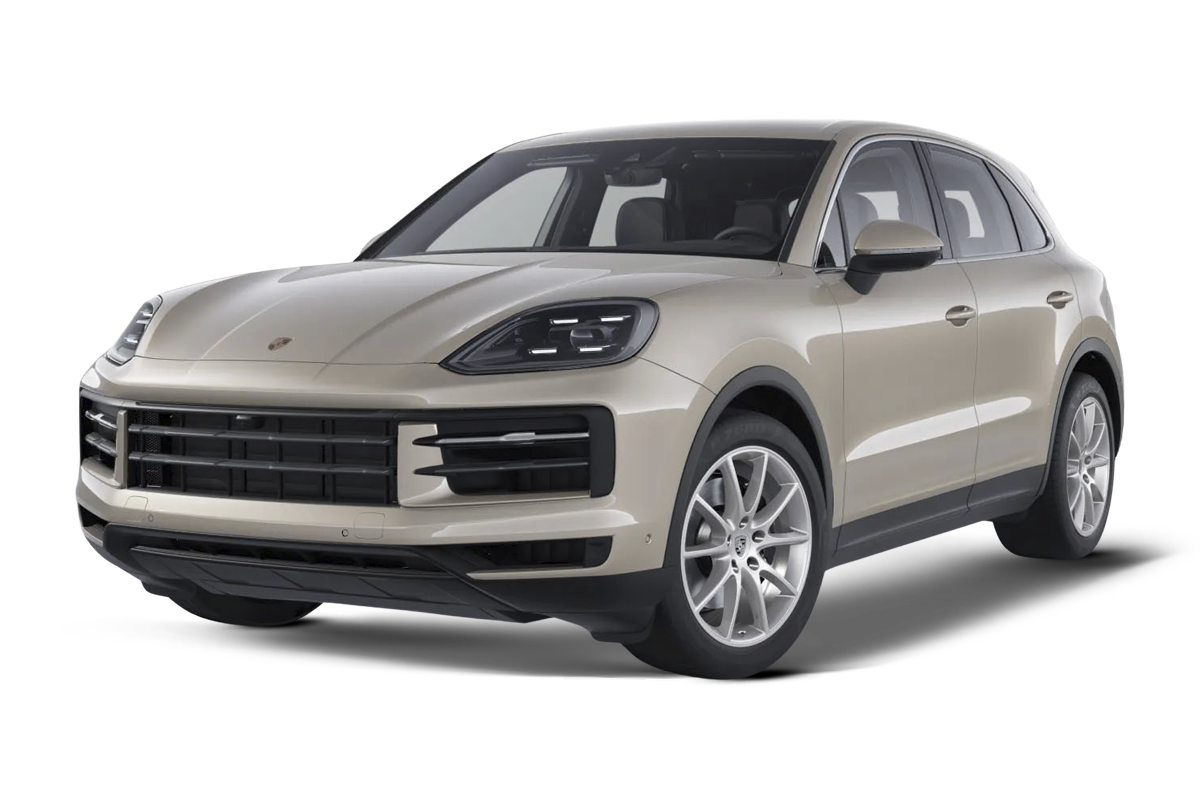
So what are we looking at here? Well the Cayenne Electric comes with a cleaner design than the petrol model it will sell alongside with. You’ll notice the absence of a big, wide grille up front and a rear bumper that doesn’t have any exhaust tips poking out of it.
Without an engine, the Cayenne Electric will go about its business in a more hushed manner, but if that all sounds a bit restrained for you so far, it still promises to blend agility with huge performance over its rivals. How huge? Well, the most powerful version can briefly produce up to 1140bhp - that’s more than the already scarcely believable 1020bhp from a Porsche Taycan Turbo GT.

And what does the Cayenne Electric have to compete with? In the world of sports electric SUVs, the class is relatively small and perhaps the most obvious rival at this size and price is the Lotus Eletre. The BMW iX and Polestar 3 may be more comfort-biased but they can match the entry-level Cayenne Electric on pace.
What’s new?
- June 2026: Review updated with driving impressions of mid-level S version
- May 2026: Deliveries of the Porsche Cayenne Electric are due to arrive in the UK
Performance & drive
What it’s like to drive, and how quiet it is
Strengths
- +Controlled ride on air suspension
- +Serious performance with Turbo
- +Good range and fast charging
Weaknesses
- -BMW iX has an even longer range
- -Slightly fidgety ride in firmest setting
- -Big battery means charging at home takes an age
How fast is it and which motor is best?
All versions of the Cayenne Electric come with two electric motors to deliver its power to all four wheels – and you won’t be short on power in any version.
Even the entry-level Cayenne Electric produces up to 436bhp when you activate launch control. Do so, and it can sprint from 0-62mph in 4.8sec, making it almost as quick as the BMW iX xDrive60, the entry-level Lotus Eletre 600 and Polestar 3 Dual Motor. There’s plenty of performance for most buyers, but, because it builds up its power quite gently, it never feels that quick. If you’re after proper sports SUV performance, it might leave you wanting.
The 657bhp output of the mid-spec may be more appealing to some, as it sprints from 0-62mph in 3.8sec. It, predictably, feels a good deal faster as well, because the extra power is felt sooner.
For maximum thrills, you’ll want to look at the extremely potent Turbo. Activating launch control unlocks a (frankly ridiculous) output of 1140bhp, which means this 2.6 tonne family SUV achieves a 0-62mph time of 2.5sec – that’s about the same time as the Bugatti Veyron hypercar.
Is it agile and is the ride comfortable?
While the Cayenne Electric feels its width when you initially thread it down some city streets, you soon forget about its size once you start flowing down a country road.
Even in its softest Comfort mode, the Cayenne has little body lean when cornering and precise steering that helps you quickly build up confidence. As you switch your way up to Sport (and Sport Plus with the Sport Chrono Package), you incrementally firm up the standard-fit air suspension and lower the ride height to improve the car’s composure, while the steering builds up more weight to help it feel engaging.
It’s worth noting the cars we’ve driven have been fitted with optional Pirelli P Zero performance tyres (the latter gets an even stickier set of P Zero Rs). There’s a huge level of grip in each version, but it’s the car’s eagerness to tuck its nose into corners that sets it above its rivals.
What’s even better is that the Turbo comes with torque vectoring and a limited-slip rear differential that not only maximises traction, but also allows for a touch of rear-biased playfulness that’s missing in the standard model and the Lotus Eletre. These features are available as optional extras on the S model.
Rear-wheel steering is available as an option on all versions. This reduces the turning circle and helps the Cayenne Electric turn in more eagerly at slower speeds, increasing manoeuvrability around town.
You’d be right in thinking the BMW iX has a softer, more cossetting ride, but the Cayenne Electric’s air suspension still does a great job of isolating occupants from the road in a very controlled manner. You barely hear potholes, for example, let alone feel them, and the car feels well tied down over undulating roads.
A small compromise is that the stiffest Sport Plus setting – which comes as part of the optional Sport Chrono pack on standard and S models – results in a slightly fidgety ride on the 22in wheels we’ve tried so far. Even so, you’re barely jostled around in your seat when dealing with potholes or speed bumps.
Both S and Turbo models are available with an Active Ride system that promises to further improve comfort. It very quickly softens to absorb speed bumps and potholes, for example, but it will also stiffen up certain corners to counteract the car from pitching or leaning too much and keep the car as level as possible. It works pretty well, but we feel that it could absorb bumps with a bit more control. As a result, we reckon most buyers will be more than happy with the standard setup.
To slow the Cayenne down, the car’s regenerative braking system does most of the work. It’s powerful enough that it only uses the friction brakes under hard braking.
Is it quiet and how easy is it to drive smoothly?
Unless you’re experiencing the Turbo’s brutal launch control system, the power delivery in all versions builds up gently and it’s very easy to drive the Cayenne Electric in a smooth and relaxed manner. Meanwhile, the brake pedal is responsive and well weighted to help you judge your inputs accurately.
The Cayenne’s smooth regen braking system recoups energy as you slow down, but the braking effect when you lift off the accelerator is mild. There isn’t a setting strong enough to act as a one-pedal driving mode and you simply choose between on, off or Auto. The latter varies the strength based on sat-nav data or the distance between you and the vehicle ahead.
There’s a mild level of road noise from the wide tyres, along with a faint thump over harsher potholes and ridges when driving in its firmest Sport Plus mode, but there’s barely any wind noise or any motor whine. It’s quieter than the Lotus Eletre, although the BMW iX is even more hushed if you want a really peaceful cruiser.
What’s the range and efficiency like, and how quickly can it charge?
With an official range of around 400 miles, both the entry-level Cayenne and Cayenne S Electric travel the farthest on a full charge. That’s a bit better than the Lotus Eletre (up to around 370 miles) and about the same as the Polestar 3 Dual Motor. A BMW iX xDrive60 can travel up to 426 miles, though.
On paper, there isn’t a big penalty in range by going for the Turbo, which drops to 383 miles. That’s still a bit better than the iX M70 (at around 365 miles), although you’re unlikely to match the official range in real-world conditions. Over a mixture of country roads and motorways, the entry-level version indicated a real-world range of around 300 miles.
The sleeker shape of the Porsche Cayenne Coupé Electric means it slips through the air a little more efficiently, and it can travel a few miles farther than the regular SUV as a result.
Every Cayenne Electric is powered by a large, 108kWh (usable capacity) battery, and if you charge it at home from a 7.4kW wallbox, it’s estimated to take more than 17 hours to charge it from 0-100%. If you can find one of the few ultra-powerful 800v public chargers, the Cayenne Electric’s maximum charging rate of 400kW is impressive. That means a 10-80% charge could take as little as 16 minutes, which edges ahead of the Polestar 3 requiring 22 minutes for the same top up, at a peak rate of 350kW.
Plug into a more common 400v public charger and a 10-80% top takes at least 26 minutes. That’s still better than the BMW iX, which takes around 35 minutes and has a peak of 195kW.
“The Cayenne Electric’s rapid charging speed is impressive, and I’ve seen Porsche officially claim that you can achieve this when the battery is between 10-50% charged." – Lawrence Cheung, New Cars Editor

Interior
The interior layout, fit and finish
Strengths
- +Comfortable driving position
- +Useful physical buttons and shortcut icons
- +Lots of personalisation options
Weaknesses
- -Lumbar adjustment optional on cheaper versions
- -Rear visibility could be better
- -Fiddly air vent controls
What does the interior look like and is it well made?
The Porsche Cayenne Electric’s interior looks more modern than the petrol version’s. You can have up to three big screens, and the result is fewer physical buttons on the lower centre console.
Like the Lotus Eletre, it has a high-set dashboard and raised centre console that wraps around you. There’s plenty of soft materials, while the fit and finish is excellent, with most parts feeling robust.
Even the entry-level version feels plush and comes with a wide selection of colours for the upholstery. You can further add to this by colour coding the seat belts or choosing from a range of trim finishers, including carbon fibre, wood or brushed aluminium.
Is the driving position comfortable and is it easy to see out?
There’s plenty of adjustment available to help you find your ideal driving position. The steering column has a good range of rake and reach adjustment, which you do so electrically on the Turbo version.
The non-Turbo versions have eight-way electrically adjustable seats, but it’s a shame you have to pay extra for the optional 14-way electrically adjustable items in order to get adjustable lumbar support. The Turbo gets 18-way adaptive sport seats that allow you to adjust the side bolstering on both the backrest and seat base to hold you more securely when cornering.
Being an SUV, you sit relatively high up compared with a Porsche Panamera or Taycan. It’s easy to see over the bonnet, and while the front pillars are quite substantial, the way they slope far ahead of you means they’re easy to look around.
Chunky rear pillars and a narrow rear windscreen obstructed by three headrests means the view over your shoulder and out back isn’t so clear. That said, all versions come with front and rear parking sensors and a 360-degree-view camera.
Matrix LED headlights are fitted to every version, which actively dim certain sections of the light pattern to prevent dazzling other road users. Go for S or Turbo models and these have an upgraded HD-Matrix system with even more pixels that can light up additional areas ahead of the car.
Are the dashboard and infotainment system easy to use?
Behind the steering wheel is a wide 14.25in curved digital driver’s display. The graphics are sharp and it offers a few layouts. Most impressive is the ability to view the in-built sat-nav map on there, which effectively fills the whole screen. There’s otherwise plenty of other information on display, including speed, battery range and trip data. The only slight downside is that some drivers may find the top section of the display can be partially obscured by the steering wheel if it’s set too low.
What’s even better is the touch-sensitive shortcuts on either side of the display that allow you to adjust the car’s settings, including the firmness of the air suspension, ride height and parking cameras; in some cars, these are buried in the touchscreen infotainment system.
Helpfully, you get some physical buttons on the steering wheel and centre console. The latter is mainly dedicated to the ventilation system, so you can easily tweak the interior temperature or fan speed. Perhaps our only big complaint is that you have to delve into a sub-menu on the centre touchscreen and swipe away to change the direction of the air vents. A simple physical slider is far less fiddly to use.
Speaking of which, the 12.2in infotainment touchscreen controls most of the car’s functions. This portrait display is also curved outwards towards the bottom to almost look like a ledge. It’s within close reach and it does make glancing down at it a bit easier.
There’s a lot to get your head around when it comes to finding functions in the numerous menus and sub-menus, and some of the icons are quite small. But, on the plus side, the screen has sharp graphics, a snappy response and there’s plenty of scope to customise widgets at the bottom of the screen for your most commonly used functions. Wireless Apple CarPlay and Android Auto are also standard.
There’s also an optional 14.9in passenger touchscreen that allows the passenger to play games, watch videos, view the sat-nav map and adjust a few settings. Sensibly, the screen has a filter that stops the driver from looking at it as soon as they select Drive.
A 10-speaker, 150-watt stereo comes as standard on non-Turbo models. A 14-speaker, 710-watt Bose stereo system is standard on the Turbo version.
“The Cayenne Electric generates a sound inside a bit like a V8 engine rumbling away when you accelerate in one of the sportier drive modes. I think it works quite well, but you can still switch it off separately.” – Lawrence Cheung, New Cars Editor

Passenger & boot space
How it copes with people and clutter
Strengths
- +Plenty of space for four tall adults
- +Versatile rear seats
- +Handy extra storage under the bonnet
Weaknesses
- -BMW iX better as a five seater
- -Not the biggest boot
How much space does it have for people?
At nearly five metres long, there’s no denying the Porsche Cayenne Electric is a big car. That’s great news for interior space, because there’s plenty of head, leg and elbow room in the front for taller folks. The cars we’ve tested so far have been fitted with a panoramic roof and there’s still plenty of clearance above your head.
You might expect the door bins to be a bit bigger (they can easily accommodate a 500ml drinks bottle, if not much else), however, storage options are plentiful on the centre console. Slide the lid forward and there’s a deep storage cubby that contains a wireless charging pad (with magsafe attachment for iPhones to hold it in place) and four USB-C ports. You’ll also find a pair of cupholders that can be removed (like a tray) to free up more space. There’s another storage tray tucked away below the touchscreen and sliding the centre armrest reveals another one beneath it.
In the rear seats, there’s plenty of head room and enough space to stretch out your legs. There’s also more room to tuck your feet under the front seats than in the BMW iX.
You can electrically slide the bench and recline the backrest to boost comfort.
The Cayenne is officially described as a ‘4+1’ seater, and the fifth seat in the middle of the rear bench is very much one you’d use occasionally for a short trip. It’s very narrow and the bolstering on the bench for the outer passengers will dig into your legs. There’s still plenty of head room, though and while a middle passenger will have to sit with their feet straddling a wide central tunnel it isn’t very tall, so you could at least rest a foot on it. The iX is more accommodating, with both a flat floor and rear bench.
How much room does it have for luggage?
With an official capacity of 506 litres, the Cayenne Electric’s boot is bigger than the Polestar 3’s (484 litres) and about the same size as the BMW iX’s. It’s worth noting these figures are up to the parcel shelf - Porsche quotes a much larger figure of more than 700 litres that measures up to the roof – Lotus has also done the same with the Eletre’s 688-litre figure.
Even so, the load area is still very useful, being a long rectangular shape that’s free of intrusion and we’ve had no trouble fitting in a couple of carry-on suitcases, a few rucksacks and some camera gear. Besides, those sliding rear seats means you can sacrifice some rear leg room to free up some extra space behind them.
There’s also a relatively short storage area under the boot that’s wide and deep enough for the charging cables. It doesn't end there, either: up front, a deep 90-litre storage well under the bonnet is effectively twice the capacity of the Eletre’s and will easily accommodate a carry-on suitcase.
Loading items in and out of the boot is easy, thanks to the boot floor sitting almost flush with the entrance, plus, there are buttons that allow you to electrically raise or lower the rear ride height to further help out.
For bulkier items, the rear backrests also fold down at the press of a button to create an extended load bay, which do so in a versatile 40/20/40 split. This allows you to fold down the central section to accommodate longer items and still leave room for two rear passengers.
“It shouldn’t be a deal-breaker for buyers, but it’s worth noting the Bose sound system fitted to the Turbo model has a subwoofer that takes up some boot space under the floor” – Lawrence Cheung, New Cars Editor

Buying & owning
Everyday costs, plus how reliable and safe it is
Strengths
- +Good level of standard equipment
- +S offers plenty of attractive options
- +Excellent Euro NCAP crash rating
Weaknesses
- -Plenty of options to drive up the price
- -Porsche’s sub-par reliability record
- -General concerns over high-end EV depreciation
How much does it cost and what equipment do you get?
As a cash purchase, the entry-level Porsche Cayenne Electric costs significantly more than the cheapest BMW iX and Polestar 3, but about the same as a Lotus Eletre. Meanwhile, the flagship Turbo model costs significantly more than an iX M70 and about the same as an equivalent Eletre 900 Sport. It’s too pricey to recommend, but if it’s within budget, you do get Bugatti Veyron pace for a fraction of that car’s cost.
The high-end electric car market hasn’t seen great resale values, so if you are buying a Cayenne Electric privately, it’s worth noting it may lose its value quickly over the first few years. That may also translate to high monthly costs if you plan to buy a Cayenne Electric on PCP finance.
Where the Cayenne Electric makes the most sense is for company car drivers, with its fantastically low BIK tax rating (especially if you compare it with a petrol-powered Cayenne), commanding low monthly costs when paying via salary sacrifice.
The entry-level Cayenne comes with 20in alloy wheels, two-zone climate control, heated front seats, a heated steering wheel, keyless entry and soft-closing doors. Mid-level S comes with subtle styling changes, including a different wheel design and a bit more body-coloured paint on the bumpers. However, the main draw is the amount of optional kit available that you’d also find on the Turbo model, including ceramic brakes, the Active Ride suspension and Sport Chrono Package (that gives you an analogue dash mounted stopwatch, a boost mode and stiffer Sport Plus mode).
Our pick is the entry-level Cayenne, which manages to blend pace with comfort and a good level of equipment. There’s no doubt the Turbo’s blistering pace and more playful handling is more exciting, but these aspects seem like a bonus rather than a necessity when you consider the big jump in price.
Whatever version you choose, you’ll have to pay extra for other bits that often come as standard on rivals, such as privacy glass and adaptive cruise control.
Is it reliable, and how long is the warranty?
Porsche finished in the lower half of the table in our most recent What Car? Reliability Survey, achieving 19th position out of 30 manufacturers. That’s better than Audi and Mercedes, but far behind BMW and Tesla.
Porsche offers a three-year, unlimited-mile warranty, which is on a par with BMW’s and slightly better than Polestar’s cover, which is capped at 60,000 miles.
The Cayenne Electric’s high-voltage battery is guaranteed for eight years or 100,000 miles.
How safe is it?
The Cayenne Electric provided a strong level of protection for adults and children when it was crash tested by Euro NCAP. Its excellent five-star overall rating puts it on a par with the BMW iX and Polestar 3.
It has plenty of safety equipment fitted as standard, including automatic emergency braking (AEB), lane-keeping assist, blind spot monitoring, speed-limit sign recognition, rear cross traffic alert and exit monitoring – to warn if you’re about to open the door on a cyclist. You also get Isofix mounts on the outer rear seats.
“It’s not often you see ceramic brakes as an option on electric cars, but I’ve been told by Porsche that it’s mainly for those planning to take their car on track – the regenerative braking system is effective enough in everyday driving” – Lawrence Cheung, New Cars Editor
Buy it if…
– You want a good range and fast charging
– You’re looking for a big SUV that’s great to drive
– You want blistering performance from the Turbo version
Don’t buy it if…
– You want the cheapest electric SUV
– You’re hoping all models are as thrilling as the Turbo
– You don’t have much scope to spend on options
For all the latest reviews, advice and new car deals, sign up to the What Car? newsletter here

FAQs
The Porsche Cayenne Electric is available to order in the UK now, with deliveries expected in June 2026.
It’s estimated to arrive a year after the Cayenne Electric goes on launch, but you should be able to install a floor pad at home (indoors) and be able to charge up the car’s battery wirelessly when parked over it, at a speed of 11kW.
| RRP price range | £83,265 - £130,965 |
|---|---|
| Number of trims (see all) | 2 |
| Number of engines (see all) | 1 |
| Available fuel types (which is best for you?) | electric |
| MPG range across all versions | 0 - 0 |
| Available doors options | 5 |

