Hyundai Ioniq 6 N review
Category: Performance car
Hyundai’s electric performance car combines aggressive looks with ferocious performance and fast charging


What Car? says...
There’s an old joke about Charles Dickens’ masterpiece Great Expectations, with the punchline: it wasn’t as good as I thought it was going to be. However, there’s also an underlying truth behind this that highlights the challenge facing the fully electric Hyundai Ioniq 6 N performance car.
You see, when the Hyundai Ioniq 5 N hot hatch was launched in late 2023, little was expected of it because – at the time – it had few electric rivals, and none of them were much fun to drive. So, people were blown away when they discovered the 5 N was both faster than petrol alternatives and every bit as thrilling in its own way.
New Hyundai Ioniq 6 N video reveal
But, of course, it’s going to be harder for this souped up version of the Ioniq 6 executive car to have the same impact, because we’ve now seen what Hyundai’s N performance division is capable of. And things are made tougher still by the fact that the 6 N competes in a sector of the electric car market where there are already brilliant alternatives, including the Audi E-tron GT, BMW i4 M50 and Porsche Taycan.

How, then, has Hyundai gone about tackling them? And how does the resulting car stack up in key areas such as performance, handling, practicality and costs?
What’s new?
What’s new
- November 2025: Ioniq 6 N launched. One spec/trim available: 84kWh battery, 641bhp motor, unique suspension set-up, four-wheel drive
- July 2025: Ioniq 6 N makes debut at Goodwood Festival of Speed
- June 2022: Ioniq 6 debuts in the UK
Performance & drive
What it’s like to drive, and how quiet it is
Strengths
- +Rapid acceleration
- +Agile and involving to drive
- +Charges quickly
Weaknesses
- -Not as comfortable as some pricier alternatives
- -Range could be better
How fast is it and which motor is best?
Like the Ioniq 5 N, the 6 N has a motor on each axle to deliver four-wheel drive and a combined output of 601bhp – or 641bhp for 10-second bursts when you press a boost button on the steering wheel.
The result is ferocious acceleration if you put your foot down, with the 0-62mph sprint taking just 3.2 seconds and the car pinning you back in your seat.
By comparison, the rival BMW i4 M50 needs 3.6 seconds. And while there are versions of the Audi E-tron GT and Porsche Taycan that are even faster, you’ll pay around twice as much for those.
Among saloon cars, only the Tesla Model 3 Performance gives you similar pace for similar money, but that feels like a far less focused machine on winding roads.
Is it agile and is the ride comfortable?
The Ioniq 5 N handles very well for a heavy and comparatively tall car, but the 6 N improves on it, aided by its lower weight and centre of gravity.
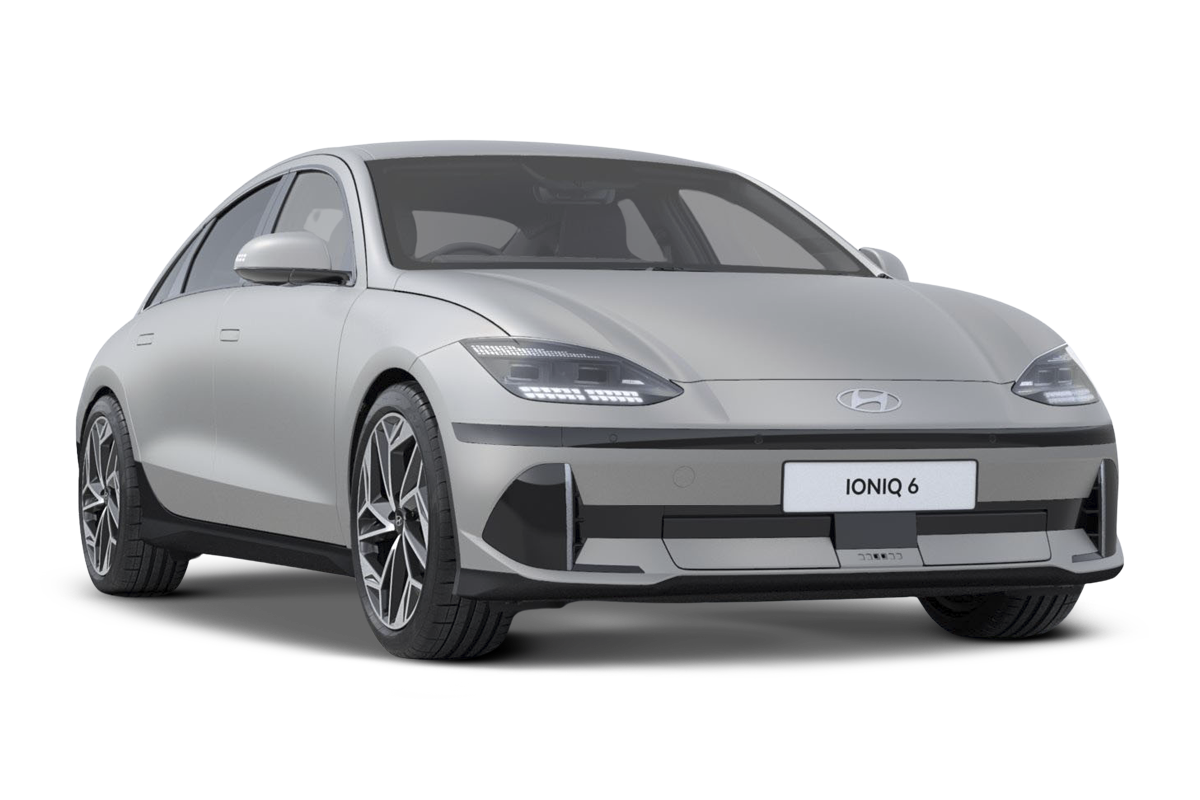
It feels even more eager to turn in to bends, almost like it’s pivoting around you, and also beats the E-tron GT and Taycan in this respect. What's more, there are huge reserves of grip, and body lean is kept tightly controlled when the adaptive suspension is in its sportiest setting.
Better yet, you can customise the way the car behaves to suit your tastes, with it possible to adjust the proportion of power that is sent to the front and rear wheels so the balance either feels more neutral or more playful.
There’s even a drift mode, which positively encourages the back end of the car to slide, but with a hint of traction control to prevent you from spinning. However, this is really just for those who indulge in track days.
Ride comfort never approaches the levels of the E-tron GT and Taycan on their air suspension, but when you take the Ioniq 6 N out of maximum attack mode, it doesn’t feel overly firm.
Is it quiet and how easy is it to drive smoothly?
The Ioniq 6 N comes with wide Pirelli P-Zero performance tyres that generate some road roar. However, even at motorway cruising speeds, you hear only a hint of wind noise from around the windscreen pillars.
In addition, there’s little whine from the electric motors. But switching on a system called N Active Sound Plus triggers fake engine noise that’s played through six interior speakers and two external ones.
Cleverly, this synthetic soundtrack works with a virtual ‘gearbox’ (called N eShift) to deliver an accurate perception of your speed that’s lacking with many fast electric cars.
Flat-out acceleration sends the ‘revs’ soaring. Then when you pull a paddle behind the steering wheel for an upshift, the power delivery is interrupted briefly until the next ‘gear’ engages, causing a jolt through the driver’s seat.
Not only is this surprisingly fun, but it allows you to be more precise on twisty roads, particularly on the way into corners, where you can shift down for extra engine braking.
What’s the range and efficiency like, and how quickly can it charge?
The Ioniq 6 N draws its power from the same 84kWh (total capacity) battery as the Ioniq 5 N. And while the official range is still to be revealed, it seems reasonable to assume that it will be slightly better than the 278 miles of the 5 N, given that the 6 N is a lighter car and has a more aerodynamic shape.
For perspective, though, the i4 M50 has an official range of 318 miles, while the E-tron GT offers 386 miles in entry-level form and the Taycan up to 422 miles.
It’s also worth bearing in mind that the range will plummet if you make full use of the performance on offer (as is the case with any fast electric car).
Fortunately, it doesn't take that long to top up the battery when it runs low; the 6 N has a maximum charging rate of 238kW, which can get it from 10-80% in around 18 minutes if you can find a suitable fast public charger. By comparison, the i4 M50 maxes out at 207kW, although the entry-level E-tron GT and Taycan can hit 270kW.
“In addition to bringing an extra layer of interaction, I found the N e-shift ‘gearbox’ genuinely useful in helping me judge my cornering entry speeds.” – Steve Huntingford, Editor

Interior
The interior layout, fit and finish
Strengths
- +Responsive touchscreen infotainment system
- +Sports seats are comfy and supportive
Weaknesses
- -Interior doesn’t feel special enough
- -Some visibility issues
What does the interior look like and is it well made?
If there’s an area in which the Ioniq 6 N disappoints, this is it – not because the interior is poorly made, but because it barely feels any more special than that of a regular Hyundai Ioniq 6.
Yes, you get heavily bolstered front seats and a sports steering wheel with N buttons for activating the car's more aggressive driving modes. However, while the Ioniq 6 N feels solidly assembled, most of the plastics are hard and grey.
Is the driving position comfortable and is it easy to see out?
The driver’s seat in a regular Ioniq 6 is adjusted electrically, whereas here the seat is manual. But there is a good range of adjustment, plus the seat holds you tightly in place through corners, and is both comfortable and supportive on longer drives.
If you’re tall, you might find the steering wheel blocks the top corners of the digital driver's display. However, this isn’t actually a huge problem, because a head-up display duplicates key information, projecting it onto the windscreen.
Similarly, while your rearward view is compromised by the Ioniq 6's styling, parking sensors (front and rear) and a rear-view camera help out with tight manoeuvres.
UK buyers won’t get the digital door mirrors fitted to our German-spec test car, which replace traditional mirrors with cameras that display what’s behind on two small screens. But they’re no real loss, actually making it more difficult to judge distances and the speed of approaching vehicles.
Are the dashboard and infotainment system easy to use?
Aside from some bespoke N menus that let you customise the way the car drives, the infotainment system is identical to that of a regular Ioniq 6.
This means some icons on the 12.3in touchscreen are a bit small, but it responds quickly to prods and there are helpful physical shortcut buttons beneath it.
The fact that the climate controls are always visible on a separate panel is also welcome, but these ‘buttons’ are touch-sensitive rather than physical, so require more of your attention to operate.
“Hyundai plans to offer a suede and carbon design pack in some markets, and I very much hope this comes to the UK to help lift the rather ordinary standard interior.” – Steve Huntingford, Editor

Passenger & boot space
How it copes with people and clutter
Strengths
- +Loads of leg room
- +Flat floor in the back
- +Some under-bonnet storage
Weaknesses
- -Tight rear head room
- -Boot brace compromises flexibility
How much space does it have for people?
There’s loads of leg room in the Hyundai Ioniq 6 N – both in the front and the back. However, anyone who is more than about 5ft 8in tall will have to slouch when sitting on the rear bench, due to the car’s plunging roofline.
More positively, a completely flat floor means even a central rear passenger will have plenty of space for their feet. By contrast, in the Audi E-tron GT, BMW i4 and Porsche Taycan, the person in the middle has to sit with their legs splayed either side of a bulky hump. And, indeed, a central seat is only optional in the Taycan.
How much room is there for luggage?
The Ioniq 6 N is a saloon rather than a hatchback, so the boot has a relatively narrow opening when compared with an i4 M50 or a Porsche Taycan Cross Turismo. The E-tron GT and regular Taycan suffer from the same problem, though.
As for actual capacity, the Ioniq 6 N gives you a respectable 401 litres to play with – enough to swallow seven carry-on suitcases. That matches the number we fitted in the i4, and is one more than we got in the E-tron GT or Taycan. But when you fold the rear seats down to carry bigger loads, the Ioniq 6 N is the least practical, due to a structural brace between its boot and rear seats.
A smaller second boot under the bonnet lets you keep the charging cables separate from the rest of your luggage. Plus, there’s an abundance of storage space dotted around the interior, including a two-tier centre console between the front seats.
“I found it surprisingly easy to fit a child seat, due to wide-opening rear doors. And with so much leg room, there’s little danger of children leaving footprints on the back of the front seats.” – Steve Huntingford, Editor

Buying & owning
Everyday costs, plus how reliable and safe it is
Strengths
- +Expected to cost less than rivals
- +Should be reliable
- +Long warranty
Weaknesses
- -Doesn’t use electricity very efficiently
How much does it cost and what equipment do you get?
The price is still to be confirmed, but we’d be surprised if it ended up being much higher than that of the Hyundai Ioniq 5 N (£65,010). If the Ioniq 6 N lives up to our expectations here, it will undercut all of its electric performance car rivals – some by a massive margin.
In addition, like all electric cars, it qualifies for a low rate of benefit-in-kind (BIK) tax. But judging by our test drive, it doesn’t use electricity very efficiently – the downside of having all that power.
You can expect the list of standard equipment to match that of the Ioniq 5 N, meaning everything from dual-zone climate control, and heated and ventilated front seats, to V2L charging so you can use your car to power external devices.
Is it reliable and how long is the warranty?
While we have no data on this N version, the regular Ioniq 6 is proving very dependable; in the 2025 What Car? Reliability Survey it was the fourth best performing electric car, with a score of 95.7%.
As a bonus, like all Hyundais, the Ioniq 6 N is covered by a five-year, unlimited mileage warranty, whereas the warranties on the Audi E-tron GT, BMW i4 M50 and Porsche Taycan last for only three years.
As is the norm with electric vehicles, the main drive battery of the Ioniq 6 N gets a separate eight-year, 100,000-mile warranty.
How safe is it, and is it easy to steal?
When it was tested by the independent safety experts at Euro NCAP in 2022, the Ioniq 6 earned the maximum five-star rating, with its adult occupant protection, child occupant protection and safety assist technology scores all very impressive. Euro NCAP has since made its test criteria stricter, though.
As you’d expect, the Ioniq 6 N comes with a Thatcham Category 1 alarm and immobiliser system.
“Our all-black test car looked pretty evil, but personally I’d specify any Hyundai N car in the Performance Blue paint the N sub-brand tends to be associated with.” – Steve Huntingford, Editor
Buy it if…
- You want a performance car that’s both agile and brutally fast
- You’re looking for more driver engagement than electric cars typically offer
- You value the reassurance of a long warranty
Don’t buy it if…
- One of your main reasons for going electric is low running costs
- You regularly carry tall passengers in the back of your car
- You’re looking for a cruiser rather than a bruiser
For all the latest reviews, advice and new car deals, sign up to the What Car? newsletter here

FAQs
Pricing is still to be confirmed, but given how closely related the two cars are, we wouldn’t expect the Ioniq 6 N to cost significantly more than the £65,010 Hyundai Ioniq 5 N.
The Ioniq 6 N uses the same twin-motor set-up as the Ioniq 5 N hot hatch, which means it produces up to 641bhp and 575lb ft of torque.
Compared with the standard Ioniq 6, the front bumper has been redesigned to feature a larger grille and new aerodynamic winglets. The front wings and rear quarter panels have also been brought out by 30mm to cover wider, Pirelli P-Zero tyres. Meanwhile, at the back of the car, the ducktail spoiler from the standard Ioniq 6 has been joined by a sizeable rear wing.
The Tesla that’s the closest match for the Ioniq 6 N is the Model 3 Performance. It actually accelerates fractionally faster, getting from 0-62mph in 3.1 seconds compared with the 3.2 seconds of the Ioniq 6 N. However, the Hyundai is far more fun to drive.
| RRP price range | £47,050 - £54,050 |
|---|---|
| Number of trims (see all) | 2 |
| Number of engines (see all) | 1 |
| Available fuel types (which is best for you?) | electric |
| MPG range across all versions | 0 - 0 |
| Available doors options | 4 |

