Jeep Compass review
Category: Small SUV
The Compass is a family SUV that’s more prepared for a rugged lifestyle


What Car? says...
If you’re looking for an SUV that’s hardy enough to withstand the rigours of family life, who better to build it than a company that made its very name from four-wheel-drive cars that were tough enough to take to war? Yes, now entering its third generation, the Jeep Compass promises to be just the right kind of general-purpose vehicle to haul your little troopers off to boot camp. Or, perhaps, school.
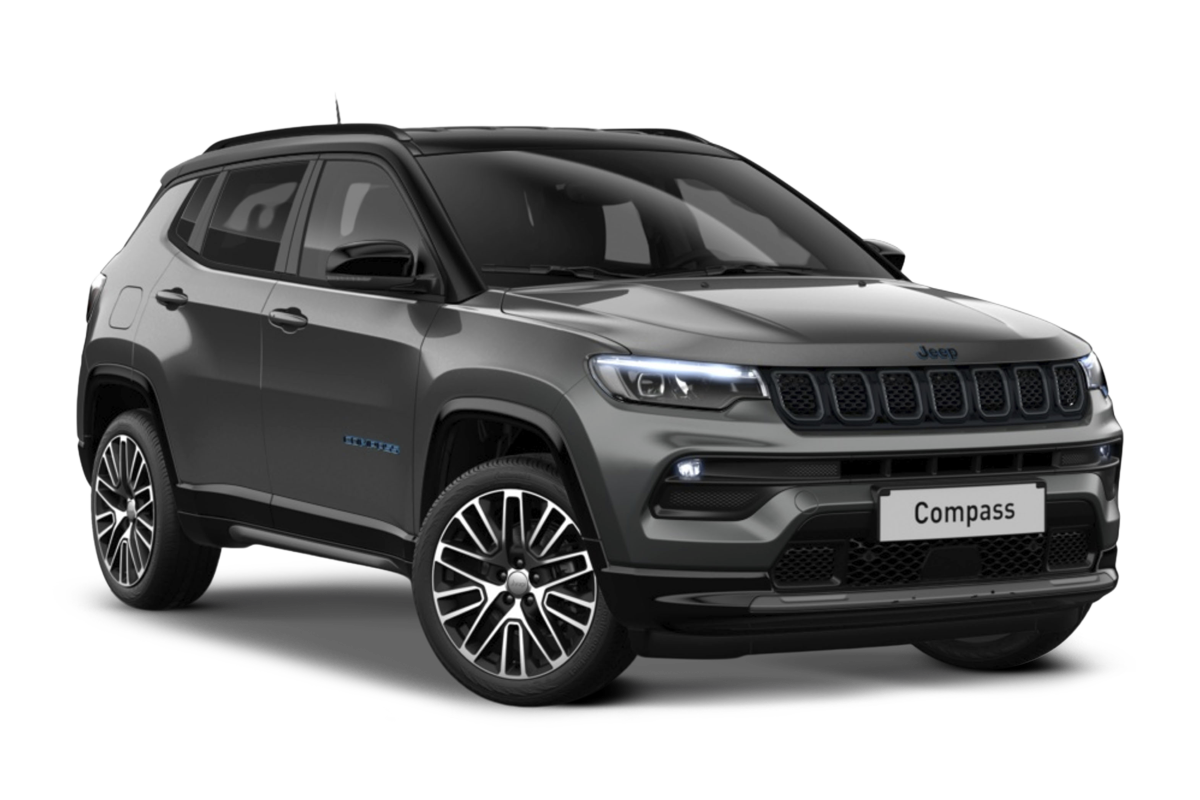
That all said, while it shares showroom space with the star spangled Jeep Wrangler, which devours terrain like nervous dates do breath mints, the Compass is not really intended for conquering wild open frontiers. It may dress the outdoorsy part, with its purposeful-looking bumper shields and bodyside cladding, but the initial front-wheel drive versions are more at home on urban Tarmac than they would be in isolated tundra.
For now, there’s a choice of mild hybrid petrol or full electric power (in the Compass Electric), and this review tackles both versions. In due course, the Compass range will extend with plug-in hybrid power. The Compass Electric line-up will, itself, expand to offer two battery sizes and a four-wheel version to match the offerings of its rivals.

Speaking of which, the Compass is similar in size to the Kia Sportage (our current favourite family SUV) and slightly smaller than the super-practical Skoda Kodiaq, along with the Citroën C5 Aircross, Peugeot 3008 and Vauxhall Grandland. The Compass Electric, meanwhile, faces adversaries as diverse as the MG S5, Peugeot e-3008, Renault Scenic, Skoda Elroq and the Vauxhall Grandland Electric.
Read on to find out how the Jeep Compass and Compass Electric rank against the best family SUVs and electric SUVs.
What’s new
- November 2025: First UK deliveries take place
- October 2025: Compass production starts in Italy and orders open. First Edition trim only. Choice of 143bhp e-Hybrid and 210bhp Full Electric with 74kWh battery. Both are front-wheel drive
- May 2025: Third-generation Jeep Compass revealed
Performance & drive
What it’s like to drive, and how quiet it is
Strengths
- +Electric version has decent performance
- +Prepared for mild off-road use
Weaknesses
- -Mild hybrid has vague brake pedal response
- -Firm, thumpy ride
- -Automatic gearbox can be hesitant on mild hybrid
How fast is it and which engine is best?
Badged the e-Hybrid, the petrol-engined version of the Jeep Compass is powered by the same 1.2-litre mild-hybrid unit found in the Peugeot 3008 and Vauxhall Grandland.
The 142bhp engine has no problems keeping up with traffic at low speeds, but the rate of acceleration tails off once you venture out of town. It’s best to switch into Sport mode, which encourages the engine to work harder with the electric motor to provide a bit more mid-range shove.
There’s a pause from the automatic gearbox when you need a burst of acceleration, though, and pulling the steering wheel mounted paddles to manually change down (or up) isn’t always met with an immediate response. Most rivals, such as Kia Sportage and VW Tiguan have a bit more overtaking urge.
While it’s front-wheel-drive only, a 192bhp 4XE plug-in hybrid is in the works. This uses a 1.6-litre petrol engine to drive the front wheels and an electric motor that powers the rears.
The Compass electric is a different kettle of fish, with much more shove (211bhp) all delivered instantly and this helps to make it more relaxing to drive. Its acceleration is similar to that of the entry-level Skoda Elroq, but there are much quicker versions of that rival – a more powerful 370bhp Compass with four-wheel-drive will arrive later.
Is it agile and is the ride comfortable?
Given the Compass is more keen to go off-road than its rivals, it’s perhaps expected to be less agile and fun to drive when you’re on it. Indeed, while it’s far from feeling like an agricultural workhorse (like the Jeep Wrangler), it is best suited to being driven at moderate speeds.
For example, the steering responds quickly and accurately enough that you can track around corners instinctively, but a lack of weight build-up doesn’t inspire much confidence at higher speeds. And while the Compass never feels unstable when pressing on, a little more body lean than its rivals and a lower sense of grip means it doesn’t feel as composed. The petrol-powered Kia Sportage and VW Tiguan are much tidier to drive, while the Skoda Elroq is a much better battery-powered rival.
However, where the Compass struggles is its ride comfort. With firm suspension, the Compass trips up when dealing with potholes and road imperfections and it doesn’t take much for the ride to start fidgeting. The Electric version is worse, with an even firmer ride and bigger wheels (19in-20in in size, rather than the petrol’s 18in items) that thunk as they struggle to take the brunt of a pothole. The Hyundai Tucson and Kia Sportage are far better at soaking up bumps, while the Elroq is one of the most comfortable electric rivals at this price.
The upside should be that the Compass is more capable off-road, but on rutted roads or gravel surfaces, the firm ride is amplified and results in a lot of jostling in your seat. That said, both the Compass e-Hybrid and Compass Electric models coped well with a fairly steep, winding dirt track with deep ruts. The Compass is also better at climbing over modest obstacles, thanks to a slightly higher ride height than the Grandland or e-3008, while short front and rear bumpers are shaped to deal with steep inclines.
Your kids may be disappointed if the route to their school is blocked by a burst pipe, too; the Compass can wade through up to 408mm of standing water (470mm for the Compass Electric). Every model has a Selec-Terrain feature, with Snow and Sand/Mud modes that tailor power delivery to cope with those conditions.
Is it quiet and how easy is it to drive smoothly?
A modest level of road and wind noise filtering through into the Compass means their respective rivals are quieter and more relaxing to spend time in. You can also sometimes feel the coarseness of the road surface through the floor and seats.
You’d be right in thinking the lack of an engine makes the Compass Electric the quieter option of the two, but it suffers more from the wheels thumping into potholes.
Thankfully, even when you put your foot down on the accelerator pedal, the petrol engine in the Compass remains relatively hushed, while the mild hybrid system can also drive on electric power with the engine off at very low speeds – when creeping in traffic or parking, for example. However, the most notable difference is the vague brake pedal response – there’s quite a lot of travel in the pedal before anything happens followed by a slightly grabby response right before you stop.
The brake pedal in the Electric has more positive weighting that makes it easier to judge your inputs. That’s down to its regenerative braking system, which recovers energy that would be lost under deceleration and turns it into electricity to feed back into the battery. Many such systems bring an unnatural feel to the brake pedal, but in the Compass you don’t feel the technology handing over to the conventional brakes, and that makes it easy to pull up smoothly to a halt.
You can use the paddles on the back of the steering wheel to increase the braking effect, with three levels to choose from. None of them are particularly strong but the braking effect builds up smoothly. Alternatively a one-pedal driving mode can be selected by pressing a button on the dash, which is strong enough to bring the car almost to a stop.
What’s the range and efficiency like, and how quickly can it charge?
The Compass Electric comes with a 73kWh (usable capacity) battery that’s officially good for 310 miles on a full charge. That’s similar to the Peugeot e-3008 and Vauxhall Grandland Electric. The forthcoming dual-motor Compass officially hits 375 miles on its bigger, 94kWh battery.
The Compass Electric can accept a charge at rates of up to 160 kW, enabling a 20-80% charge in 31 minutes. The Skoda Enyaq takes about the same time, but the Kia EV6 (with a 300kW peak charging rate) takes much less time to charge.
“I quite like the distinctive thrum from the three-cylinder engine; it’s more characterful than it is annoying.” – Chris Haining, Subeditor

Interior
The interior layout, fit and finish
Strengths
- +Elevated driving position
- +Good all-round visibility
- +Some interior materials designed to be durable
Weaknesses
- -Some family SUVs feel classier inside
- -Infotainment system menus could be more logical
What does the interior look like and is it well made?
Inside, you’ll not find as many plush surfaces as in the 3008 (and, to a lesser extent, the Grandland); soft-touch surfaces are limited to the higher regions of the dashboard and doors and the lid of the centre console. Passengers in the rear won’t find any at all. The Kia Sportage is noticeably more plush inside, while the Volvo XC40 is far more upmarket and doesn’t cost significantly more.
However, while the surfaces are nothing special in the Compass, its construction feels perfectly sturdy. In fact, when you factor in the wetsuit-like upholstery and rubberised switches on the centre console and steering wheel, the Compass feels well equipped to withstand the spilled squash, chocolatey fingers and kicking feet of family life.
Is the driving position comfortable and is it easy to see out?
While its relatives raise you a fair distance from the ground, the Compass’s slightly higher ground clearance places you that bit higher up, so you get a great view out and get to look down slightly on Kia Sportage owners. Rearward and over-the-shoulder visibility is decent by family SUV standards, thanks to the big side windows. Front and rear parking sensors are standard, while a rear-view camera is standard on First Edition. Bright LED Matrix headlights are also standard on this higher-spec trim level.
The seat itself is comfortably sculpted and while electric adjustment is optional as part of a pack (which also includes a massage function), the manual seats are easy to use and also include adjustable lumbar support. You sit nicely in line with the steering wheel and pedals, the former of which has plenty of height and reach adjustment for tall and shorter folk alike.
Is the dashboard and infotainment system easy to use?
The slim 10.25in digital display screen behind the steering wheel might look a little slim compared with rivals, but it looks sharp and offers a few layout options.
Right next to the driver’s display, every Compass has a 16in infotainment screen with clear, attractive icons that are big enough not to be too fiddly. The screen is pleasingly responsive to touches but the menus aren’t structured as clearly as they are in a Tucson or a Sportage. Wireless Android Auto and Apple CarPlay are standard so you can use your preferred smartphone navigation app in preference to the car’s sat-nav, although we found the connection a bit unstable.
Voice control is available but it can be a bit hit-and-miss; while it could select our chosen radio station, it couldn’t bring up Apple Carplay.
More positively, the Compass provides a long row of physical buttons below the infotainment screen. These provide direct access to certain infotainment menus as well as key climate control functions - true, physical climate control knobs would be still more convenient, but when the outer extremes of the infotainment screen permanently display large icons close by for the the two climate control zones, adjusting the temperature is easy enough.
First Edition-spec cars benefit from a wireless phone-charging tray and an upgraded sound system by Focal, which sounds clear and punchy.
“The sat-nav in our test car could be slow to respond, so using a smartphone nav app via the wireless Android Auto or Apple CarPlay is worthwhile” – Chris Haining, subeditor

Passenger & boot space
How it copes with people and clutter
Strengths
- +Loads of passenger space
- +All versions have a big boot
- +Rear seats have a versatile 40/20/40 split
Weaknesses
- -Rear seats don't slide
How much space does it have for people?
Strip off the Compass’s combat fatigues and you’ll find the same basic underpinnings used by the smart-casual Peugeot 3008 and Vauxhall Grandland. However, Jeep has given the Compass a slightly longer wheelbase than its stablemates (the distance between the front and rear wheels) to improve on its predecessor’s interior space.
Among human specimens, you’d have to be quite extreme in proportions before you had any problem fitting in the front of the Compass. A six-footer with broad shoulders runs no risk of feeling hemmed in, and there’s enough seat adjustment for smaller folk to feel at home, too. Basketball players and rugby prop forwards are well served for headroom, even in cars with the panoramic glass sunroof.
The rear seats, too, are very accommodating for people of all sizes, helped by there being 55mm more leg room than in the outgoing car. Our lanky front-seat occupants would happily be able to sit behind themselves, and head room is in no shorter supply than it is in the front. We’d avoid the optional panoramic roof, which eats into head room and leaves a six-footer brushing their head on the ceiling.
The Electric version has a slightly raised floor in the rear, which means you can’t stretch out your legs as much and fully tuck your feet underneath the front seats. Thankfully, the floor isn’t so high that you end up sitting uncomfortably with your knees raised.
Adding a third rear passenger between the outer pair does make things cosy, but at least the centre occupant’s feet have only a small floor hump to negotiate, so they’ll not feel too cramped.
There’s lots of interior storage opportunities; the door pockets will easily take a 1.0-litre water bottle, and there are deep cubbies in the centre console, a sizeable glovebox and a large open tray built into the top of the dashboard.
How much room does it have for luggage?
The petrol and electric versions of the Compass each have a 550-litre boot that matches the Vauxhall Grandland, making it a similar size to those of the Hyundai Tucson and Kia Sportage, but a lot smaller than that of the Skoda Kodiaq. It’s a very usable, square shape, though, and the opening is wide, tall and uncluttered, so it shouldn’t be too much of a chore to slide in ungainly cargoes like bicycles or pushchairs.
The rear seatback splits and folds in a flexible 40/20/40 arrangement, but there aren’t any levers to release them remotely from the boot opening (these are standard in the Tucson and Sportage). When the seats are folded down, an adjustable boot floor enables a flat load bay from the door opening to the front seatbacks. First Edition brings a hands-free powered tailgate.
The rear seats don’t slide to and fro to balance interior room against boot space, though; that’s a facility you get in the Ford Kuga and Renault Austral, and the Skoda Karoq’s Varioflex option is even better, allowing you to remove the rear seats altogether.
“At six-foot five, I found that I could comfortably sit behind a six-foot tall driver, and I didn’t have to crouch for head room.” – Chris Haining, Subditor

Buying & owning
Everyday costs, plus how reliable and safe it is
Strengths
- +No model is stingily equipped
- +Decent electric range and fuel efficiency
Weaknesses
- -Warranty is less generous than with many rivals
- -Jeep hasn’t featured in our Reliability Survey
How much does it cost and what equipment do you get?
Of the hybrids, the Compass is priced head-to-head with the entry-level Grandland and undercuts the 3008. However, a Kia Sportage can be had for less, while an XC40 isn’t much more.
You do get a good level of standard equipment, including adaptive cruise control, heated front seats, a heated steering wheel, ambient interior lighting, wireless phone charging, an illuminated grille, and rear privacy glass.
Likewise, the Compass Electric is competitive against a similarly equipped Grandland Electric, but it’s undercut by some versions of the Skoda Elroq – including models with a bigger battery and a longer range.
While the forthcoming plug-in hybrid (PHEV) will cost less in company car tax than the MHEV petrol, the Compass Electric will make even more sense because its low CO2 output brings the lowest possible BIK tax rating. As with other plug-in hybrids – you’ll need to keep the battery charged up as much as possible to maximise fuel economy.
Speaking of which, the petrol-engined Compass officially returns around 50mpg – a similar figure to the Grandland and 5008.
Is it reliable, and how long is the warranty?
The latest Jeep Compass is too new to feature in our annual Reliability Survey, and too few Jeep owners participated in our most recent survey for the brand to appear in the rankings.
Every Jeep sold in the UK comes with a three-year, 60,000 mile warranty, which is on par with Vauxhall, but is less generous than Hyundai (five year, unlimited mileage) or Kia(seven years, 100,000 miles).
How safe is it, and is it easy to steal?
Safety experts, Euro NCAP, awarded the Compass a four star rating (out of five) when it was crash tested in 2025. That matches the 3008 and Grandland, with identical ratings in terms of adult and child protection in a collision.
All versions come with automatic emergency braking, lane-keeping assist and speed-limit sign recognition.
“The Jeep Compass Electric is a capable family-focused electric SUV but in this price range, it's also worth considering the Kia EV3.” – Steve Huntingford, Editor
Buy it if…
- You’d like a family SUV with a bit of off-road capability
- You want an interior that’s designed to cope with a bit of mess
- You’re a fan of Jeep’s outdoorsy styling
Don’t buy it if…
- You’re looking for a luxurious interior
- You want a family SUV that feels sporty
- You’re working to a really tight budget
For all the latest reviews, advice and new car deals, sign up to the What Car? newsletter here

FAQs
At first, the petrol-engined Jeep Compass has only mild hybrid technology; this provides a bit of electrical assistance when you accelerate, and enables the car to drive using electricity alone for very short distances, such as when negotiating a multi-storey car park. A plug-in hybrid version will join the range soon, as will versions of the Compass Electric with a longer range and more power.
The petrol-engined Compass has 142bhp, and that proves more than enough for nipping around town or joining the motorway. Only on steep inclines does it feel a little breathless. The Compass Electric, meanwhile, with 211bhp, feels altogether more muscular when you put your foot down, with strong response from any speed. Many electric rivals have even more power, though.
Unlike the Jeep Wrangler, the smaller Jeep Compass has only front-wheel drive for the first versions, so it’s clearly not designed for real off-roading. However, it has a higher ground clearance than most family SUVs, and the way its bumpers are designed means the Compass can crawl over small obstacles, such as high kerbs. More powerful four-wheel drive versions will join the range later.
| RRP price range | £34,635 - £44,200 |
|---|---|
| Number of trims (see all) | 3 |
| Number of engines (see all) | 3 |
| Available fuel types (which is best for you?) | electric, petrol hybrid, petrol plug-in hybrid |
| MPG range across all versions | 0 - 94.16 |
| Available doors options | 5 |
| Company car tax at 20% (min/max) | £78 / £2,178 |
| Company car tax at 40% (min/max) | £157 / £4,356 |

