Skoda Superb Estate review
Category: Estate car
The Superb Estate is a comfy, practical and well priced but interior quality could be better


What Car? says...
It’s often said space is a luxury, and it’s certainly something we’re used to paying big money for. A larger home? Expensive. Extra leg room on a plane? Expensive. There are exceptions though – including the Skoda Superb Estate.
We'd be exaggerating only slightly if we used words like gigantic, ginormous or gargantuan to describe the Superb Estate, yet it remains a competitively priced car (as is the Skoda Superb hatchback). Better still, the latest, fourth-generation version has even more capacity for people and luggage than its predecessor.
Skoda Superb video review
Its vastness makes the Superb a less-expensive alternative to spacious, premium-brand estate cars, including the BMW 5 Series Touring and Mercedes E-Class Estate.
Alternatively, for similar money, its rivals range from the BMW 3 Series Touring to the frugal Toyota Corolla Touring Sports, or the closely related VW Passat (which is available solely as an estate).
What’s new?
- January 2026: Skoda Superb Estate wins What Car? Estate of the Year 2026
- July 2024: Superb iV PHEV goes on sale, and offers a pure-electric range of 84 miles and a 510-litre boot area that expands to 1770 litres with the rear seats down
- March 2024: new Skoda Superb Estate available to order. Range includes both mild-hybrid and plug-in hybrid options

Performance & drive
What it’s like to drive, and how quiet it is
Strengths
- +Supple ride with adaptive (DCC) suspension
- +Decent handling
- +PHEV has a long electric range
Weaknesses
- -PHEV has slightly grabby brakes
- -Diesel engines are noiser
- -BMW 3 Series Estate is more fun to drive
There is no shortage of engine options for the Skoda Superb Estate, with three petrol engines, two diesels and a plug-in hybrid (PHEV). All versions get a DSG automatic gearbox as standard and are either front or four-wheel drive.
If you’re a private buyer, the entry-level 148bhp 1.5-litre petrol (badged 1.5 TSI e-TEC 150) would be our pick. It features mild-hybrid technology to boost performance and fuel economy, and it's great for everyday use. It has enough oomph to get you from 0-62mph in a creditable 9.3secs and it's reasonably quiet and smooth when you rev it out, too.
The 1.5 TSI isn't the best option if you need a tow car, though. In that instance, you'd be better off with the 148bhp 2.0 TDI 150 diesel, which has similar straight-line pace but pulls harder from lower revs.
There's also a more powerful 190bhp 2.0 TDI 193 with standard four-wheel drive. It's even gutsier – hitting 62mph in around 7.5 seconds – and the extra four-wheel traction is an added boon in slippery conditions. You do have to put up with slightly more noise and vibration from both the diesels, though.
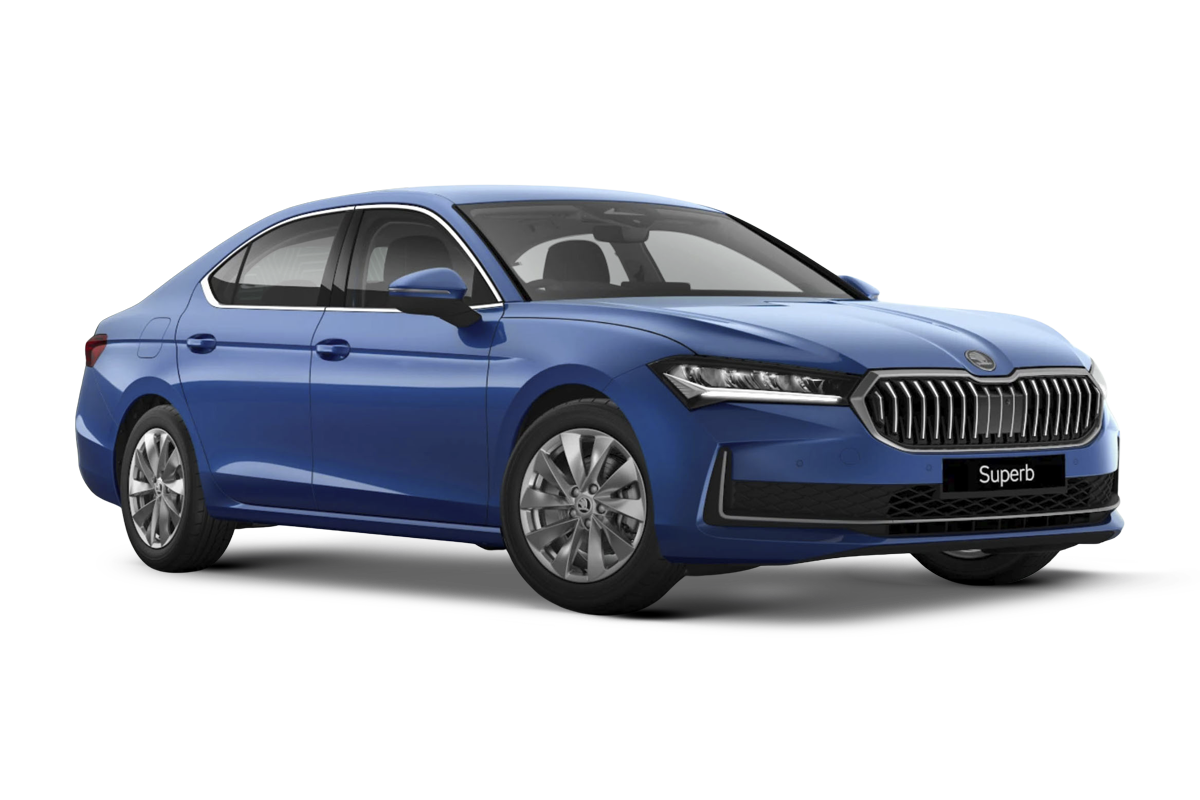
For something that's smooth and quick, have a look at the more powerful petrols: the 201bhp 2.0 TSI 204, or the 261bhp 2.0 TSI 265. The latter also comes with four-wheel drive and will romp to 62mph in 5.7secs, so it's properly quick.
But what if you want to drive your Superb Estate like an electric car? For that, you’ll need the plug-in hybrid (PHEV), called the 1.5 TSI iV. It also has 201bhp, so it's brisk (0-62mph in 8.1secs), and officially drives for over 85 miles on battery power alone before the petrol engine kicks in. That’s about the same as a VW Passat PHEV, and further than the equivalent plug-in hybrid BMW 5 Series Touring, Mercedes C-Class Estate or Mercedes E-Class Estate.
The big dynamic downside of the Superb Estate PHEV is the brakes are a bit grabby; it's not as easy to slow down smoothly compared with the rest of the Superb range. That's due to the PHEV's regenerative braking; the brakes on the petrol and diesel versions are more progressive.
If the Superb is on standard passive suspension sharp ridges and potholes can cause a thud as you pass over them. The ride isn't uncomfortable overall, but the Passat does a better job of smoothing out imperfections, especially at speed.
For a cushier ride, you'll need your Superb fitted with Dynamic Chassis Control Plus (DCC). It's an option on SE L trim and standard on Sportline and top-spec L&K trim. It's an adaptive suspension system, so you can stiffen or soften the car’s ride in multiple increments using a slider on the infotainment touchscreen. Few cars are as customisable and you can really tune the Superb Estate to suit your tastes.
Even in its softest setting, the Superb isn't wallowy. It's well controlled over uneven surfaces and still does a good job of minimising the impact of bumps. Move the suspension to the sportiest setting and the ride gets noticeably firmer but not choppy.
In the sportiest setting, the Superb Estate still isn't as agile or entertaining to drive as smaller, sportier estate cars – such as the BMW 3 Series Touring – but you can drive it with confidence on a sinewy road. There's decent grip, not too much body lean, and it steers accurately, too, building weight naturally so you have a good feel for the grip levels. Meanwhile, the steering's light at slow speeds, making the Superb easy to manoeuvre in town.
Wind noise is well contained but you do hear some roar from the tyres at speed, plus some background thumps from the suspension over rutted surfaces.
"It’s a tidy, reassuring handler, and none of the engines feel short on power. I covered a lot of miles in the entry-level 1.5-litre petrol-powered car, and I reckon it's all most people will ever want or need." – Will Nightingale, Reviews Editor

Interior
The interior layout, fit and finish
Strengths
- +Comfortable driving position
- +User-friendly controls
- +Good visibility
Weaknesses
- -Interior feels a tad flimsy in places
All versions of the Skoda Superb Estate have lots of steering wheel and seat adjustment to help you find a good driving position. That’s especially true if you go for SE L trim or above, which has 14-way electrically adjustable seats (including adjustable lumbar support), extendable seat bases, and a massage function to help you stay comfortable on long journeys. You can add those seats as an option on entry-level SE Technology trim.
Visibility is pretty good all-round, thanks to large windows with reasonably slim pillars. And no matter which trim you go for, you get front and rear parking sensors and a rear-view camera. Top-spec L&K trim takes things one step further with a 360-degree camera and Park Assist, which will manoeuvre the car into spaces for you (it’s optional on the other trims).
The 13.0in infotainment touchscreen is positioned high on the dashboard, so you don’t have to take your eyes far from the road to operate it. Plus, the icons are large and clear, and the natural-speech voice-control system (called Laura) doesn’t require you to remember specific commands.
All trims come with built-in sat-nav and wireless Apple CarPlay/Android Auto smartphone mirroring, plus you get a cooled wireless charging pad, which helps prevent your phone overheating.
While many brands seem determined to consign physical controls to the history books, the Superb Estate has three rotary dials beneath its touchscreen. They're multifunctional – you change what they adjust by pressing them – and make changing settings a doddle to carry out while driving. The outer two adjust the climate control and heated seat temperatures, while the central one changes the fan speed, stereo volume or selects a different driving mode.
Those rotary controls bring us on to the topic of interior quality. While they're really useful, they feel a little cheap to operate. And while the Superb Estate's interior looks stylish and doesn't feel poorly finished in the main, the creaky nature of some of the dashboard trims make it feel less robust than the closely related VW Passat. The fit and finish isn't as good as some premium alternatives, either, like Volvo V60.
The instruments are displayed on the Superb Estate's highly configurable 10.3in digital driver's display. A head-up display, which projects your speed and other key information onto the windscreen, is available as an option from SE L trim up.
"The Superb's physical rotary controls are a reminder that sometimes the old ways are best. I find them so much easier to operate on the move than it would be to mess around with the touchscreen." – Will Nightingale, Reviews Editor

Passenger & boot space
How it copes with people and clutter
Strengths
- +Hugely spacious front and rear
- +Enormous boot on non-PHEV versions
- +Loads of oddment space
Weaknesses
- -Plug-in hybrid sacrifices some luggage space
Up front, there's loads of room in the Skoda Superb Estate, and the same is true in the rear seats. Indeed, one downside of rivals such as the Toyota Corolla Touring Sports is that rear passenger space is quite cramped. The Skoda Superb Estate is the complete opposite. It offers ample rear leg and head room for two six-footers to stretch out, and it's one of the most spacious cars on sale today.
You can fit three passengers in the rear more easily than you can in a lot of estate cars, although there are compromises for the middle-seat passenger. The middle seat is slightly higher than the outer two, cutting head room a little, and there's a hump in the floor for that they have to straddle.
There's plenty of storage space, including deep door bins, a myriad of useful cubbies, and cupholders front and rear. The rear cupholders are incorporated into the rear armrest, which also has a holder for a phone or tablet so passengers can watch videos on the go.
Boot space has always been one of the top reasons to buy a Superb Estate and the latest car has more than ever: 690 litres in non-PHEV versions. That's 30 litres more than the third-generation model and the same as you get in the VW Passat.
For context, the Toyota Corolla Touring Sports has 596 litres, and even the latest BMW 5 Series Touring and the Mercedes E-Class Estate fall short, with 570 litres and 615 litres respectively. Just bear in mind that the Superb’s boot capacity falls to 510 litres if you go for the PHEV model, although that's still a big space.
If you do need more room, the rear seats fold down in a 60/40 split using handy release handles in the boot itself. There’s a step up in the boot floor when the rear seats are folded, but you can option a height-adjustable floor (in all versions except the PHEV) that smoothes that out when it's set in the upper position.
You get a central ski hatch as standard, which allows you to carry long items while still using the two outer rear seats, and the boot has handy storage cubbies either side of its entrance.
"With vast space on offer, you'd have to be transporting something or someone truly colossal for it to not fit inside the Superb Estate. I didn't come close to filling it up." – Dan Jones, Reviewer

Buying & owning
Everyday costs, plus how reliable and safe it is
Strengths
- +Well priced for cash buyers
- +Plug-in hybrid makes a fairly cheap company car
- +Lots of standard equipment
Weaknesses
- -Toyota's reliability and warranty are better
Value has always been key to the appeal of the Skoda Superb Estate (as it is with the Skoda Superb hatchback), and that remains the case today. Indeed, while it’ll cost you more to buy outright than the smaller Toyota Corolla Touring Sports, it undercuts all of its other rivals, including the VW Passat. At the time of writing, it uncut the Passat on PCP finance, too.
And it's not that Skoda's kept the price low by being stingy with the equipment. Even the entry-level SE Technology trim comes with 17in alloy wheels, auto-dimming rear-view mirror, heated front seats, three-zone climate control, privacy glass, keyless start/stop and lots of other kit – including the parking aids and infotainment goodies we mentioned earlier. It’s the one that we’d go for.
Stepping up to SE L adds more niceties, including more premium interior trims and faux leather seats, 18in alloy wheels, 14-way electric front seats (with cooling and massaging functions), ambient lighting, matrix LED headlights, keyless entry and a hands-free powered tailgate.
Sportline adds sportier styling inside and out (including sports front seats and 19in alloys) and DCC adaptive suspension. Meanwhile, top-spec L&K adds heated rear seats, a 360-degree camera and an upgraded Canton sound system with 14 speakers.
Promising up to 56.5mpg (official average consumption), the entry-level petrol engine should keep running costs down, but it’s worth mentioning that the Corolla Touring Sports is even more efficient. If you're a private buyer wanting the cheapest fuel costs the 2.0 TDI 150 diesel is the most economical in the real world.
If you're a company car driver rather than a private buyer, the long electric range of the 1.5 TSI iV plug-in hybrid cuts down your benefit-in-kind (BIK) tax rating – it's lower than most of its rivals. Just bear in mind that fully electric cars such as the Peugeot e-308 SW will save you even more.
The PHEV’s ability to run on electricity for so long should help to keep your fuel bills down – but only if you keep the battery topped up and charge overnight on a cheap overnight tariff. If you plug the Superb Estate PHEV into a 50kW public DC charger it'll charge from 10-80% in around 26 minutes.
The latest Superb Estate is too new for us to have any reliability data, but the previous-generation car was significantly more dependable in petrol form than diesel. As for the Skoda brand, it finished a respectable 16th out of 30 manufacturers in the 2025 What Car? Reliability Survey – below Peugeot and Toyota but above VW.
It’s also worth noting that the warranty on the Corolla Touring Sports can last for up to 10 years or 100,000 miles if you continue to get your car serviced at a Toyota dealer. Skoda’s warranty is less impressive and, like most rivals, expires after three years or 60,000 miles.
The latest Superb scored the full five stars when it was tested by Euro NCAP in 2024. It scored highly across all areas, matching the Passat's test scores. The Mercedes E-Class managed a slightly higher rear-seat child-protection score, though.
You get plenty of standard safety equipment with the Superb, including traffic-sign recognition, lots of airbags, lane-keeping assistance, front cross-traffic assist, automatic emergency braking (AEB) and blind-spot detection.
"Because life with a Superb Estate ought to be relatively easy, I find it odd that the length of the car's warranty is merely average." – Claire Evans, Consumer Editor
Buy one if...
- You want an estate with masses of passenger and boot space
- You're looking for a plug-in hybrid with a long electric range
- A long list of standard features is important to you
Don't buy one if...
- You'd like an estate that's fun to drive
- You want the very best high-end finish inside
For all the latest reviews, advice and new car deals, sign up to the What Car? newsletter here

FAQs
Yes, especially if you want an efficient, well-equipped and practical estate car. The Superb Estate should definitely be on your estate shortlist.
If you’re after a petrol, the entry-level 1.5 TSI e-TEC 150 officially averages up to 56.5mpg. That’s the same as the 2.0 TDI 150 diesel, but we still suspect the latter will be more efficient in the real world.
The top-spec 2.0 TSI 265 is the fastest engine on offer with the Super Estate. That gives you 261bhp, four-wheel drive and a 0-62mph sprint of 5.7sec.
While the Octavia Estate is a fine estate and will cost you less to buy, it’s also smaller, less practical and not as well equipped as the Superb Estate.
| RRP price range | £38,135 - £51,390 |
|---|---|
| Number of trims (see all) | 4 |
| Number of engines (see all) | 4 |
| Available fuel types (which is best for you?) | diesel, petrol hybrid, petrol, petrol plug-in hybrid |
| MPG range across all versions | 35.3 - 232.6 |
| Available doors options | 5 |
| Company car tax at 20% (min/max) | £331 / £3,565 |
| Company car tax at 40% (min/max) | £663 / £7,129 |

