Volkswagen T-Roc review
Category: Small SUV
The T-Roc small SUV is pricier than many rivals but offers more comfort than most


What Car? says...
There is an argument that a Kinder Surprise egg is far less satisfying nowadays than it used to be back in the 1990s. Okay, those in agreement might be showing their age, but the reason isn’t down to the outer chocolate shell; it’s because the toys inside used to feel better made and far more desirable.
The Volkswagen T-Roc is the opposite. The original version was an immediate sales success, bringing the same aspirational energy to the small SUV class that the VW Golf brings to family cars. And the T-Roc's exterior looked really rather tasty, but what lay inside felt a tad cheap.
However, to boost the appeal of this second-generation model, VW is promising buyers a real treat when they prise open the T-Roc.
There’s a greater focus on interior quality, and this latest version is also 122mm longer than before, bringing a bit more rear seat space and a slightly bigger boot.
So what other cars is the T-Roc up against? Well, the cheaper versions compete with the likes of the sporty Ford Puma, the affordable Seat Arona, and the spacious Skoda Kamiq. The higher-price fancier trims push into the premium territory of the Audi Q2, Lexus LBX and Range Rover Evoque.

The question is, should you choose the VW T-Roc over any of those rival small SUVs? And is it actually nicer inside now, or a better option than its Volkswagen SUV stablemates, the Taigo and the T-Cross? Let's find out...
What’s new?
- January 2026 - VW T-Roc wins WhatCar Small SUV of the year award
- November 2026 - All new, second generation model launches in the UK with mild hybrid petrol engines.
- December 2025 - T-Roc receives five-star Euro NCAP rating, gaining particular praise for its driver assistance systems
The 2025 What Car? Reliability Survey is live, tell us about your car now
Performance & drive
What it’s like to drive, and how quiet it is
Strengths
- +Quiet petrol engines
- +Plenty of performance
- +Very comfortable ride
Weaknesses
- -Not as entertaining to drive as a Ford Puma
- -No plug-in hybrid option
- -Larger wheels degrade the ride
How fast is it and which engine is best?
From launch, the VW T-Roc offers three mild hybrid petrol engines, kicking off with a pair of 1.5-litre eTSI units. Both drive the front wheels through a standard seven-speed automatic gearbox, but they offer a choice of power outputs.
The 114bhp entry-level version is fine for everyday driving. There’s enough low-down shove and it’s keen to rev once you get going. The automatic gearbox also helps, by changing down gears eagerly when you need a burst of acceleration. The Ford Puma 125 offers more power for less money, but only if you're happy to have a manual gearbox instead.
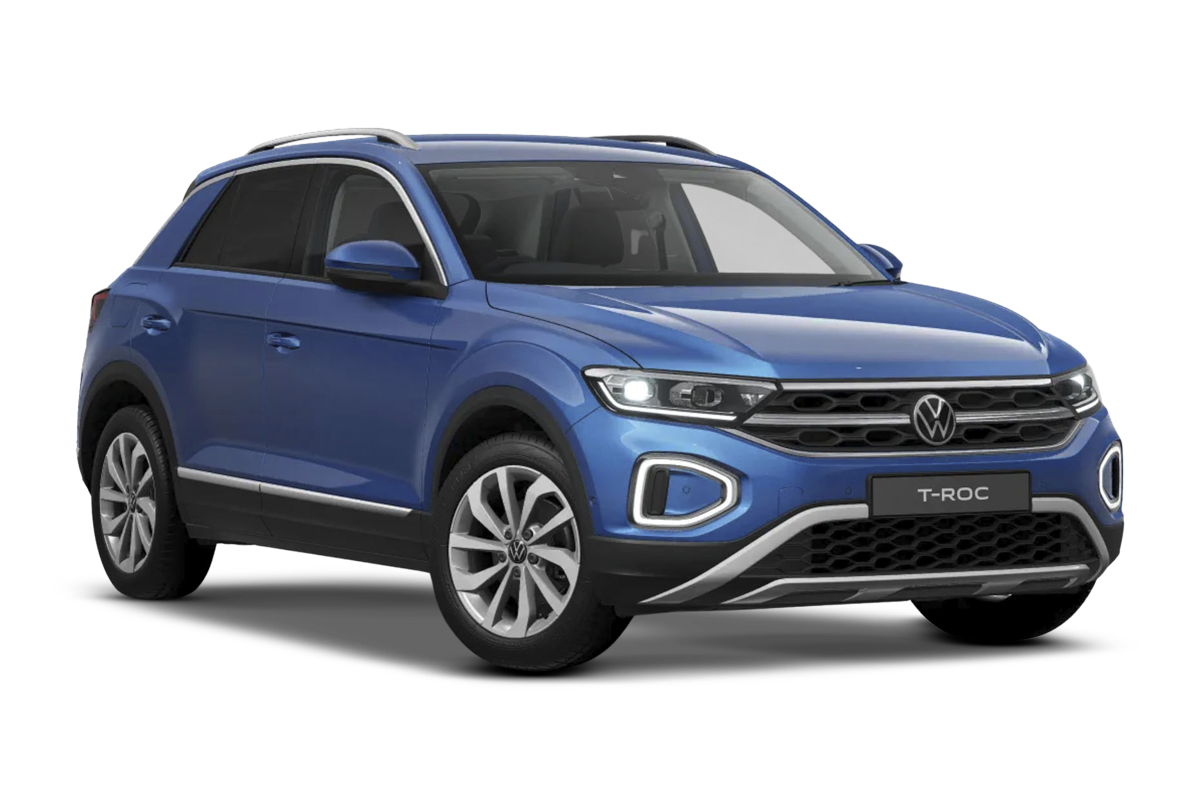
The more powerful 148bhp eTSI is our favourite. Its additional mid-range punch makes overtaking or keeping up with motorway traffic easier. And we managed a spirited 0-60mph time of 8.8sec when we tested one against a Lexus LBX, which, by the way, took 9.2sec.
If you want even more grunt, a 201bhp 2.0-litre petrol with four wheel drive will be available soon, and later this year, two full hybrid versions will arrive offering 134bhp and 168bhp respectively. The hybrids combine a 1.5-litre petrol with an electric motor to increase fuel efficiency. A plug-in hybrid version is not currently on the cards, but there will be a high-performance T-Roc R (with 329bhp) going on sale in 2027.
Is it agile and is the ride comfortable?
The previous T-Roc was among the most comfortable small SUVs around; the good news is that's still true now. It's more supple than the Ford Puma, soaking up most bumps exceptionally well, and feels more settled along undulating country roads than the sometimes-floaty Toyota Yaris Cross. And so far we haven't sampled a T-Roc fitted with the smallest 16in wheels that are standard on entry-level Life trim – we reckon they'll help make the ride even cushier.
We’ve also driven the top-spec R-Line with optional adaptive suspension called Dynamic Chassis Control (DCC), which allows you to adjust the softness of the ride. However, we don’t think it’s worth the extra outlay because it doesn’t improve ride comfort greatly compared with the standard suspension. We’d also avoid upgrading to the larger 20in wheels, which can cause the T-Roc to thump over bumps.
The T-Roc’s light steering makes it a breeze to thread around town and, when you're on open roads and cornering quicker, the steering gains a bit more heft to help you gauge your inputs better. There’s also plenty of grip and not too much body lean.
It all adds up to a car that’s more responsive through bends than the Peugeot 2008 and reassuring to drive at a decent lick. However, we wouldn't class it as sporty. If you're a keen driver looking for some fun behind the wheel, the more agile Ford Puma is a better option.
Is it quiet and how easy is it to drive smoothly?
Compared with the three-cylinder engines in the Ford Puma, Peugeot 2008 and Skoda Kamiq, the T-Roc's 1.5-litre four-cylinder engines are quieter and transmit fewer vibrations into the interior.
The 1.5-litre also has a more linear power delivery than the Puma’s engine, so it's easier to accelerate smoothly, and the standard DSG automatic gearbox plays its part with slick gear shifts. The T-Roc’s brakes are a little sharp at low speeds, but once you've adjusted to that quirk you can scrub off speed off progressively.
When you’re up to cruising speed, wind and road noise are kept to a minimum. That not only makes the T-Roc quieter overall than the Puma and Lexus LBX, but also one of the most hushed small SUVs you can buy.
"The first thing I noticed as soon as I started the engine was how smooth and quiet it was.” – Lawrence Cheung, New Cars Editor

Interior
The interior layout, fit and finish
Strengths
- +Comfortable, high-up driving position
- +Good visibility
- +Touchscreen is responsive and well positioned
Weaknesses
- -Upmarket rivals still feel plusher inside
- -Not enough physical buttons for major functions
What does the interior look like and is it well made?
The T-Roc’s interior feels like it's screwed together well and it's finished off with some pleasing materials in key spots. Even the entry-level Life trim gets a mix of padded fabric on the top half of the dashboard and doors. There are harsher plastics lower down, as is the case with most small SUVs, but, for the money, it feels a step up for quality over the equivalent Ford Puma or Renault Captur.
R-Line trim looks sportier inside and uses a broader palette of materials, including soft-touch plastics farther down the dashboard, and faux-leather on the doors. But R-Line is expensive, pushing well into the price range of the Audi Q2 and Lexus LBX, and it doesn’t feel as plush inside as they do.
Is the driving position comfortable and is it easy to see out?
You’ll like the VW T-Roc if you appreciate a raised driving position; you sit higher up than you do in the LBX, Seat Arona and Skoda Kamiq. It feels more like a proper SUV in that sense.
And it’s easy to get comfortable behind the wheel, with plenty of adjustment for the steering wheel and the driver’s seat. All versions include electrically adjustable lumbar support; mid-level Style trim comes with a massaging function; and R-Line adds sports seats with bigger bolsters for more support in corners.
The instruments are on a 10in digital screen behind the steering wheel. The graphics are clear but when the steering wheel is in its lowest position some people may find it obscures the top of the screen.
Still, you shouldn’t have a problem seeing where you’re going; the T-Roc gives you a great view of the road ahead. The lofty driving position is part of the reason, but the windscreen pillars are also relatively thin compared with some small SUVs, which minimises blindspots at junctions.
Rear visibility is a little more restricted – it’s easier to see out the back of Kamiq – but every T-Roc comes with front and rear parking sensors and a rear-view camera as standard, so it’s not a massive problem.
Automatic LED headlights are also standard, and from mid-level Style trim, the headlight beams move in the direction you steer, so you can see more clearly in corners.
Are the dashboard and infotainment system easy to use?
The T-Roc uses the same infotainment system as the bigger Volkswagen Tiguan. The screen measures 12.9in, it’s high definition, and the software is responsive. There are lots of sub-menus, though, so it takes time to learn where some of the features are buried, but you can configure up to five shortcuts at the top of the screen, which is really helpful.
The infotainment screen controls most aspects of the car. Like any touchscreen, you have to take your eyes off the road to find and tap the icon you want, but the main icons are reasonably big and the screen is easy to reach. We still prefer scrolling through menus and selecting functions with a physical rotary controller. You get one of those in the Mazda CX-30, and it’s so much less distracting to use while driving.
Some rivals offer more physical controls for main functions, like climate controls. The Lexus LBX, Renault Captur, Skoda Kamiq and Toyota Yaris Cross all do, and it makes their usability better. The T-Roc has touch-sensitive sliders underneath the infotainment screen for adjusting the volume and interior temperature, but they’re no easier to use than the touchscreen.
In the T-Roc, physical controls are limited mostly to the buttons on the steering wheel and the knob on the centre console; that also adjusts the volume but if you press it, it changes function so you can alter the driving modes.
Sat-nav comes as standard, as well as wireless Android Auto and Apple CarPlay smartphone mirroring, so you can use your phone's sat-nav app through the touchscreen. Wireless phone-charging is standard, too, and the two USB-C sockets in the front and in the rear should keep everyone’s devices topped up without any problems.
You get a six-speaker sound system as standard, with a nine-speaker Harman Kardon upgrade available on Style and R-Line trims.
“I wish there were more physical buttons in the T-Roc, because they are much easier to use while driving. The infotainment system is well equipped, though.” – Lawrence Cheung, New Cars Editor

Passenger & boot space
How it copes with people and clutter
Strengths
- +One of the more spacious small SUVs
- +Lots of storage space
- +Well-shaped boot has useful adjustable floor
Weaknesses
- -Rear seats don't slide or recline
How much space does it have for people?
The T-Roc's always been one of the more spacious small SUVs, and the current model is better than ever. Front space is very good, so if you're taller than average you won't struggle for head or leg room.
Getting in and out the rear seats is a doddle thanks to the T-Roc's generous rear door openings; they make life easier if you're fitting child seats, too. Once inside, the T-Roc is more accommodating than the Ford Puma, Lexus LBX and Nissan Juke.
Six-footers will have enough leg room and life's made more comfortable thanks to the generous foot space under the front seats. Head room is also good, as long as you avoid the optional panoramic roof; it reduces the head room drastically.
You can fit three people in the rear but the middle-rear passenger gets a rawer deal. That's because the middle seat is raised slightly, reducing head room, and they'll have to straddle the central floor tunnel.
Storage space is impressive. The T-Roc has a large 5.5-litre centre cubby under the front armrest, long door pockets and a big glovebox. There are a few storage pockets on the back of the front seats and space for a drinks bottle in each rear door. You also get a centre armrest with a pair of built-in cupholders.
How much room does it have for luggage?
At 475 litres, the T-Roc’s boot space is bigger than average for a small SUV. We managed to fit seven carry-on suitcases below the T-Roc's tonneau cover, which is two more than the Seat Arona and one more than the Lexus LBX. If you need a bigger boot try the Ford Puma – that swallowed eight suitcases.
All versions come with a useful height-adjustable boot floor as standard. In its highest position, it minimises the load lip at the entrance and ensures that there’s no step up in the floor when the rear seats are folded.
The T-Roc’s rear seats don’t recline or slide. Those features are a rarity in the small SUV class, but are available in the Renault Captur and VW T-Cross.
While the T-Roc's rear seats split and fold 60/40, you also get a ski hatch in the middle. That makes it almost as versatile as the 40/20/40 arrangement you get in the Hyundai Kona and Range Rover Evoque. And if you have a really long load, you can fold the front passenger seat, too.
“I like that you get a ski hatch and the ability to fold the front passenger seat down. It means you can fit really long loads in the T-Roc." – Lawrence Cheung, New Cars Editor

Buying & owning
Everyday costs, plus how reliable and safe it is
Strengths
- +Sensible running costs
- +Performed well in Euro NCAP safety tests
- +Even entry-level Life trim comes well equipped
Weaknesses
- -Plenty of rivals are cheaper to buy
- -No hybrid version yet
How much does it cost and what equipment do you get?
The VW T-Roc isn't cheap. The list price for the entry-level 1.5 eTSI 116 Life is slightly more than the Lexus LBX, and a lot more than the equivalent Ford Puma, Skoda Kamiq or Toyota Yaris Cross. It's also relatively expensive on PCP finance, but there weren't any deals at the time of writing – check what incentives are available when you're ready to buy.
Running costs for cheaper T-Rocs look sensible, though. Both versions of the 1.5 eTSIs officially average around 50mpg, which is pretty good. If you need something even more economical then wait for the hybrid T-Roc to arrive later in the year. If you can't wait that long, the LBX and Yaris Cross are both hybrids; they're available now, and can officially average around 60mpg.
While the T-Roc's engines are relatively efficient, its higher price means the P11D value is more, too. So company car drivers will pay more in BIK tax by opting for the T-Roc than something cheaper, like the Puma. The difference isn't huge, though. Again, the hybrid versions are worth waiting for because they should reduce the BIK tax, but even those won't be as cheap for company car drivers as an electric SUV.
We'd stick to entry-level Life for two reasons: it keeps costs down and still comes with plenty of standard kit. It includes 16in alloys wheels, an auto-dimming rear-view mirror, automatic wipers, two-zone climate control and adaptive cruise control.
Style trim is the next step on the T-Roc ladder and adds 17in alloy wheels, illuminated exterior VW logos, keyless entry, heated front seats, switchable driving profiles and three-zone climate control.
Top-spec R-Line brings a sportier appearance, with 18in wheels, slightly different bumpers, rear privacy glass and silver pedals, but it's very expensive.
Is it reliable, and how long is the warranty?
We’ll have to wait to find out how the T-Roc fares in the What Car? Reliability Survey. Its predecessor achieved a strong result when compared with other small SUVs, finishing second in the class. However, as a brand, Volkswagen finished in a disappointing 24th place out of 30 car makers featured in our latest survey. That’s not great – matching Ford, but worse than brands such as Hyundai, Lexus, Mazda, Renault, Skoda, and Toyota.
A three-year warranty, limited to 60,000 miles, comes as standard. Hyundai provides a five-year, unlimited-mileage warranty and Kia covers its cars for seven years or 100,000 miles. Toyota offers up to 10 years' cover – providing you have you car serviced regularly at a franchised dealer.
How safe is it, and is it easy to steal?
The T-Roc achieved the full five star rating when it was crash tested by safety experts, Euro NCAP. All T-Rocs come with nine airbags as standard, as well as Isofix child seat mounting points on the front passenger and outer rear seats.
In terms of driver assistance tech, the T-Roc includes an automatic emergency braking (AEB) system that can detect pedestrians and cyclists as well as other cars. There’s also lane-keeping assist, traffic sign recognition (that displays the speed limit) and rear cross traffic alert (to warn of approaching vehicles when you’re reversing).
All trims come with an anti-theft alarm and immobiliser as standard.
“The higher trim levels are expensive, so I like the fact that Life trim is well equipped and, if there's something missing that you really want, some of the option packs aren't too pricey.” – Claire Evans, Consumer Editor
Buy it if...
- You want a small SUV that’s really comfortable and relaxing to drive
- Has a good amount of space for four adults
- Has the ability to carry lots of luggage
Don’t buy it if…
- You want a hybrid - they're coming soon, though
- You want the most bang for your buck
- You’re after something that’s fun to drive
For all the latest reviews, advice and new car deals, sign up to the What Car? newsletter here

FAQs
As a small SUV, the T-Roc gives you slightly more space than you’ll find in the VW Golf (which we class as a family car). The major difference is that it sits you higher above the road, appealing to those after a more SUV feel.
The main difference between the T-Roc and VW Tiguan is size – while the T-Roc is a small SUV, the Tiguan is a larger family SUV.
No. While the T-Roc measures 4373mm in length, the Nissan Qashqai family SUV measures 4425mm. But the T-Roc still offers plenty of room for passengers and luggage.
| RRP price range | £31,620 - £38,920 |
|---|---|
| Number of trims (see all) | 3 |
| Number of engines (see all) | 1 |
| Available fuel types (which is best for you?) | petrol hybrid |
| MPG range across all versions | 49.6 - 50.4 |
| Available doors options | 5 |
| Company car tax at 20% (min/max) | £1,729 / £3,209 |
| Company car tax at 40% (min/max) | £3,458 / £6,417 |

