Peugeot 308 review
Category: Hatchback
The 308 has an attractive interior and plenty of engine options, but there are cheaper family cars that arguably offer more


What Car? says...
While good looks can help you stand out in a crowd, sometimes beauty is only skin deep. In the case of the Peugeot 308 hatchback, a striking appearance could help it get your attention – but for lasting success it must be as good or better than rival family cars.
That won't be easy because there are plenty of other models to consider. So buyers will also be looking at the sharp-handling Seat Leon, the remarkably efficient Toyota Corolla and the popular VW Golf (to name a few).
It's a good thing then that the 308 has plenty of power options, with mild hybrid (MHEV) petrol, diesel and plug-in hybrid (PHEV) versions available, as well as a fully electric Peugeot e-308. The latter two make it worthy of your consideration if you're looking for your next company car.
So is that enough to propel the Peugeot 308 into the ranks of the best family cars available or is it a case of style and a bit of hybrid tech over substance? Read on to find out how we rate it against rivals, including the closely related Vauxhall Astra.

What’s new?
- November 2025 – We drive the 308 facelift, where mid-life updates include refreshed styling inside and out, revised engines, a bigger battery for the PHEV, and more
- December 2021 –The 308 goes on sale in the UK, with first deliveries scheduled for May 2022
- September 2021 – We test the car for the first time in Cannes, France
- March 2021 – The third-generation 308 is revealed
Performance & drive
What it’s like to drive, and how quiet it is
Strengths
- +No version is short on power
- +Calm high-speed ride
Weaknesses
- -Grabby brakes in PHEV
- -PHEV rivals have longer electric range
- -Seat Leon is more fun to drive
How fast is it and which engine is best?
The cheapest engine in the 308 is a 1.2-litre MHEV petrol (badged Hybrid 145) that uses a tiny electric motor to bolster performance and fuel economy. It produces 143bhp, with 0-62mph taking 8.8sec officially – that’s a touch faster than the 1.8-litre Toyota Corolla (9.1sec). It can occasionally cover very short distances on electric power alone, too.
If diesel is your thing, there’s a 1.5-litre option (badged 1.5 BlueHDI 130) producing 129bhp. While performance figures for this version are yet to be confirmed, it’s paired with an eight-speed automatic gearbox as opposed to the six-speed setup in the MHEV.
Finally, there’s PHEV, badged Plug-in Hybrid 195. It’s powered by a 1.6-litre petrol engine and an electric motor for a combined 193bhp – enough for 0-62mph in 7.6secs. While it’s a touch slower than a VW Golf eHybrid (7.4sec), it still allows for swift progress via its seven-speed automatic gearbox.
Is it agile and is the ride comfortable?
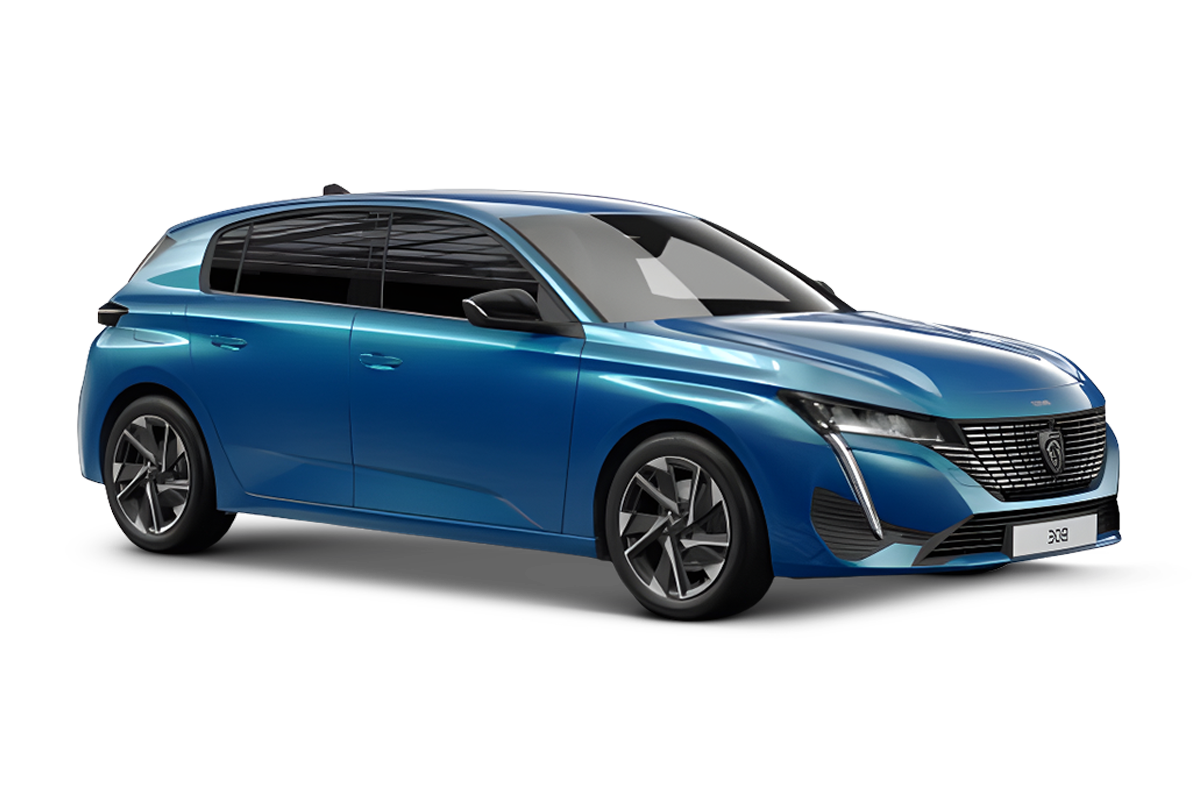
The mild hybrid version of the 308 is the most agile in the line-up. It’s grippy and tidy enough in the bends, but it doesn’t handle as sweetly as a Toyota Corolla, Seat Leon or VW Golf. The PHEV is noticeably less composed than the mild hybrid because of the extra weight of the batteries under the boot floor.
Unusually, the 308 has a tiny steering wheel that wouldn’t look out of place in a go kart. While it has a good amount of weight to it at speed, it feels a little artificial and elastic off-centre. It doesn’t feel as quick or direct as the setup in the Leon, which ultimately is the more fun car to drive overall. The 308’s suspension is softer than the set-up in the Leon, though, but it lacks the body control of that car. So while it feels relatively calm at a motorway cruise, once you turn off and on to a more demanding stretch of undulating Tarmac, it can feel quite floaty over crests and dips.
Having said that, the 308’s suspension does absorb minor imperfections better than the Leon, but harsh bumps – such as potholes and large cracks – do cause a loud thump. If ride comfort is a priority, we’d recommend sticking with smaller alloys. Wheels of up to 18in are available but the 17in rims are likely to give you the best cushioning. The ride in the PHEV is slightly firmer than in the MHEV petrol because of the latter’s heavier weight.
Is it quiet and how easy is it to drive smoothly?
There's some wind noise on motorways in all versions: noise levels are about on a par with a Seat Leon but higher than in a Corolla or Golf. As for smoothness, the driving experience is hampered by the regenerative braking system. In the mild hybrid, the car slows quite aggressively as it recuperates energy when you lift off the accelerator pedal, resulting in a jerky driving experience in town.
The PHEV is smoother than the mild hybrid, plus it’s quiet to drive in hybrid and electric modes. However, the regenerative braking system causes the brake pedal to feel grabby as you come to a stop. Thankfully, the calibration of this in the mild hybrid is better, with a more progressive feel to the pedal.
While the gearbox in each version is different, we found the six-speed setup in the mild hybrid and seven-speed unit in the PHEV to be responsive and smooth enough. No version of the 308 is available with a manual gearbox.
What’s the range and efficiency like and how quickly can it charge?
The PHEV's 14.6kWh (usable) battery pack offers an official electric-only range of 53 miles. That’s similar to the Toyota Prius, but the PHEV versions of the Golf and Leon can travel considerably farther, with an official range of 88 and 82 miles respectively for both.
As for topping up those electrons, the PHEV has a maximum charge speed of 3.4kW, meaning a 0-100% charge with a 7.4kW home charger should take around four hours and 20 minutes. As an option, you can specify the 308 PHEV with an upgraded rate of 7.4kW, which reduces the charge time to around two hours and five minutes with a suitably powerful charger.
“I think the 1.2-litre mild hybrid petrol engine is a good match for the 308. It might be small, but it has plenty of mid-range shove for overtaking and merging onto the motorway.” – George Hill, Used Cars Writer

Interior
The interior layout, fit and finish
Strengths
- +Smart design
- +Classy choice of materials
- +Good fit and finish
Weaknesses
- -Driving position might not suit everyone
- -Touchscreen response time could be snappier
What does the interior look like and is it well made?
The 308’s interior has a lot of visual appeal. It has an almost tier-like set-up to it, with an upper, middle and lower section to the dashboard, which contributes to an interior that is more interesting than that of the Golf. Overall quality is good too, with all of the surfaces you touch regularly feeling of high quality, while much of the dashboard and doors are covered with squidgy plastics and soft-touch materials.
Further down, there are harder, scratchier plastics, including around the lower door cards and central tunnel. The Skoda Octavia is better here, because while it too features similar materials lower down, they feel pleasant enough to touch. The 308 is about on a par with the Seat Leon and everything feels well screwed together and built to last.
Is the driving position comfortable and is it easy to see out?
The 308’s driving position is somewhat unusual. As with other Peugeot car models there’s a high-set digital instrument panel that you’re supposed to view over rather than through a tiny steering wheel.
The good news is that none of our testers struggled to see the instruments (a problem in the 208). The bad news is that the driving position is still a bit awkward for some – you almost feel as though you’re sitting on the floor.
All trim levels come with adjustable lumbar support to aid comfort for the driver, while top-spec GT is available with a massage function.
Front visibility in the 308 is good, thanks to a low dashboard and slim windscreen pillars, which mean you don’t have to constantly recheck your sides at junctions. The view out of the back is hampered by wider pillars and a smaller back window than what you’ll find in the Leon.
Fortunately, every 308 comes with rear parking sensors and a reversing camera as standard, while GT trim gets front and rear sensors. GT Premium adds a 360-degree camera. Eco LED headlights come as standard on lower-spec 308s, while GT trim gets full matrix LED lights, which automatically adapt their pattern to provide maximum visibility without dazzling other drivers.
Are the dashboard and infotainment system easy to use?
The i-Cockpit infotainment system – presented on a 10in touchscreen in the 308 – features clear, crisp graphics but can be a little slow to respond to your inputs. Plus, the illogical menus mean it’s more distracting to use than systems offered by rivals, especially those with a rotary controller like the one in a Mazda 3. You can bypass some of the Peugeot’s system because Android Auto and Apple CarPlay smartphone mirroring are included as standard.
Unfortunately, to access the climate controls, you have to tap a button to bring up the full menu on the touchscreen, making small adjustments – like increasing the interior temperature – a faff to do while driving. In the Honda Civic and Toyota Corolla, you simply twist a well-positioned dial. Or, you can use the natural voice recognition software, which lets you ask the car to alter the temperature, change the radio station or set a new sat-nav destination merely by talking to the car. It works well when stationary but is not so great with the background noise of a car full of people.
Need to charge up your phone? There are two USB ports in the front of the 308, while Allure trim and above provides two more in the rear.
“I get on well with Peugeot’s i-Cockpit driving position, but it doesn’t suit everyone. I’d recommend taking a 308 for a test drive to see if it works for you.” – George Hill, Used Cars Writer

Passenger & boot space
How it copes with people and clutter
Strengths
- +Plenty of space in the front
- +Competitive boot size
Weaknesses
- -Tight rear seat space
- -Lack of cable storage area on PHEV
How much space does it have for people?
Even those who are both big and tall will have no problems with space in the front of the 308. There’s plenty of head and leg room, and very little chance of you rubbing shoulders with the person sitting next to you.
You’ll find numerous options to stow your keys, wallet or whatever else you might want to bring with you. Spaces range from a wide door bin (carpeted at the bottom to limit rattles) to a deep cubby under the central arm rest. Your phone will slide neatly into a recess at the front of the centre console. On Allure trim and above you get a wireless charging pad in there too.
A six-footer sitting behind someone else the same height won’t want to be in the back of the 308 for very long. Their head is likely to brush the roof, their knees will be pressed into the front seatbacks and there’s not much foot space.
It’s similar to the closely-related Vauxhall Astra – meaning smaller adults or children will be fine, but if you plan to carry lofty passengers frequently, the Skoda Octavia is a better bet. Similarly, anyone in the middle seat will be rubbing shoulders with the person next to them, and has to straddle a central tunnel, but for short journeys it should be fine.
There’s more storage for oddments in the rear, with wide door bins and a cubby for your change on the back of the centre console.
How much room does it have for luggage?
With 412 litres of boot space for mild hybrid/diesel versions, the 308 beats most rivals (excluding the vast Skoda Octavia) in terms of capacity, so even a family incapable of travelling light should have no trouble fitting in their holiday luggage.
The boot is a useful square shape with only a small loading lip at its entrance, which makes heaving your items in and out easier. There's no option to have a height-adjustable boot floor. It’s worth noting that if you go for a 308 PHEV, the boot shrinks to 314 litres to accommodate the 14.6kWh battery pack under the boot floor. We could fit five carry-on suitcases, which is about average for a PHEV family car.
The 308’s rear seats fold down in a 60/40 arrangement, which is pretty standard for family cars in this price bracket. GT trim and above includes a ski hatch to allow you to thread longer items between two passengers. If you want a more flexible 40/20/40 split, you’ll need to spend more and get a mid-spec Audi A3 or a Mercedes A-Class.
“On my GT-spec PHEV test car, I was disappointed to find the underfloor storage area taken up by a subwoofer, leaving nowhere to store the charging cable.”– George Hill, Used Cars Writer

Buying & owning
Everyday costs, plus how reliable and safe it is
Strengths
- +Plenty of standard equipment
- +Strong fuel economy
- +Good reliability rating
Weaknesses
- -A little more expensive than some rivals
- -Rivals achieve higher safety ratings
How much does it cost and what equipment do you get?
The 308 costs slightly more to purchase than a Seat Leon, Skoda Octavia or Vauxhall Astra, but less than a Honda Civic or Toyota Corolla. As for running costs, the mild hybrid is fairly frugal, with official economy rated at more than 60mpg – similar to the Civic and Corolla.
While the PHEV can officially average 148.1mpg, you’ll have to plug the car in regularly to get anywhere near that figure in real-world driving. CO2 emissions are reasonably low, but to get the lowest BIK tax rate, company car users should look at the PHEV 195 or Peugeot e-308.
The 308 range is broken up into Allure, GT and GT Premium trims and no version is poorly equipped. On Allure, standard kit includes 17in alloy wheels, adaptive cruise control, rear parking sensors, a reversing camera, automatic lights and wipers, rear privacy glass and a six-speaker sound system. It’s the best value in the line-up, making it our trim of choice.
GT adds a few more extras, including 18in alloys, front parking sensors, an illuminated front grille, ambient interior lighting, a rear centre armrest and a ski hatch. GT Premium brings Alcantara upholstery, a 360-degree reversing camera, heated front seats (with massage function) and a heated steering wheel on top, but costs too much to recommend.
Is it reliable and how long is the warranty?
In our latest What Car? Reliability Survey, the 308 did quite well, finishing in 11th place out of 30 contenders in the family car class, with a score of 94.6%. This places it above the A3, Golf and Leon, but below the Civic and Corolla. As a brand, Peugeot came 11th out of 30 manufacturers, placing it above Audi, Seat and Volkswagen, but below Honda, Kia and Toyota.
Every 308 comes with a three-year, 60,000-miles warranty, which is similar to the cover from Audi, Seat and Volkswagen, but short of Kia’s seven-year offering and Toyota’s service-activated 10-year/100,000-mile cover. The 14.6kWh battery pack of the PHEV is covered for up to eight years or 100,000 miles.
How safe is it and is it easy to steal?
When it comes to safety, the 308 scored a slightly disappointing four stars out of five when it was tested by Euro NCAP in 2022. It scored well in most areas but protection for the driver's chest was found to be fairly weak. Most family cars score five stars here.
Thankfully, the safety suite is well-equipped right from entry. A driver monitoring system, lane-keeping assistance and traffic-sign recognition are all included, as is an automatic emergency braking (AEB) system that can recognise pedestrians and cyclists. Blind-spot monitoring and rear cross traffic alert are optional on GT and standard on the range-topping GT Premium trim.
“While the PHEV has a longer electric-only range than the pre-facelift car, I struggle to see the appeal of it. The Seat Leon and VW Golf eHybrids sit in lower company car tax brackets, as does the fully electric Peugeot e-308.”– George Hill, Used Cars Writer
Buy it if…
-You value a high-quality interior
-You want family car with lots of standard equipment
-You do lots of motorway driving
Don’t buy it if…
-You regularly carry passengers in the back
-Driving enjoyment is a top priority
-You want the cheapest company car
For all the latest reviews, advice and new car deals, sign up to the What Car? newsletter here

FAQs
Yes, the regular 308 is available as a mild hybrid or plug-in hybrid. It’s also available as an electric car, which you can read about in our Peugeot e-308 review.
Peugeot’s i-Cockpit set-up includes a 10in infotainment touchscreen with crisp graphics, plenty of customisation options and shortcut buttons. It can be slow to respond to your touch and some of the smaller icons are tricky to hit while you're driving but you do get Android Auto and Apple CarPlay smartphone mirroring.
| Available fuel types (which is best for you?) | |
|---|---|
| MPG range across all versions | Infinity - -Infinity |
| Company car tax at 20% (min/max) | £76 / £2,020 |
| Company car tax at 40% (min/max) | £151 / £4,040 |

