MG HS review
Category: Family SUV
This great-value family SUV promises lots of space and equipment for the money


What Car? says...
The MG HS is a world away from the two-seaters MG found fame with – but it's proved to be a good thing for the brand's bottom line.
Since the original HS was launched, this family SUV has sold in big numbers, and this second-generation model has been through some radical changes.
As well as a new look, the latest HS comes with an updated infotainment system, more standard equipment, and a wider range of engines: a petrol, hybrid and plug-in hybrid (PHEV) with a long official range.
MG HS video review
So can the MG HS match the value of the Dacia Bigster, the sportiness of the Ford Kuga or Mazda CX-5, and the comfort of the Citroën C5 Aircross? And how do we rate it against the best family SUVs, such as the Kia Sportage?
What’s new?
- January 2025: MG HS wins What Car? PHEV of the year award
- May 2025: new Hybrid+ version of MG HS announced, equipped with a 1.5-litre petrol engine and an electric motor to boost performance and economy over the pure petrol version.

- January 2025: double success for MG HS at What Car? Awards, as HS is named Plug-in Hybrid of the Year, and Best Family SUV for Value
- July 2024: MG reveals all-new version of HS SUV, with the choice of pure petrol or plug-in hybrid engines
Performance & drive
What it’s like to drive, and how quiet it is
Strengths
- +Hybrid versions offer strong performance
- +Plug-in Hybrid has a long electric range
- +Hybrids models have decent ride and handling
Weaknesses
- -Non-hybrid petrol is coarse...
- -...unresponsive and jerky with the auto 'box
- -Ford Kuga and Kia Sportage are more fun to drive
How fast is it and which engine is best?
The non-hybrid 168bhp 1.5 T-GDi petrol engine is available with a six-speed manual gearbox or a seven-speed dual-clutch automatic. Stick with the manual version and the performance feels gusty enough; 0-62mph takes 9.4sec, which is a fraction quicker than the equivalent petrol Dacia Bigster.
In theory, the automatic version should feel just as perky, but the truth is somewhat different. The engine still feels willing and able, but it’s stymied greatly by a gearbox that’s woefully slow to respond from a standing start or when you kick down to overtake. The upshot is the 1.5 T-GDi automatic is a combination to avoid.
The full hybrid version, badged the Hybrid+, is only available with an auto gearbox, but it's much, much better. Why the change of heart? For two good reasons: it uses a completely different type of automatic gearbox, and the engine’s performance is supplemented by an electric motor. It’s a package that works well. The Hybrid+ far more responsive and, with a combined 221bhp, jolly nippy, too. 0-62mph takes just 7.9sec and it feels effortless to drive in everyday use.
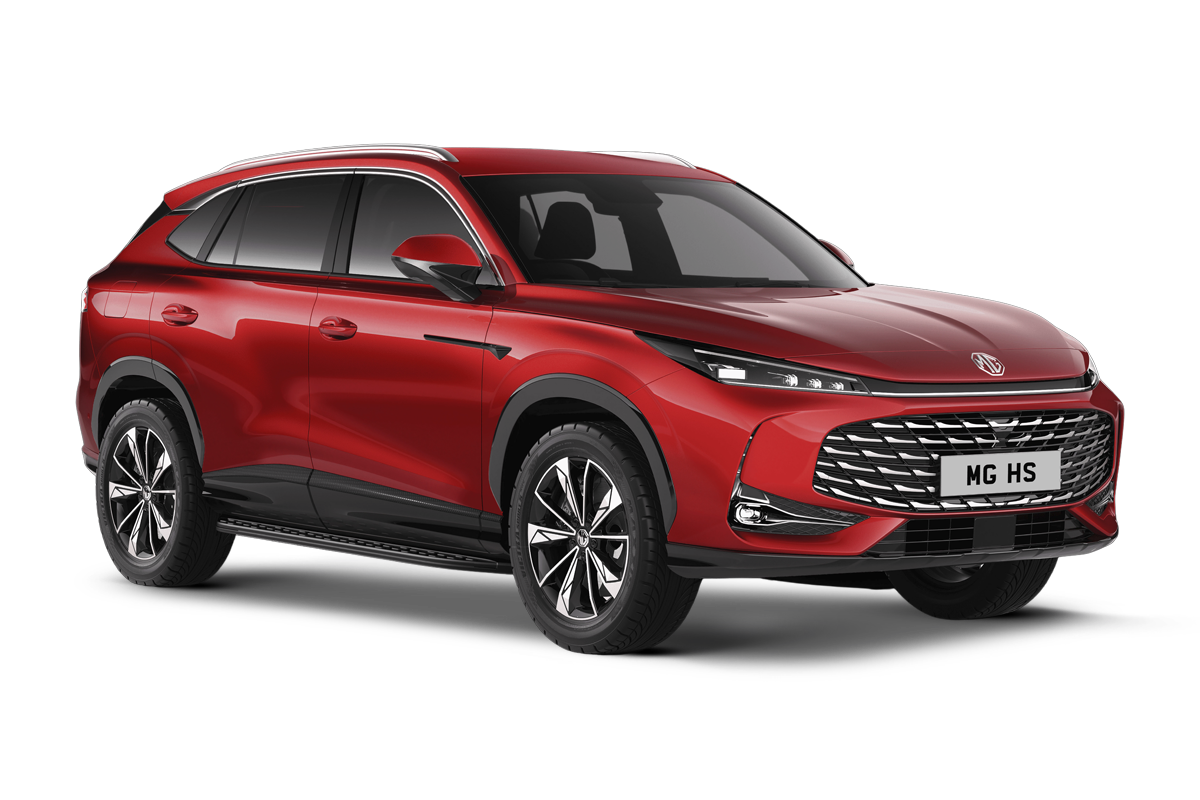
But our pick of the range is the MG HS Plug-in hybrid (PHEV). It uses the same engine and auto ‘box as the Hybrid+, but a more powerful electric motor and a bigger battery ramp up the power tally to 295bhp. As you can imagine, then, it’s the quickest HS; when we tested one it managed 0-60mph in just 6.1sec, which was substantially quicker than the equivalent PHEV versions of the BYD Seal U (8.6sec) and Jaecoo 7 (7.6sec).
Is it agile and is the ride comfortable?
Again, it depends on which engine you opt for.
If it's the non-hybrid 1.5 T-GDi petrol, the ride is fidgety over smaller imperfections and bouncy over larger bumps. It's annoying rather than uncomfortable, but the Citroën C5 Aircross offers a more settled experience.
The hybrids have firmer suspension (to cope with the added weight of the battery) but it's not detrimental to comfort. Far from it, in fact, because the Hybrid+ and Plug-in hybrid ride pretty well. You feel some impacts from sharp potholes and expansion joints, but they are far better controlled the rest of the time and, overall, more comfortable.
The softer non-hybrid petrol also leans more in bends. The firmer-sprung hybrids are more stable and sharper to driver, and feel more poised on a twisty road than the equivalent BYD Seal U or Jaecoo 7 SHS. The HS's steering is a little vague, though, so it's not a sporty car to drive. If you're after a family SUV that's more precise and enjoyable in bends, try out the Ford Kuga or Kia Sportage.
Is it quiet and how easy is it to drive smoothly?
Sorry, this is starting to sound like a broken record, but guess what? You're right, the non-hybrid petrol HS isn't great. The engine can sound coarse, and the dimwitted, unresponsive automatic gearbox causes the car to lurch forward clumsily when you pull away. The Citroën C5 Aircross and Dacia Bigster petrols operate with more panache.
Again, the HS hybrids are much better and highly recommendable. That's partly because the auto 'box is slicker, but also because the electric motor smoothes out any flat spots in the petrol engine's power delivery. The petrol engine is quieter than it is in the non-hybrid HS, too, and, of course, it's not always running. The Hybrid+ can cover short distances serenely in electric mode, while the PHEV can travel much farther using battery power alone.
Whatever the power source you pick for the HS, there's some wind and road noise at 70mph. The Kuga and Sportage are generally quieter at speed.
What’s the range and efficiency like and how quickly can it charge?
The HS Plug-in Hybrid's battery takes around four hours to charge from 0-100% using a 7kW home EV charger. According to official figures, when it's fully charged, the PHEV can run on battery power for up to 75 miles. And we almost matched that in our real-world testing, covering a total of 74 miles before we heard the petrol engine fire up.
That's an impressive and very useful real-world range for a PHEV. On the same day that we tested the HS Plug-in Hybrid (so the comparison is accurate), the plug-in hybrid Seal U managed 45 miles and the Jaecoo 7 SHS covered 51 miles. PHEV versions of the Ford Kuga, Hyundai Tucson and Kia Sportage officially manage around 40 miles.
Officially, the non-petrol 1.5 T-GDi will average around 40mpg, and we achieved that figure during our on-road testing. The Hybrid+ officially averages around 50mpg. When we tested the HS Plug-in Hybrid, it averaged 42.8mpg when the battery was empty and it was running mainly on the petrol engine.
“I'm properly impressed by the electric-only range of the plug-in hybrid MG HS, and I was chuffed that we got so close to the official figure during testing.” – Dan Jones, Senior Reviewer

Interior
The interior layout, fit and finish
Strengths
- +Impressive interior materials for the money
- +Well-equipped infotainment system
- +Comfortable driving position
Weaknesses
- -Infotainment software is sluggish
- -Very few physical controls
- -Slightly compromised view at junctions
What does the interior look like and is it well made?
A low starting price often implies rough edges and cut corners, but there’s an awful lot to like about the MG HS’s interior. Whereas cut-price rivals, such as the Dacia Bigster, take a solid but utilitarian approach to interior quality, the HS feels solid but also plusher on the inside.
There's supple, perforated leather on the steering wheel, and swathes of soft-touch plastic and faux-leather on the dashboard and doors. And the top-spec Trophy trim with optional contrasting tan leather looks the bees knees.
Overall, the HS feels great for the money and at least as nicely finished as the Citroën C5 Aircross. If you want a family SUV that's really swish, though, the Mazda CX-5 stands out.
Is the driving position comfortable and is it easy to see out?
Starting with the basics, the steering wheel, seat and pedals are positioned thoughtfully to leave you sitting naturally and feeling relaxed behind the wheel. The steering wheel adjusts for rake and reach and SE trim has a six-way electrically adjustable driver’s seat. The top-level Trophy trim adds lumbar adjustment and a memory recall function.
Visibility is a bit of a mixed bag, though. It's easy to see straight out over the bonnet, but the size and angle of the front pillars hamper your vision slightly at junctions. If you're reversing and looking over your shoulder, the small windows cut into the rear pillars open up the view of what's behind helpfully.
Rear parking sensors and a rear-view camera are standard on SE trim, and Trophy trim adds front parking sensors and a 360-degree camera.
Is the dashboard and infotainment system easy to use?
Every HS comes with a pair of 12.3in high-resolution digital screens. One is the driver's display behind the steering wheel, which shows all the essentials you'd expect. However, you can also configure it to show extra information, including a full-screen sat-nav map. And next to that, in the middle of the dashboard, is the infotainment touchscreen.
The Citroën C5 Aircross and Kia Sportage have snappy infotainment software, while the HS's infotainment system can be sluggish to respond to commands. That's also true of the infotainment system in the Dacia Bigster, but life's more frustrating in the HS because pretty much everything is controlled from the touchscreen, including the climate controls. The Bigster does at least have more physical controls for adjusting often-used features, such as the interior temperature, and so do other family SUVs, such as the Mazda CX-5 and Nissan Qashqai.
While the HS's in-car software is questionable, the infotainment system is well equipped for the price. SE trims includes a six-speaker stereo, sat-nav, four USB-C ports and Apple CarPlay and Android Auto smartphone mirroring. Trophy trim adds wireless phone charging, live internet services, and an eight-speaker stereo.
“The MG HS's infotainment screen offers good resolution but it’s a little slow to respond to your inputs and I found adjusting the air-con distracting because of the lack of physical controls.” – Dan Jones, Senior Reviewer

Passenger & boot space
How it copes with people and clutter
Strengths
- +Plenty of room in the front and back seats
- +Lots of interior storage space
Weaknesses
- -Decent boot capacity but not the best
- -Some rivals have more versatile rear seats
How much space does it have for people?
The MG HS has always been a big car, and the latest version is bigger than ever.
No matter how tall you are, you shouldn't struggle when it comes to head or leg room in the front. What’s more, the interior is wide, so there's little chance of banging elbows with your passenger.
Oddment space is up to snuff, too, and includes a lidded cubby (with USB ports and a 12V socket) in the centre console, two cupholders, and additional storage under he front sliding centre armrest.
In the rear, the HS has more leg room than the Citroën C5 Aircross and it's basically as roomy as the Dacia Bigster. Two tall adults will have plenty of space in the back, but shoulder room can feel tight if you squeeze a third, larger adult on the middle seat.
The middle passenger has a little less head room, too, because the central rear seat is raised slightly, but they'll have plenty of foot space because the central tunnel that runs along the floor isn't very big.
How much room does it have for luggage?
Whether you go for the HS 1.5 petrol, Hybrid, or Plug-in Hybrid, the boot space is a consistent 507 litres, which is unusual; normally hybrid models lose some boot volume over non-hybrid versions to accommodate the battery pack.
To compare cars' boots we use our suitcase test to give you some real-world context to assess their usefulness. The HS's boot swallowed six carry-on cases below the load cover. That's not bad, but we crammed seven cases in a Dacia Bigster hybrid's boot, and eight cases in the back of a Kia Sportage hybrid. So if luggage space is a priority, have a look at those instead.
You can drop the HS's rear seats in a 60/40 configuration, increasing the load space to 1,484 litres. That's handy – although the Bigster and Peugeot 5008 both have a more versatile 40/20/40 split. The HS’s rear seats don’t do anything else, like sliding back and forth, and it’s a shame you don’t get any additional storage under the boot floor.
“While the MG HS's boot is a decent size and was big enough to take my wake-boarding kit, families with a couple of children might wish it was even more spacious.” – Dan Jones, Senior Reviewer

Buying & owning
Everyday costs, plus how reliable and safe it is
Strengths
- +Very competitive list price for a family SUV
- +Lots of standard kit
- +Excellent NCAP safety rating
Weaknesses
- -MG's poor reliability record
- -Not necessarily the cheapest for PCP finance
How much does it cost and what equipment do you get?
Price is where the MG HS comes into its own, especially when you consider the whole package from practicality to standard equipment. The HS 1.5-litre petrol manual is the cheapest engine option, and it's priced roughly inline with the similarly affordable Dacia Bigster. However, we don't rate the HS 1.5-petrol, especially with the auto gearbox, for the multitude of reasons we've outlined above.
The HS hybrid models are much better, very recommendable, and still good value. The Hybrid+ in entry-level SE trim it costs about the same as a mid-spec Volkswagen T-Cross, which is a small SUV. The HS, remember, is a bigger family SUV, such as the Citroën C5 Aircross, and the Hybrid+ SE is cheaper than any version of that, too.
Even if you opt for the HS Hybrid+ in top-spec Trophy trim, it's a lot cheaper as a cash buy than the equivalent hybrid Hyundai Tucson and Kia Sportage. In short, the HS really is a great-value cash buy if you're on a budget but after a roomy SUV.
Crucially, the HS's keen pricing also puts the plug-in hybrid version within reach of private buyers, which is why it's our favourite version. It's also the best option for company car drivers. With its low CO2 emissions and long electric range, the PHEV sits in a low benefit-in-kind (BIK) tax band and, combined with its low price (P11D), is a very tax-efficient company car – although full electric cars, including the MG S5 will be even cheaper.
The only note of caution is that the MG HS is expected to lose value quicker (over three years) than an equivalent Sportage. And weaker resales values can increase the cost of PCP monthly payments. So, if you're buying on finance, don't rule out automatically any alternatives simply because they have a higher list price.
So the HS is generally great value to buy and run, but it also comes with plenty of kit. That's why we're happy to recommend sticking with the entry-level SE trim. It includes all the infotainment features, parking aids, and the electrically operated front seats we've mentioned already, plus 19in alloy wheels, air conditioning, keyless entry and start, automatic LED headlights, rain-sensing wipers, cruise control (adaptive cruise control on the hybrid and automatic 1.5 petrol), auto-dimming rear-view mirror and rear privacy glass. That's a healthy spec list.
If you have a little more to spend, the top-spec Trophy trim is worth considering, too; it has all the luxuries you could reasonably need. We already covered some of them – front parking sensors, electric front lumbar adjustment, wireless phone charging, 360-deg camera, upgraded eight-speaker stereo – but it also adds a powered tailgate (hands free operated on hybrid models), dual-zone climate control, faux-leather seats, heated front seats, and power-folding door mirrors.
Is it reliable, and how long is the warranty?
Well, the news isn't great for reliability. The MG brand came bottom out of 30 manufacturers ranked in our latest What Car? Reliability Survey. The current HS was too new to feature in the family SUV category, but hopefully it'll fare better than its predecessor – the previous HS Hybrid ended up in 43rd place out of 76 in a family SUV class.
Fortunately, all MG car models come with a seven-year, 80,000-mile warranty. Kia gives you seven years, too, while Toyota offers up to 10 years cover with servicing conditions. Most rival brands, including VW, only offer a three-year warranty.
How safe is it, and is it easy to steal?
In terms of safety kit, every HS has automatic emergency braking (AEB), lane-keeping assistance, blind-spot monitoring, automatic high-beam assist and rear cross-traffic alert. There’s also a driver attention monitoring system, but it’s very sensitive and we think it tells you off more than is necessary, which can get annoying.
Even so, the long list of standard safety equipment is really impressive at this price point, and helped earn the HS a five-star Euro NCAP rating. And looking at the crash-test scores, there were no major shortcomings concerning adult or child occupant protection.
“If, like me, you appreciate value for money, the MG HS is very tempting. Not only does it manage to undercut almost all its rivals on price, but it also gets loads of standard equipment.” – Dan Jones, Senior Reviewer
Buy it if...
- You need a plug-in hybrid with a long battery range
- You’re on a budget but desire a classy and well-equipped interior for the price
- You need a reasonably comfortable and roomy family SUV
Don’t buy it if…
- You’re after a family SUV with the most agile handling
- You don't want a hybrid – the non-hybrid HS 1.5 petrol isn't as good
- You like simple, physical dashboard controls
For all the latest reviews, advice and new car deals, sign up to the What Car? newsletter here

FAQs
Yes. While the MG HS is competitively priced it's also great in lots more ways. It comes with loads of standard kit, it's roomy inside, the interior finish feels classier than other budget rivals and it has a top-drawer NCAP safety rating. If you go for the hybrid versions, it's good to drive, has plenty of performance, but doesn't a fortune to run. And the Plug-in Hybrid (PHEV) has a much longer range than some far more expensive alternatives.
No matter which version of the HS you go for, you’ll find five seats inside. If you need more, see our best seven-seaters page.
The MG HS competes with other family SUVs including the Citroën C5 Aircross, Dacia Bigster, Ford Kuga and Kia Sportage.
MG's reliability record isn't great but the long warranty helps mitigate that to an extent. We recommend avoiding the HS non-hybrid 1.5 petrol, especially with the automatic gearbox, because it's not great to drive. But the Hybrid+ and Plug-in hybrid are genuinely good cars on merit.
| RRP price range | £26,495 - £34,995 |
|---|---|
| Number of trims (see all) | 2 |
| Number of engines (see all) | 3 |
| Available fuel types (which is best for you?) | petrol hybrid, petrol, petrol plug-in hybrid |
| MPG range across all versions | 37.1 - 705 |
| Available doors options | 5 |
| Company car tax at 20% (min/max) | £255 / £2,072 |
| Company car tax at 40% (min/max) | £509 / £4,144 |

