Omoda 5 review
Category: Family SUV
The Omoda 5 is very competitively priced but there are much better family SUVs available


What Car? says...
Made in China labels can be seen on clothes, electronics and furniture, but what about cars? Well, we’ve seen a steady increase in Chinese models arriving in the UK over the last few years and the Omoda 5 appears to be finding a spot outside many people’s homes in relatively little time.
With an attractive price tag, this value-focussed family SUV is hoping to take on the popular Kia Sportage, MG HS and the Nissan Qashqai, but is there more to it than just a low price? It’s currently offered with a petrol engine, but there’s also a fuel efficient hybrid version and the pure electric Omoda E5 (which we’ve reviewed separately).
So, does the Omoda 5 have what it takes to challenge the best family SUVs and would we recommend buying one? Read on to find out…
What’s new?
- February 2026: SHS-H Hybrid version tested
- August 2025: heavily updated Omoda 5 revealed, with revised suspension and detuned petrol engine
- August 2023: Omoda brand launches in the UK, and heralds the introduction of the 5 SUV, which is powered by a 197bhp 1.6-litre turbocharged petrol engine

Performance & drive
What it’s like to drive, and how quiet it is
Strengths
- +Reasonable handling
Weaknesses
- -Coarse engine
- -Fidgety ride
- -Light and unnatural steering feel
The Omoda 5’s entry-level 145bhp 1.6-litre turbocharged petrol engine is a detuned version of what it came with when it first went on sale. It sends power to the front wheels and is paired with a seven-speed automatic gearbox (there’s no manual gearbox option).
While its official 0-62mph time of 10.1sec is on a par with an equivalent 1.3-litre mild-hybrid Nissan Qashqai and 1.5-litre MG HS, it’s not as pleasant as those rivals to drive.
That’s because the Omoda 5’s engine needs working hard to get any performance out of it and becomes quite coarse when you do so. Meanwhile, the automatic gearbox also takes a moment or two to respond when you accelerate from a standstill or when you need a burst of acceleration.
With 221bhp and a 0-62mph time of 7.9sec, the hybrid (badged SHS-H) is a marked improvement. Thanks to an electric motor that provides some immediate shove, this version is far more nippy and responsive in everyday driving. The electric motor provides most of the propulsion while the petrol engine tends to wake up at higher speeds to provide a surge of power. However, we would prefer the engine to do so sooner when you need a quick burst of acceleration – when overtaking, for example.
Both engines are quite vocal when accelerating but they do fade into the background at a cruise. However, with more tyre and wind noise than most rivals at high speed it’s not as relaxing over a long journey.
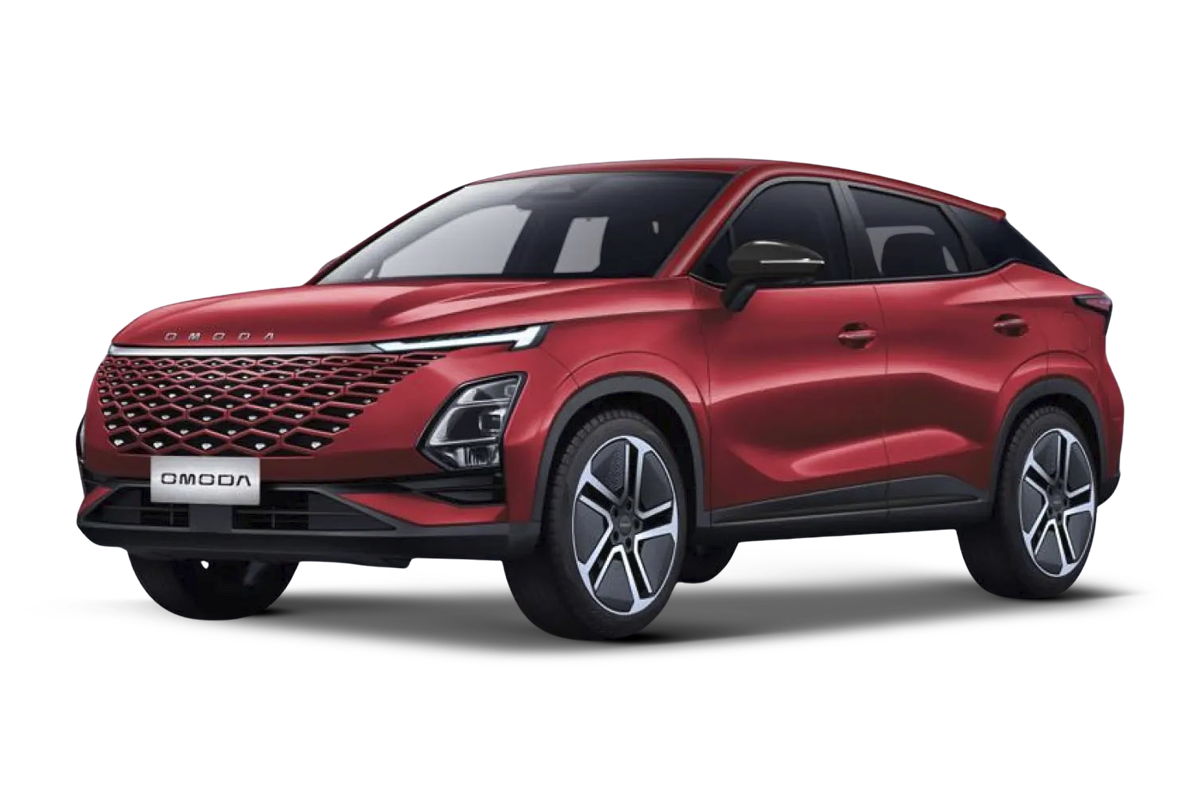
Around town, the brake pedal is well-weighted and responds predictably to help you come to a smooth stop. It’s just a slight shame it loses that reassuring feel when stopping at higher speed, which makes it harder to judge your inputs.
With the firm suspension frequently fidgeting over lumps and bumps at all speeds, the Omoda 5’s ride comfort is also disappointing. Overall, the Kia Sportage and Nissan Qashqai are calmer and far more effective at isolating you from the road surface.
The 5’s light steering makes it easy to manoeuvre around town. However, because it doesn’t build up much weight at speed, it feels vague and doesn’t inspire much confidence when cornering. Of course, this isn’t a sports SUV, but plenty of rivals (including the Ford Kuga and Kia Sportage) are more precise to drive.
More positively, despite being quite tall, the Omoda 5 handles reasonably well and doesn’t pitch into corners too much when the going gets twisty. In fact, it’s much better than a Citroën C5 Aircross in this area, but it does struggle for grip on sharper turns.
“In the hybrid, the electric motor’s sharp initial surge of power means it can be jerky when setting off. I found that Eco mode has a slightly smoother, more gentle delivery” – Lawrence Cheung, New Cars Editor

Interior
The interior layout, fit and finish
Strengths
- +Raised seating position
- +Good material quality
Weaknesses
- -Poor rear visibility
- -Basic infotainment system
- -Climate controls are buried into the touchscreen
If you like a high driving position, you’ll feel right at home in the Omoda 5, while the sporty, bucket-style front seats offer plenty of support and electric adjustment, so it’s easy to get comfortable.
You get a good view ahead over the bonnet, but the view out back is quite restricted, due to a sloping roofline and really wide rear pillars which create a blind spot. The rear window is tiny and partially obstructed by the rear headrests. At least you get a rear-view camera as standard to help with parking. Head up to Noble trim and it gets upgraded to a 360-degree view unit.
Considering the Omoda 5’s keen pricing, the interior offers a good level of visual appeal. It has a simple layout and you’re immediately greeted by two 12.25in screens encased within one long housing.
While they give the interior a smart look, the graphics for the touchscreen infotainment system are not very sharp and it could be quicker to respond to inputs. It’s good that the main icons on the home screen include your media, phone, climate control and vehicle settings but they are quite small and tricky to aim for while driving. More positively, you can swipe down from the top of the screen and quickly find big shortcut icons for the driver assistance systems.
You do get wireless Android Auto and Apple CarPlay as standard, which allows you to bypass the music and sat-nav apps with ones on your phone, but having to swipe up from the bottom of the screen to access the ventilation controls each time is a bit fiddly.
It’s a similar story with the digital driver’s display, which offers an equally simple layout for your speed and trip information, but little configurability.
Material quality is good when you consider that the Omoda 5 is one of the more affordable models in the family SUV class. There’s soft faux-leather for the areas you touch regularly, such as the steering wheel, and a firm but high-quality feeling plastic on the dashboard and doors. The materials are slightly nicer than those used in a Dacia Bigster, but a long way off the Nissan Qashqai’s.
“I like the Omoda 5’s high driving position and the bucket-style front seats, which offer plenty of lower back support. It’s great that entry-level cars get electric adjustment for the driver’s seat too.” – Oliver Young, Used Cars Reporter

Passenger & boot space
How it copes with people and clutter
Strengths
- +Good space in the front
- +Decent rear leg room
- +Plenty of interior storage
Weaknesses
- -Poor rear head room
- -Back seats feel claustrophobic
- -Small boot
There’s no shortage of head and leg room for the driver and front passenger in the front of the Omoda 5, no matter how you adjust the seat. You'll find plenty of storage areas dotted around the place, including a large glovebox, and a two-tier centre console that houses a large central cubby underneath the armrest, two cup holders and another storage tray underneath.
Things are more disappointing in the back seats. While there’s a reasonable amount of leg room for a six-footer, there’s not much space for feet underneath the front seats. Meanwhile, a sloping roofline means head room is poor and most passengers will find their heads brushing up against the ceiling. Factor in the high windowline, small rear windows and broad front bucket-style seats and these all create a cramped feeling. In short, most of the 5’s rivals are more accommodating for a pair of six-footers.
A middle seat passenger gets a slightly worse deal, with the protruding centre console eating into knee room. At least the central hump in the floor is quite small and doesn't intrude too much on foot space. Head room is similarly limited, though.
Unfortunately, matters don’t get much better in terms of the boot space. With a 307 litre load area, it should offer more than enough room for a big weekly supermarket shop but it’s tiny compared with the Kia Sportage (591 litres), MG HS (463 litres) and Nissan Qashqai (504 litres). This is partly because the underfloor storage area is taken up by a spare wheel. On a positive note, the boot opening is large and square.
The rear seatbacks fold down in a 60/40 configuration, which is the same as in the HS and Qashqai. The Sportage beats them for flexibility, though, because its seats split 40/20/40.
“I’m 6ft 2in and I found the Omoda 5’s back seats to be quite tight. My head brushes up against the ceiling and there’s minimal leg room, particularly when sitting behind a similarly tall driver.” – George Hill, Staff Writer

Buying & owning
Everyday costs, plus how reliable and safe it is
Strengths
- +Competitive price and long warranty
- +Generous standard equipment
- +Good safety rating
Weaknesses
- -Thirsty petrol engine
It’s easy to see why the Omoda 5’s price is attractive. Not only does its sub-£25k entry-level price undercut rivals by a considerable margin, it’s a lot more car than a similarly-priced Toyota Yaris small hatchback. As rivals go, only the Dacia Duster and MG HS come close and you’ll have to pay more than £30k for a Hyundai Tucson, Nissan Qashqai or Kia Sportage, making the Omoda 5 one of the more affordable cars in the family SUV class.
On a PCP finance deal, the Omoda 5 is also significantly cheaper per month than a Kia Sportage, although the Dacia Bigster is much closer (think £20 per month, rather than £100 per month, for example).
While the Omoda 5 is slightly cheaper to buy outright than some of those rivals, it won’t be as affordable to run. The 1.6-litre petrol engine achieves an official mpg figure in the low 30s, which is noticeably less than what you get in most rivals, including the Citroen C5 Aircross, Qashqai and Sportage. With significantly better fuel economy of around 50mpg, the hybrid will save you money on fuel - however, since it costs more to buy in the first place, you’ll need to cover a lot of miles to recoup that initial outlay back.
CO2 emissions for the petrol engine are relatively high, at just under 170g/km, although the hybrid’s 120g/km output is more competitive against equivalent rivals. That said, you might want to look at the fully electric Omoda E5 or a plug-in hybrid if you’re a company car driver seeking minimal BIK tax ratings.
Standard kit is very generous, with the entry-level Knight trim offering 18in alloy wheels, adaptive cruise control, faux-leather upholstery, keyless ignition and heated front seats.
Noble trim adds a heated leather steering wheel, an electrically adjustable front passenger seat, a panoramic glass sunroof, a powered tailgate and an eight-speaker Sony sound system upgrade (up from four speakers) but we don't think it's worth the extra cost.
The Omoda 5 did not feature in the latest What Car? Reliability Survey but for extra peace of mind, all 5s come with a seven-year, 100,000-mile warranty. That’s more than MG, Nissan and Volkswagen offer, and the same as Kia's cover.
The Omoda 5 achieved the full five-star safety rating when it was crash tested by Euro NCAP in 2022. All versions come with plenty of safety kit as standard, including automatic emergency braking (AEB), blind-spot monitoring, a driver monitoring system, lane-departure warning and road-sign recognition.
“The Omoda 5 comes with a long list of standard safety equipment, which is great, but I did find the road-sign recognition system to be inaccurate at times.” – Claire Evans, Consumer Editor
Buy it if…
- You want lots of equipment, but don’t have a huge amount to spend
- You tend to keep your cars for a long time, so want the reassurance of a long warranty
- You don’t really care what a car is like to drive
Don’t buy it if…
- You’re looking for a fuel-efficient petrol engine to keep your running costs down
- You regularly carry adult passengers in the back of your car
- You need a boot that can cope with more than just the weekly shop
For all the latest reviews, advice and new car deals, sign up to the What Car? newsletter here

FAQs
Omoda is a subsidiary of Chery, which is one of the biggest Chinese automotive brands and sold almost 1.9 million cars worldwide in 2023.
At around 4.4m long, the Omoda 5 is one of the smaller Family SUVs on sale. That said, its low price makes it attractive against much smaller cars available for similar money
| RRP price range | £24,040 - £29,255 |
|---|---|
| Number of trims (see all) | 2 |
| Number of engines (see all) | 2 |
| Available fuel types (which is best for you?) | petrol, petrol hybrid |
| MPG range across all versions | 31.17 - 52.2 |
| Available doors options | 5 |
| Company car tax at 20% (min/max) | £66 / £1,946 |
| Company car tax at 40% (min/max) | £132 / £3,892 |

