Ford Puma Gen-E review
Category: Electric car
The Puma Gen-E is the all-electric version of Ford's hugely popular Puma small SUV


What Car? says...
How do you make one of the UK’s best-selling cars even better? Well, for some buyers, this new Ford Puma Gen-E electric SUV could be the answer.
Up until now, the closest the hugely popular Ford Puma range has offered to an electric car has been some mild-hybrid engine tech. With the arrival of the all-electric Gen-E, you can now choose a version that runs purely on battery power.
Ford Puma Gen-E video review
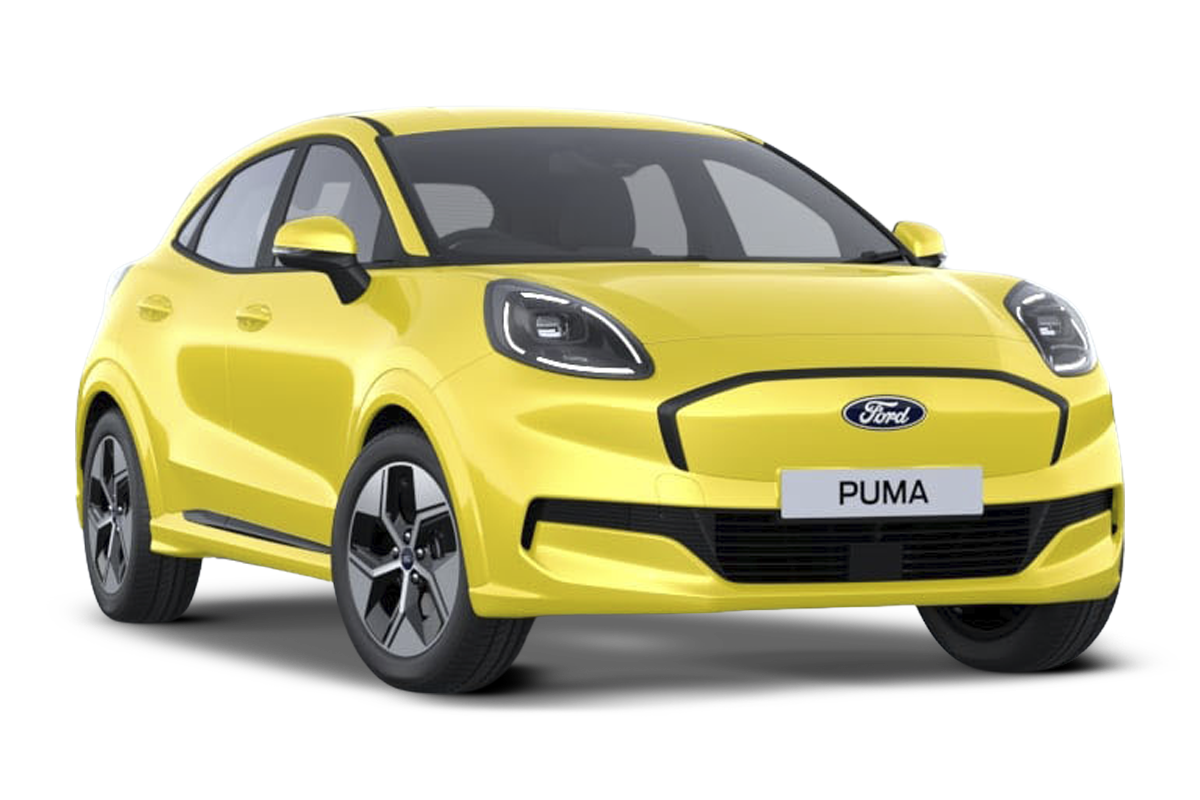
How can you tell a Gen-E apart from petrol Pumas? Well, it has a smoothed out front grille, a slightly longer rear spoiler and white badging on the tailgate. It's also available in a unique paint colour named Electric Yellow for those who want their electric Puma to stand out.
And the Ford Puma Gen-E will certainly need to stand out because it's in competition with loads of other models, the key ones being the Kia EV3, Jeep Avenger Electric and Renault 4. Read on to find out if this is one of the best electric SUVs you can buy…
What’s new?
- November 2025: Ford announces updated 2026 model after selling out the initial 2025 batch. Deliveries are scheduled for May 2026, and this version is available with BlueCruise hands-free driving and an improved 259-mile range.

- March 2025: Volume production begins at Ford’s Craiova plant in Romania, with the first customer deliveries reaching the UK in the month after.
- December 2024: Ford officially unveils the all-electric Puma Gen-E; order books open with a starting list price of £29,995.
Performance & drive
What it’s like to drive, and how quiet it is
Strengths
- +Punchy performance
- +Entertaining handling
- +Smooth brake-pedal response
Weaknesses
- -Slightly more road noise than rival electric SUVs
- -Firm, sometimes harsh ride
How fast is it and which motor is best?
The Ford Puma Gen-E is certainly sprightly for a small electric SUV. Every version has a 165bhp electric motor (driving the front wheels) and the resulting 0-62mph time is officially 8.0sec. You’re too modest, Ford: we managed 7.8sec when we tested it – in the wet, of all conditions – and that’s around half a second faster than the Renault 4 (R4) we tested on the same day.
In fact, the Gen-E is quicker than most direct rivals, including the equivalent Peugeot e-2008 or Vauxhall Mokka Electric, and it’s not far off the Kia EV3 Standard Range.
If you’re after something much quicker, check out the Smart #1 which, even in its entry-level form, can do 0-62mph in 6.7sec (officially).
Is it agile and is the ride comfortable?
The Gen-E is more than 200kg heavier than a petrol Ford Puma, but the company has done an admirable job of retaining as much of that car’s amazing agility as possible. It has a sharp front end with precise, direct-feeling steering, good grip levels and very little body lean in the corners. In other words, it’s more agile and fun to drive than the Jeep Avenger Electric, EV3 and R4.
The trade off is a firm ride. Some people will appreciate its controlled, planted feel, especially at higher speeds, but there’s no denying that it’s less forgiving over bumps and potholes than most of the competition. If cushy ride comfort is a top priority, the softer EV3 is a much better choice.
Is it quiet and how easy is it to drive smoothly?
Let’s start with driving smoothly, because we found ourselves impressed with the Gen-E’s brake pedal: it’s predictable and progressive, making it easy to bring the car to a steady stop. It's less grabby than the pedal in an Avenger Electric or R4.
What’s more, the Gen-E's regenerative braking system activates more smoothly than in a Smart #1. You can use a drive mode menu to crank up the regen effect so the car stops when you lift off the brake, allowing for one-pedal driving – something you can't do in an Avenger Electric.
There are quieter small electric SUVs, though. While you don’t hear any motor whine, there’s a minor amount of wind noise by the windscreen and a bit more road noise resonating inside than you'll hear in an EV3 or R4.
What’s the range and efficiency like, and how quickly can it charge?
With a 43kWh (usable capacity) battery, the Puma Gen-E has an official range of up to 259 miles (depending on trim level). That’s quite a bit better than a Smart #1 Pure (193 miles) and on a similar footing to the Jeep Avenger Electric (249 miles), Kia EV3 Standard Range (270 miles) and Renault 4 (245 miles).
It’s not impossible to get a small SUV that’ll do more than 300 miles on a charge, though. There’s the EV3 Long Range (375 miles) and Nissan Leaf 75kWh (386 miles), for instance. Just know that there’s a price premium involved.
And of course, it’s important to keep in mind that the range you manage in the real world will likely be less than the official range. In normal driving conditions, it’s better to expect roughly 200 miles from a full charge of a Gen-E.
With a maximum charging rate of 100kW, the Puma Gen-E officially takes 23 minutes to charge from 10-80% from a suitably powerful public EV charger. Most rivals, including the Avenger Electric and EV3, take around half an hour.
“I like how the Puma Gen-E mostly retains the petrol version’s fun-to-drive handling, but the firm ride might not be worth the compromise if you mainly do city driving.” – Lawrence Cheung, New Cars Editor

Interior
The interior layout, fit and finish
Strengths
- +Comfy driver's seat
- +Smartphone mirroring standard across the range
Weaknesses
- -Windscreen pillars can impede your view
- -Most of the interior plastics feel a bit cheap
- -Touchscreen-based climate controls are fiddly
What does the interior look like and is it well made?
The Ford Puma Gen-E’s interior is eerily similar to the regular petrol Ford Puma’s – who’d have thunk it? It’s quite minimalistic and that funky, almost square steering wheel might divide opinion.
There are plenty of cheap-feeling plastics on the dashboard and the doors, and while you get some areas covered in padded faux leather, they're not very squidgy or expensive-feeling.
The buttons are well-damped but the interior doesn’t feel as robust or upmarket as the Kia EV3, Renault 4 or Smart #1. The Gen-E still pips the Jeep Avenger Electric, though.
Is the driving position comfortable and is it easy to see out?
No matter which of the trims you go for, the driver's seat in the Ford Puma Gen-E is comfortable and comes with adjustable lumbar support. There’s plenty of adjustment for the seat and steering wheel, and while you don’t sit as high up as in a Kia EV3, some buyers will appreciate the slightly sportier driving position.
The Puma Gen-E's steeply angled front pillars can partially obscure your view at junctions and roundabouts, so it's harder to see out than in an EV3, with its larger side windows. Every Gen-E gets front and rear parking sensors to help out, but a reversing camera is optional. Range-topping BlueCruise Edition trim has a 360-degree parking camera as standard.
LED headlights come as standard, while matrix LEDs – which alter their beam to avoid dazzling other drivers – are standard with Premium and BlueCruise Edition trim.
Are the dashboard and infotainment system easy to use?
The Gen-E’s 12.8in infotainment touchscreen is easy to reach from the driving seat, and most of the icons are big and easy to hit while driving. It’s just a shame the sat-nav map takes a few seconds to load back up if you’ve moved away from it, and some of the functions could be easier to find. For example, the icon that opens the tailgate remotely is buried in the Features menu.
At least you don’t have to use the touchscreen to adjust the side mirrors, as you do in a Volvo EX30 – the Gen-E has physical controls on the driver’s door.
You do, though, have to use the screen to adjust the climate settings, with no physical controls available. It's helpful that the adjusters are permanently on display on the screen (unlike in the Peugeot e-2008) but we prefer physical controls like you get in the Kia EV3 and Renault 4.
All Gen-Es come with wireless phone-charging and wireless Android Auto and Apple CarPlay so you can run smartphone apps through the touchscreen. Going for either Premium trim or the BlueCruise Edition adds a punchier 10-speaker B&O sound system, rather than the standard six-speaker system.
“The Puma Gen-E's driving position is mostly sound but I find it a bit odd having to deal with a slightly square steering wheel.” – Lawrence Cheung, New Cars Editor

Passenger & boot space
How it copes with people and clutter
Strengths
- +Plenty of space in the front
- +Good in-car storage
- +Boot is big and versatile
Weaknesses
- -Some rivals are more spacious in the rear
- -No sliding rear seats
The Gen-E has a slightly higher floor than the regular Puma because of the battery underneath. Back-seat passengers will find their knees slightly raised and a bit less foot space under the front seats. As a result, your legs feel a bit more restricted.
Still, there's a bit more knee room than in a Jeep Avenger Electric. Head room is a bit tight for a six-footer; a Kia EV3 or Smart #1 is far more generous overall.
How much room does it have for luggage?
One of the biggest changes the Gen-E gets over the petrol-powered Ford Puma is a redesigned two-tier centre console that gives you more storage space. The upper section has a tray for your phone and a couple of cupholders.
You can stow more items on a tray lower down, where you’ll also find the USB ports, but they can be tricky to access. Otherwise, you still get decent-sized door bins and a cubby below the armrest between the front seats.
All Pumas have a 60/40 split-folding rear backrest. Most small electric SUVs get the same, but the Hyundai Kona Electric has a more versatile 40/20/40 split. If you want sliding back seats, have a look at the Smart #1.
In terms of boot space the Gen-E is actually better than the petrol Puma. With the rear seats up and the height-adjustable boot floor removed, the all-electric version has 523 litres of storage against 456 in other versions. Plus, there's a 43-litre front boot – ideal for holding the charging cable.
That much space actually makes it one of the biggest boots in the class, with the Gen-E managing to swallow a total of nine carry-on suitcases. By contrast, the Avenger Electric took five, and the Kona Electric, EV3 and Renault 4 six.
“The Puma Gen-E's Gigabox underfloor boot storage can carry 145 litres of luggage, which I find impressive: it’s nearly double what a petrol Puma’s Megabox holds.” – Lawrence Cheung, New Cars Editor

Buying & owning
Everyday costs, plus how reliable and safe it is
Strengths
- +Competitive pricing
- +Decent charging speeds
- +Home charger included
Weaknesses
- -No heat pump, even as an option
- -Some rivals offer longer warranties
- -Four-star safety rating
How much does it cost and what equipment do you get?
In entry-level Select trim, the Ford Puma Gen-E costs about the same as an entry-level Jeep Avenger Electric or Smart #1, but more than the Renault 4.
Even so, the Puma Gen-E still looks like good value, with even the well-specced Premium trim costing around the same as an entry-level Vauxhall Mokka Electric and slightly less than the most affordable Kia EV3 or Peugeot e-2008.
The Gen-E is predicted to lose its value at a similar rate to an EV3 and more slowly than an e-2008. That should help keep PCP finance costs down.
It’s also worth knowing that Ford includes a home EV charger and 10,000 miles of energy credit (around £250) with all its electric cars as part of the Power Promise incentive scheme.
Company car users will pay much less in BIK tax for the Gen-E than for a petrol Puma. What’s more, its low P11D price means it’s competitive against rival electric SUVs when you pay on a salary sacrifice, although the differences will be small.
The cheapest Gen-E trim – Select – comes with enough equipment to make it our recommended version. The list includes 17in alloy wheels, automatic LED headlights, rear privacy glass, ambient lighting, automatic climate control, cruise control and a heated windscreen.
Premium trim gets you 18in wheels, adaptive LED headlights and keyless entry, while BlueCruise Edition adds special interior materials, some exterior styling tweaks and the Advanced Driver Assistance Pack as standard equipment. We don't think either is worth the extra cost, and the larger wheels make the ride even firmer.
Options available on both trim levels include a panoramic sunroof and a Winter Pack that includes heated front seats and a heated steering wheel. There's also an optional Advanced Driver Assistance Pack available on Select and Premium trims. It's not cheap but adds adaptive cruise control, blind-spot monitoring and rear cross-traffic alert. You can increase the wheel size on Premium trim cars to 19in but we wouldn’t recommend it.
The Gen-E is not available with an EV heat pump to warm the interior more efficiently, which is a shame. You get one as standard with a Peugeot e-2008 and Renault 4.
Is it reliable, and how long is the warranty?
The Gen-E was absent from our 2025 What Car? Reliability Survey but the petrol Ford Puma received a 91.4% reliability score – that’s about average. As a brand, Ford finished 24th out of 30 manufacturers which is a bit concerning.
Ford gives you a three-year, 60,000-mile warranty, which is nothing special, especially compared with the longer warranties you get from Hyundai, Kia and Toyota. Ford also gives you a separate warranty on the electric battery, which covers against excessive capacity loss for eight years, 100,000-miles.
How safe is it, and is it easy to steal?
When tested by the safety experts at Euro NCAP, the Puma Gen-E was given a slightly disappointing four stars out of five. Even so, you get lots of standard safety equipment including automatic emergency braking (AEB) with pedestrian and cyclist detection, lane-keeping assistance, traffic-sign recognition and a driver attention monitor.
The Puma has a Thatcham Category 1 alarm and engine immobiliser to prevent hot-wiring. Keyless entry models include a motion-sensor key fob that enters "sleep mode" after 40 seconds of inactivity: this is to block signal-boosting relay theft. Owners can also remotely monitor and lock their vehicle via Ford's own “FordPass” app.
“I wouldn't bother with the Premium trim. I reckon it’s best to stick with the entry-level version and spend some of the savings on the Winter Pack instead.” – Lawrence Cheung, New Cars Editor
Buy it if…
- You enjoy nippy acceleration and sporty handling
- You want an electric small SUV with a big boot
- You appreciate reasonable pricing
Don’t buy it if…
- You want a soft, cushy ride
- You want the roomiest interior in the class
- You’re after simple, user-friendly interior controls
For all the latest reviews, advice and new car deals, sign up to the What Car? newsletter here

FAQs
Officially, the Puma Gen-E has a range of up to 259 miles. It’s better to lower your expectations to around 200 miles in the real world, though.
It's a good car in some key respects: it’s well priced, sharp to drive and has lots of boot space. However, it could do with more battery options and some rival electric SUVs have roomier interiors and comfier rides.
With its maximum charging rate of 100kW, the Puma Gen-E takes 23 minutes to complete a 10-80% charge when using a suitably powerful public EV charger.
| RRP price range | £29,995 - £34,295 |
|---|---|
| Number of trims (see all) | 3 |
| Number of engines (see all) | 1 |
| Available fuel types (which is best for you?) | electric |
| MPG range across all versions | 0 - 0 |
| Available doors options | 5 |
| Company car tax at 20% (min/max) | £60 / £2,129 |
| Company car tax at 40% (min/max) | £120 / £4,258 |

